

E-commerce is changing how products move from sellers to customers. Higher order volumes, wider product ranges, faster delivery expectations, and increasing returns are reshaping logistics networks.
The impact extends beyond traditional warehouses. Online growth is creating new requirements for fulfillment centers, regional distribution hubs, urban logistics facilities, delivery fleets, sorting infrastructure, and returns-processing capacity.
For e-commerce companies, retailers, 3PL providers, logistics operators, developers, investors, and technology businesses, the challenge is understanding where capacity is needed, what infrastructure fits demand, and how logistics networks should evolve.
Nexdigm connects e-commerce demand with fulfillment volumes, delivery requirements, warehouse capacity, transportation networks, returns activity, technology, and market economics to help organizations evaluate these changes.
Understanding the E-Commerce Demand
E-commerce growth creates different logistics requirements across different markets.
Large cities may need urban fulfillment and last-mile infrastructure, while emerging markets may require regional distribution centers and larger warehouse capacity.
Nexdigm evaluates order volumes, customer locations, product categories, purchasing patterns, and delivery expectations to identify where logistics pressure is increasing.
How Nexdigm Assesses E-Commerce Demand
Fulfillment performance plays a critical role in customer satisfaction, delivery speed, and operational efficiency. As e-commerce volumes grow, businesses must ensure that their fulfillment networks can process orders accurately and at scale.
Nexdigm evaluates fulfillment capabilities to identify operational bottlenecks and ensure infrastructure can support increasing order volumes and customer expectations.
- Inventory Positioning: Nexdigm assesses where inventory is stored across the network to ensure products are located closer to customers, reducing delivery times and improving fulfillment efficiency.
- Warehouse Operations: The assessment evaluates inbound processing, storage, inventory management, and workflow efficiency to determine whether warehouse operations can support growing order volumes.
- Picking and Packing Efficiency: Nexdigm analyzes order picking and packing processes to identify delays, labor-intensive activities, and opportunities to improve order accuracy and throughput.
- Sorting and Dispatch Capacity: The analysis reviews sorting systems, shipment consolidation, and dispatch operations to ensure orders can move efficiently through the fulfillment network.
Nexdigm’s E-Commerce Logistics Framework
Nexdigm’s E-commerce Logistics Market Assessment evaluates opportunities across five key areas: Demand, Fulfillment, Delivery, Returns, and Infrastructure Economics.
This framework helps businesses understand where online growth is creating logistics capacity needs and where investment can generate the greatest operational and financial value.
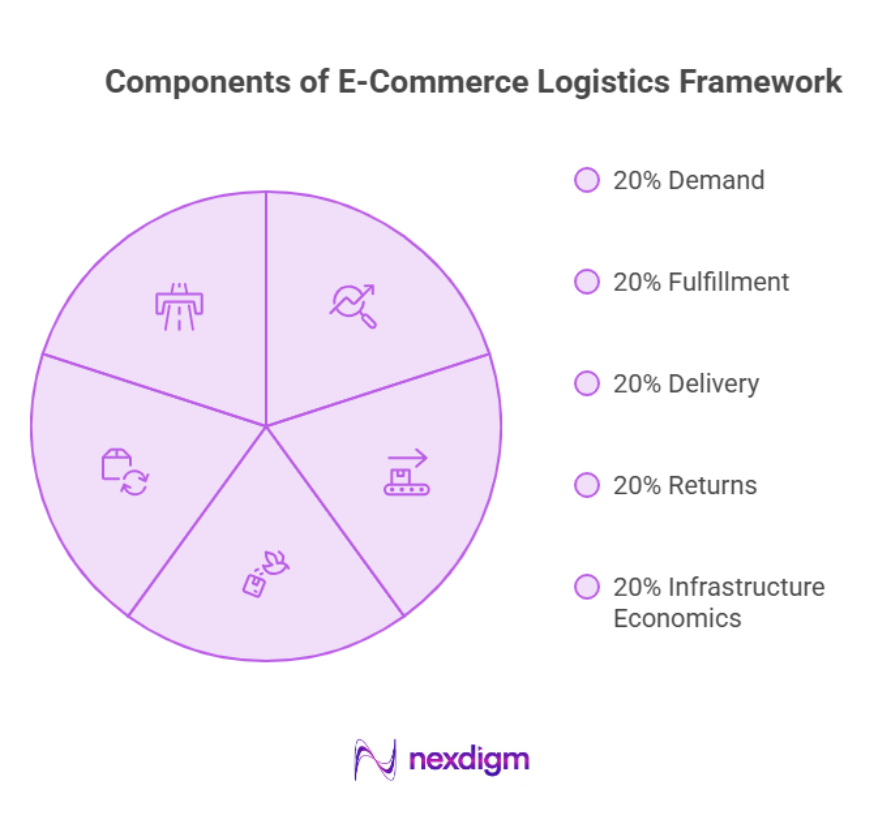
- Demand: Evaluates order growth, customer density, product characteristics, seasonal peaks, and market expansion trends to determine future requirements for warehousing, fulfillment operations, transportation networks, and delivery infrastructure.
- Fulfillment: Assesses warehouse capacity, inventory placement, order processing efficiency, automation opportunities, and facility formats to ensure fulfillment operations can support increasing order volumes and customer expectations.
- Delivery: Examines last-mile capacity, delivery speed requirements, urban logistics challenges, transportation costs, and network coverage to identify opportunities for faster and more cost-effective deliveries.
- Returns: Analyzes return volumes, reverse logistics processes, transportation networks, recovery value, and returns infrastructure to improve efficiency, reduce costs, and enhance customer experience.
- Infrastructure Economics: Evaluates warehouse expenses, delivery economics, capacity utilization, investment attractiveness, and overall network efficiency to determine whether logistics investments can generate sustainable returns.
By combining demand, fulfillment, delivery, returns, and infrastructure economics, Nexdigm helps businesses build efficient, scalable e-commerce logistics networks that support growth and long-term profitability.
Turning the Framework Into Strategic Action
The framework becomes valuable when its findings lead to clear business decisions. Nexdigm connects demand, fulfillment, delivery, returns, and infrastructure economics to show where logistics capacity should be expanded, improved, or repositioned.
- Capacity planning: Identifies markets where growing order volumes could create pressure on existing warehouse and fulfillment capacity.
- Fulfillment strategy: Helps determine whether centralized warehouses, regional hubs, urban facilities, or outsourced fulfillment best match customer and order patterns.
- Delivery improvement: Highlights locations and network changes that can reduce delivery distances, improve coverage, and support faster service.
- Returns management: Identifies growing reverse-logistics requirements and opportunities to improve returns processing, recovery, and storage efficiency.
- Investment priorities: Compares demand, infrastructure requirements, costs, and market potential to identify logistics investments with stronger commercial prospects.
- Network expansion: Reveals emerging markets and underserved locations where additional facilities or transportation capacity could strengthen the overall logistics network.
Nexdigm turns the framework into a practical decision tool, helping businesses prioritize where to expand, what to build, and how to improve logistics performance while aligning investment with future e-commerce demand.
How Nexdigm Spots the Next Growth Signals
E-commerce logistics opportunities often emerge before capacity becomes visibly constrained. Nexdigm tracks early market signals to identify where infrastructure and logistics investment may become increasingly important.
- Rising order density: Growing orders within specific locations can justify additional fulfillment capacity and shorter-distance delivery models.
- Warehouse pressure: Increasing occupancy and limited available space can signal the need for new fulfillment or distribution facilities.
- Faster delivery expectations: Shorter delivery windows can create demand for facilities positioned closer to major customer concentrations.
- Growing returns: Higher return volumes can create opportunities for dedicated reverse-logistics facilities, processing capacity, and recovery networks.
These signals together help organizations identify where logistics demand is building, when capacity may become constrained, and which opportunities deserve attention before the market becomes crowded.
Nexdigm’s Case
An e-commerce operator used Nexdigm’s E-commerce logistics market assessment to identify capacity gaps and optimize fulfillment locations. Within 12 months, fulfillment capacity increased, delivery times improved 19%, logistics costs declined 17%, and returns processing efficiency increased 22%, strengthening customer service and network performance.
To take the next step, simply visit our Request a Consultation page and share your requirements with us.
Harsh Mittal
+91-8422857704