

India’s digital learning market no longer must prove that learners can access online education. The more difficult commercial question is whether another platform can persuade those learners to return, pay and remain engaged when free content, established platforms and institutional alternatives are already widely available.
The access numbers are substantial. ASER 2024 found that 82.2% of rural 14–16-year-olds knew how to use a smartphone, while 57% had used one for an educational activity during the preceding week. At the same time, 76% had used a smartphone for social media during the same period. Access to a device, therefore, does not automatically translate into sustained educational use.
For a new platform, feasibility starts where access data stops.
The Addressable Market Is Smaller Than the User Pool
A platform may technically be available to millions of learners without having millions of realistic customers.
The relevant population depends on learning intent. A professional certification platform, a test-preparation product and a K-12 tutoring service address very different markets, even if all three operate through smartphones.
The assessment should distinguish between:
- learners who can access the platform;
- learners with a relevant educational need;
- learners actively looking for a solution;
- learners willing to switch from an existing provider; and
- learners with sufficient willingness to pay.
This creates a much more useful definition of addressable demand than total internet or smartphone penetration.
Engagement Is Where the Commercial Test Begins
Digital education has a peculiar problem: the customer can disappear without formally cancelling anything. A learner may download an application, complete an introductory module and never return. A subscription can therefore overstate actual educational engagement.
The important indicators include session frequency, course progression, assessment completion, repeat usage and retention by learner cohort. These should be analysed alongside the type of learning being delivered.
A live cohort model may generate stronger accountability but carries higher instructor and scheduling costs. Self-paced content can scale more easily but may face greater completion and retention challenges. Adaptive assessment, peer interaction and structured milestones can alter that equation.
The platform needs to establish which features change learner behaviour, rather than accumulating features because every competitor has them.
Pricing Has to Follow the Buyer
The willingness to pay for education is highly dependent on the perceived consequence of success. A family may tolerate a higher fee for a high-stakes examination product where the outcome is clearly linked to an examination or admission decision. A general supplementary-learning subscription faces a different purchasing threshold.
Professional learners may accept a higher price when a course is linked to a recognised certification, a specific occupational skill or an identifiable career transition.
This makes pricing research inseparable from segmentation. A single subscription price applied across very different learner motivations can obscure where the actual commercial opportunity sits.
Where Can a New Platform Still Differentiate?
India’s EdTech market was valued at ₹32,670 crore in 2025, according to IBEF’s May 2026 industry analysis, and is projected to reach ₹2,99,790 crore by 2034. The same analysis identifies digital education as a major growth driver.
Market growth does not mean every product category is equally attractive.
Potential differentiation may come from a narrowly defined learner problem, regional-language delivery, stronger assessment, employer-linked credentials, specialised professional learning or institutional integration.
The question is whether the differentiation is valuable enough to change acquisition, retention or pricing behaviour.
Nexdigm’s Platform Feasibility Lens
For companies considering e-learning platform feasibility assessment, Nexdigm can connect learner demand with engagement behaviour, pricing and competitive conditions to test whether a proposed platform has a commercially viable position.
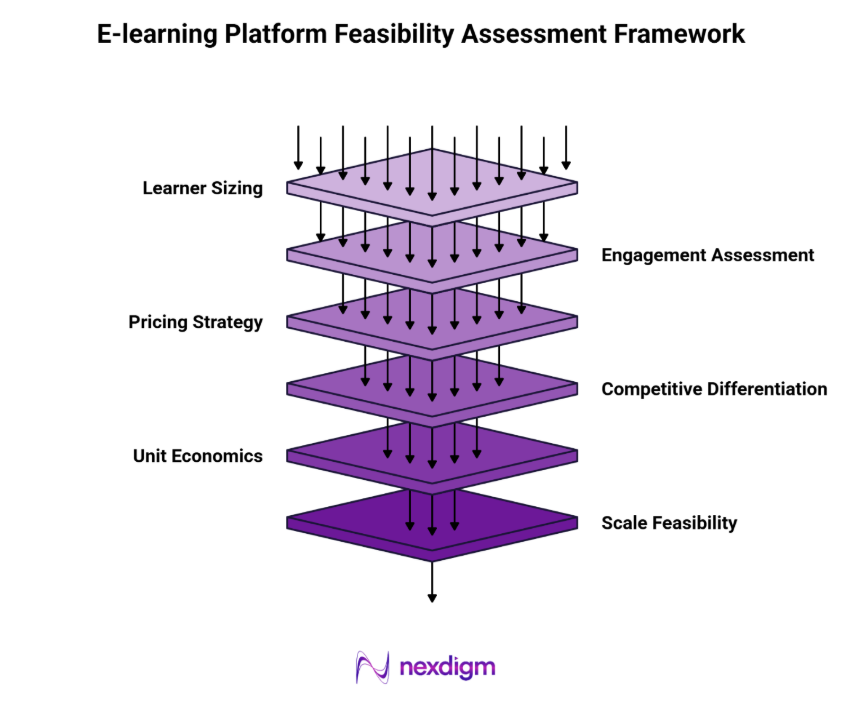
From User Base to Viable Business Model
- Addressable Learner Sizing
Define the high-intent learner population rather than relying on broad digital adoption figures. - Engagement Assessment
Analyse learning behaviour, retention drivers, completion and repeat usage. - Pricing and Willingness to Pay
Test price sensitivity against household or individual budgets and competing alternatives. - Competitive Differentiation
Assess whether the proposed proposition solves a problem that existing platforms address inadequately. - Unit Economics
Model acquisition cost, revenue per learner, retention and delivery costs. - Scale Feasibility
Assess whether the operating model can expand without eroding margins or learner experience.
Case Study Scenario: Finding the Viable Learner Segment
An e-learning provider tested three segments across 12,000 trial users. K-12 supplementary learning generated a 2.1% paid conversion rate, while professional certification reached 7.8%. Acquisition costs were 39% lower in the professional segment, leading the provider to shift its initial launch focus toward career-linked learning. A new platform needs a sufficiently large segment with a clear need, repeat engagement, acceptable acquisition economics and enough willingness to pay.
Nexdigm can support providers and investors through learner research, competitive assessment, pricing analysis, market sizing and commercial feasibility modelling.
To take the next step, simply visit our Request a Consultation page and share your requirements with us.
Harsh Mittal
+91-8422857704