

Healthcare procurement has an important role in reducing environmental impact because much of the sector’s footprint sits outside hospitals themselves. The World Health Organization estimates that healthcare accounts for roughly 5% of global greenhouse-gas emissions, with 60–80% of healthcare emissions generated through the supply chain. This makes the selection, procurement, and use of medical products important levers for decarbonization.
Waste is another consideration. WHO estimates that around 85% of healthcare waste is general, non-hazardous waste, while 15% is hazardous. Its guidance identifies green procurement, reduced shipping, ecological packaging, safe reuse where viable, and recycling as potential waste-reduction measures.
For healthcare organizations, however, sustainability cannot come at the expense of patient safety or product performance. Eco friendly medical supplies sourcing therefore requires a broader assessment of environmental impact alongside quality, clinical suitability, regulatory requirements, availability, and total procurement economics.
Greener Procurement Starts With the Right Product Criteria
Sustainable sourcing does not necessarily mean selecting the product with the strongest environmental claim. Organizations need to understand the material composition, packaging, manufacturing footprint, transport requirements, durability, disposal pathway, and clinical performance of potential alternatives. WHO’s 2025 guidance specifically encourages health systems to use procurement to support environmentally sustainable and low-carbon substitutes while maintaining clinically and operationally appropriate use.
Sustainability Can Introduce New Sourcing Trade-Offs
Choosing greener medical supplies can involve trade-offs between environmental performance, product functionality, cost, availability, and operational requirements. A product with recyclable packaging may have different logistics needs, while a reusable alternative may require additional sterilization or processing. Evaluating these factors together helps healthcare organizations determine whether a sustainability improvement is practical, scalable, and compatible with existing clinical and procurement processes.
Supplier Selection Can Determine the Sustainability Outcome
The sustainability profile of a medical supply is closely connected to the supplier’s manufacturing practices, sourcing network, packaging choices, logistics, and transparency. Nexdigm can bring healthcare and procurement expertise into this evaluation, helping organizations with:
- Supplier Practices: Examine manufacturing, sourcing, packaging, logistics, and sustainability practices that can influence the product’s environmental profile.
- Operational Fitness Assessment: Assess capacity, geographic footprint, lead times, and supply continuity to determine whether greener alternatives can support ongoing healthcare requirements.
- Overall Supplier Value Determination: Consider environmental performance alongside quality, compliance, pricing, and service capabilities to identify suppliers offering a more balanced sourcing proposition.
This enables Nexdigm to help healthcare organizations identify suppliers whose sustainability credentials are supported by practical quality, supply, and procurement capabilities.
Evaluating the Viability of Greener Alternatives with Nexdigm
A greener product becomes a meaningful sourcing option only when its environmental benefits can be balanced with clinical performance, regulatory requirements, supply availability, and commercial considerations. Through eco friendly medical supplies sourcing, Nexdigm can help organizations assess these dimensions through:
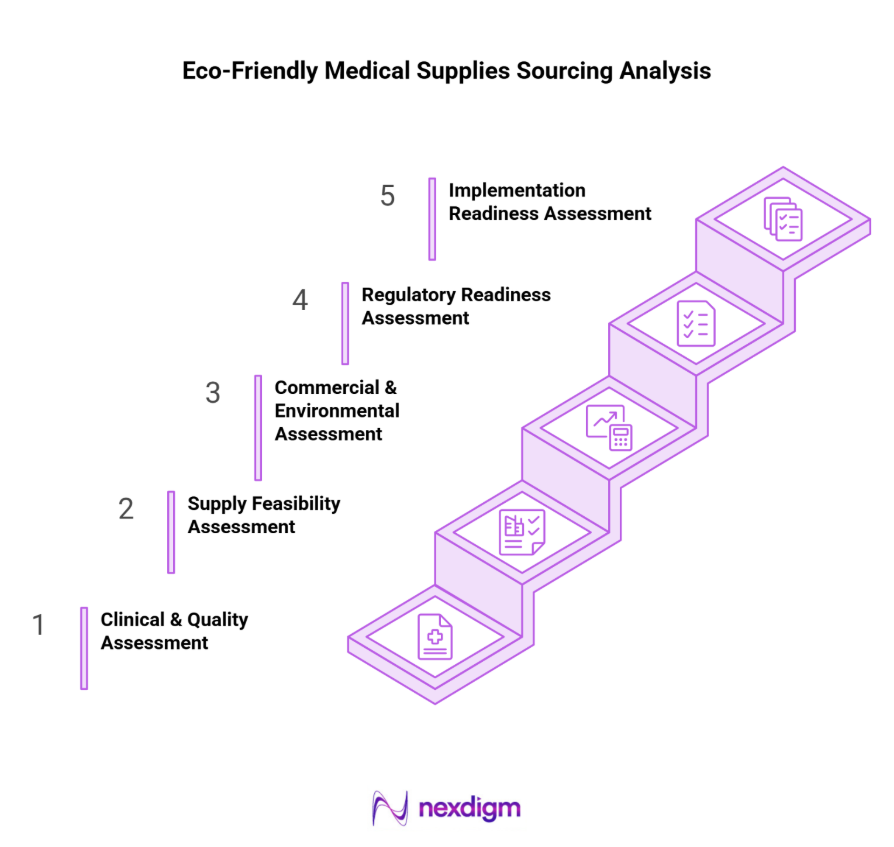
- Clinical & Quality Assessment: Compare performance, safety, specifications, certifications, and application requirements against existing products to validate suitability.
- Supply Feasibility Assessment: Evaluate supplier capacity, lead times, geographic exposure, distribution networks, and scalability before wider implementation.
- Commercial & Environmental Assessment: Compare pricing, lifecycle implications, packaging, logistics, waste, and environmental attributes to understand the overall sourcing proposition.
- Regulatory Readiness Assessment: Review certifications, documentation, compliance requirements, and validation needs to determine whether alternatives meet applicable healthcare standards.
- Implementation Readiness Assessment: Examine storage, handling, disposal, procurement processes, staff requirements, and supplier arrangements to determine practical adoption requirements.
Together, these assessments help organizations distinguish between products that appear greener and alternatives that are genuinely viable for healthcare procurement.
How Nexdigm’s Assessment Findings Offer Sustainable Sourcing Priorities
Assessment findings can help healthcare organizations move beyond identifying greener products toward determining which alternatives are worth pursuing. Nexdigm can help translate the findings into sourcing priorities by:
- Prioritizing High-Impact Categories: Identifying supply categories where sustainability improvements could offer meaningful environmental or waste-reduction benefits.
- Shortlisting Suitable Alternatives: Narrowing down the supplier and product universe to options that meet defined clinical, quality, regulatory, and supply requirements.
- Identifying Supplier Actions: Highlighting areas for supplier engagement, qualification, documentation, packaging changes, or sustainability improvements.
- Planning Adoption Pathways: Determining whether alternatives are better suited for pilot programs, phased implementation, or broader procurement adoption.
This helps turn Nexdigm’s eco friendly medical supplies sourcing from a product-search exercise into a structured procurement strategy aligned with healthcare requirements.
Nexdigm’s Experts Making Sustainability More Actionable
Nexdigm’s industry led expertise can help healthcare organizations move from sustainability objectives to specific sourcing decisions, identifying which products, suppliers, and categories merit further evaluation. This creates a clearer basis for supplier engagement and procurement planning while keeping environmental considerations connected to quality, availability, and operational requirements.
Nexdigm’s Case
Nexdigm supported a healthcare organization in assessing greener alternatives across its medical-supply portfolio. The assessment found that 31% of evaluated categories had viable sustainable alternatives, while 20% required additional quality or supplier validation. A further 18% showed opportunities related to packaging, logistics, or material use, helping the organization prioritize sustainable sourcing initiatives without compromising clinical and operational requirements.
To take the next step, simply visit our Request a Consultation page and share your requirements with us.
Harsh Mittal
+91-8422857704