

Ecommerce retailers must balance fast delivery, competitive charges, and rising customer expectations without sacrificing profitability. An effective ecommerce delivery pricing strategy uses pricing analysis to evaluate order value, delivery speed, parcel characteristics, carrier rates, route density, failed attempts, and regional demand.
By combining cost-to-serve modeling, customer segmentation and service-level benchmarking, retailers can align delivery choices with margin objectives. This approach improves pricing transparency and enables scalable fulfillment while preserving customer satisfaction across peak periods, markets, and service channels across complex ecommerce ecosystems.
A 2025 benchmark covering millions of orders across 4,000 unnamed retailers found actual delivery averaged 2.2 days versus 5.6 days quoted, while delayed orders fell from 15.7% to 7.7%, demonstrating stronger delivery efficiency and customer value through strategic pricing analysis decisions.
Pricing Analysis for Ecommerce Delivery Cost and Service Optimization
Pricing analysis helps ecommerce retailers balance delivery speed, operating costs, and customer expectations by creating data-driven shipping rates that protect margins, improve service quality, and support scalable growth sustainably. Core benefits of Ecommerce pricing analysis are:
- Improved Delivery Cost Visibility: Detailed pricing analysis reveals how carrier rates, parcel attributes, delivery zones, fuel charges, and service levels influence total shipping expenditure across ecommerce orders and markets.
- Optimized Free-Shipping Thresholds: Analyzing order value, basket profitability, conversion behavior, and delivery costs enables retailers to establish free-shipping thresholds that encourage larger purchases without weakening commercial performance.
- Better Customer Choice: Tiered pricing for standard, scheduled, express, and same-day delivery gives customers greater flexibility while helping retailers align charges with service urgency and operational complexity.
- Enhanced Carrier Negotiations: Market benchmarks, shipment volumes, surcharge data, and carrier performance metrics strengthen negotiations, enabling retailers to validate quotations, challenge inconsistencies, and secure commercially competitive delivery agreements.
Nexdigm’s Pricing Analysis Expertise for Ecommerce Delivery Networks
Nexdigm combines pricing analysis, ecommerce delivery pricing strategy, cost-to-serve modeling, delivery cost benchmarking, shipping rate optimization, and pricing intelligence to help retailers optimize delivery networks. By evaluating carrier rates, fulfillment costs, customer segments, and service levels, Nexdigm helps businesses with data-driven pricing decisions, strengthen their commercial negotiations, improve margin management and supports their sustainable ecommerce growth.
Nexdigm’s Dynamic E-Commerce Delivery Pricing Analysis Architecture
Nexdigm’s pricing analysis architecture integrates cost intelligence, customer demand, carrier performance, and service requirements to help ecommerce businesses establish responsive rates and scale delivery operations sustainably. Important features of the architecture model are:
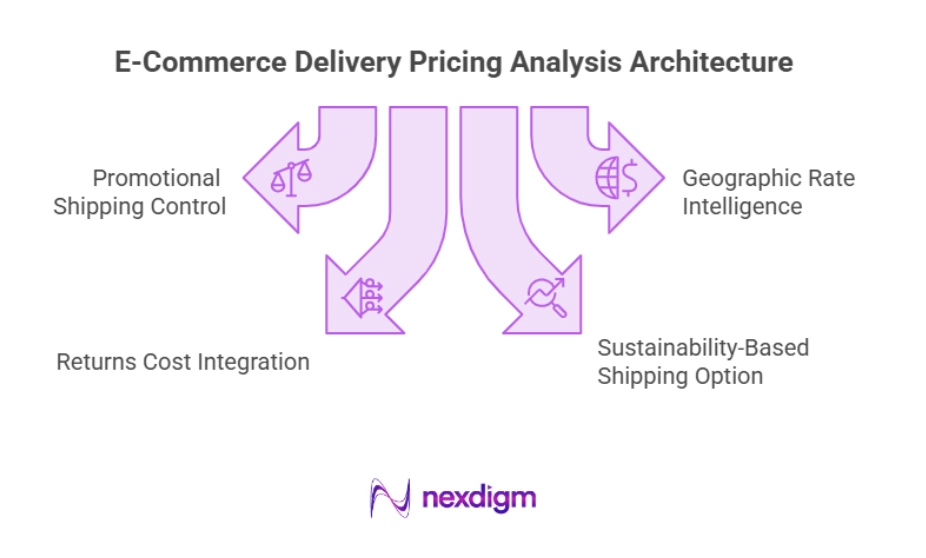
- Geographic Rate Intelligence: Regional demand, route density, distance, congestion, and carrier availability are evaluated to create location-specific rates that accurately reflect delivery complexity and market conditions.
- Sustainability-Based Shipping Option: Carbon impact, electric-vehicle availability, consolidated delivery, and slower service alternatives are evaluated to create greener shipping choices with transparent and commercially balanced pricing.
- Returns Cost Integration: Return collection, inspection, transportation, restocking, and disposal costs are incorporated into pricing decisions, helping retailers control reverse-logistics expenses and protect product-level margins.
- Promotional Shipping Control: The architecture assesses campaign volumes, discount levels, fulfillment capacity, and delivery costs before launching shipping promotions, reducing the risk of margin dilution during sales events.
Nexdigm’s Case
Nexdigm supported a parcel delivery provider managing 1.2 million monthly shipments across 20 cities. Operational risk assessments and process optimization reduced on-time delivery failures by 14% and operational cost variances by 9%, strengthening network reliability, pricing control, and resilience.
To take the next step, simply visit our Request a Consultation page and share your requirements with us.
Harsh Mittal
+91-8422857704