

E-commerce has created several logistics businesses under one market label. Fulfillment, middle-mile transportation, urban delivery, quick commerce and returns operate with very different cost structures and customer requirements. For a logistics provider entering the sector, the first commercial decision is therefore where to participate.
The most attractive opportunity may sit in a specialized service layer rather than in building an end-to-end network from the beginning.
The Customer’s Problem Defines the Entry Point
E-commerce brands do not necessarily buy the same logistics capability at every stage of their growth. A large marketplace may require high-throughput fulfillment and nationwide transportation, while a growing direct-to-consumer brand may need flexible warehousing, order processing and reliable parcel delivery. Fashion businesses can have very different requirements again because returns and reverse processing become central to their logistics costs.
This creates several potential entry points for logistics providers. The opportunity lies in identifying a service where customer demand is growing faster than available capability, rather than attempting to replicate the entire infrastructure of an established e-commerce operator.
Fulfilment Is Becoming More Distributed
The geography of e-commerce fulfilment is changing as delivery expectations become faster and customer demand spreads beyond the largest metropolitan markets.
India’s e-commerce market is increasingly expanding into Tier-II and smaller cities. At the same time, quick commerce is creating demand for inventory positioned much closer to consumers. These models require different physical networks: centralized fulfillment facilities can support broader inventory depth and consolidated operations, while localized facilities prioritize proximity and speed.
For a logistics provider, the implication is important. Warehouse location cannot be separated from the delivery promise. The facility required to support next-day delivery may be commercially unsuitable for a business promising delivery within an hour.
Speed Has to Be Paid For
Faster delivery compresses the time available for consolidation, transportation and order processing. It can therefore increase the cost of serving each order even as it improves the customer proposition.
Quick commerce illustrates the extreme end of this trade-off. Inventory has to be positioned close to demand, replenishment has to happen frequently, and the available assortment must be managed carefully. A logistics provider entering this segment needs capabilities in localized inventory management and rapid fulfilment, not simply conventional warehousing.
This creates room for specialized operators that can solve one part of the speed equation without carrying the cost of an entire consumer delivery network.
Returns Are a Separate Logistics Business
Forward fulfilment receives most of the attention, but returns create another operational chain involving collection, transportation, inspection, grading, repackaging, restocking and liquidation.
The economics vary substantially by product category. Apparel and footwear can generate materially different reverse-logistics requirements from groceries, electronics or household products. A provider that develops strong returns-processing capabilities can therefore address a specific pain point for e-commerce brands without competing directly with large parcel networks.
The commercial opportunity is particularly relevant where returned inventory loses value while waiting for inspection or disposition. Faster processing can improve both logistics efficiency and inventory recovery.
Infrastructure Is Not the Only Barrier to Entry
A logistics provider may have access to warehouses and transport capacity and still struggle to enter the e-commerce market. Technology integration, order visibility, inventory accuracy, API connectivity, cut-off management and exception handling increasingly form part of the service proposition.
This changes the nature of competition. Physical infrastructure remains important, but customers are also buying the provider’s ability to connect fulfillment, transportation and customer-order data. The strongest entry opportunities may therefore sit where operational capability and technology integration overlap.
Choose the Layer Before Building the Network
The commercial decision can be framed around five entry questions:
- Fulfilment: Is there enough customer demand to support dedicated or multi-client fulfilment capacity?
- Transportation: Are there recurring middle-mile flows that can be consolidated across e-commerce customers?
- Last mile: Does customer density support an economically viable delivery network?
- Quick commerce: Can localized fulfilment be supported at the required speed and inventory intensity?
- Returns: Is there sufficient reverse-logistics volume to justify specialized processing capability?
The answer may point toward one layer initially, with adjacent services added once customer density and operational scale develop.
How Nexdigm Assesses E-Commerce Entry Options
Nexdigm’s ecommerce logistics go-to-market entry consulting can evaluate:
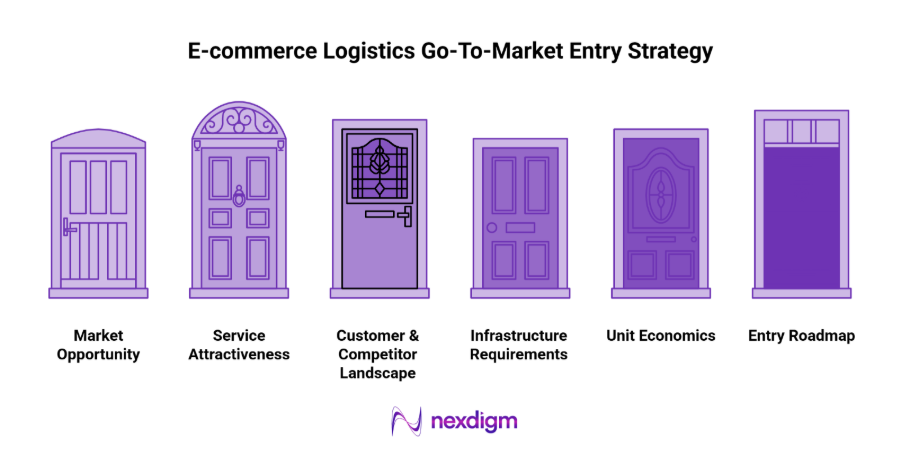
- Market opportunity: Size e-commerce logistics demand by category, customer type and geography.
- Service-layer attractiveness: Compare fulfillment, transportation, delivery, quick-commerce and returns opportunities.
- Customer and competitor landscape: Identify target accounts, incumbent providers and service gaps.
- Infrastructure requirements: Assess warehouse, transportation, technology and localized-network requirements.
- Unit economics: Model cost-to-serve, utilization, pricing and investment under different entry structures.
- Entry roadmap: Prioritize the service layer, customer segments and locations offering the strongest path to scale.
The resulting assessment helps determine where a logistics provider can enter without taking on the cost and complexity of an entire e-commerce network.
Nexdigm Case: Improving Fulfilment Economics
An e-commerce logistics provider was experiencing slower order fulfilment, rising operating costs and inventory-management inefficiencies. Nexdigm assessed the facility’s layout and operating processes, including SKU placement and warehouse workflows.
The intervention increased order fulfillment speed by 19% and reduced operational costs by 13%, improving the facility’s capacity to handle outbound demand without requiring a corresponding expansion in physical space.
To take the next step, simply visit our Request a Consultation page and share your requirements with us.
Harsh Mittal
+91-8422857704