

E-commerce procurement is becoming more complex as online sales expand across markets, suppliers, fulfillment models, and technology platforms. Global e-commerce retail sales are projected at approximately $6.88 trillion in 2026, representing around 21.1% of worldwide retail sales. At the same time, procurement teams are balancing cost with resilience: 71% of organizations say balancing cost and risk now drives procurement strategy, while only 45% say they are prepared for supply-chain disruptions, according to ISM Business research.
Recent study also reports that 94% of supply-chain leaders are innovating in risk management and resilience now or within three years. In this environment, ecommerce procurement benchmarking and sourcing consulting can help businesses identify cost gaps, evaluate vendor options, and understand supply risks across their procurement landscape.
Understanding the Ecommerce Procurement Concept
E-commerce businesses often procure across technology, packaging, logistics, fulfillment, customer service, marketing, inventory, and operational categories. Each has different suppliers, pricing models, contract structures, and risk factors. A low-cost vendor may create higher fulfillment or quality costs, while a highly reliable supplier may carry a premium that is commercially justified. Procurement therefore needs to assess total value rather than isolated purchase prices.
The Forces Shaping Ecommerce Procurement
A meaningful procurement assessment should connect cost, supplier competition, and supply continuity.
- Cost Economics: Compare prices, volumes, contracts, service fees, and operating costs to identify meaningful procurement and sourcing gaps.
- Vendor Landscape: Assess supplier availability, capabilities, pricing models, performance, and alternatives to understand where competitive sourcing opportunities exist.
- Supply Risk: Examine supplier concentration, geographic exposure, capacity, lead times, and disruption risks to determine where procurement resilience needs strengthening.
Together, these dimensions help e-commerce businesses identify where procurement costs can improve without creating unnecessary operational or supply risks.
How Nexdigm Brings Clarity to Ecommerce Sourcing
Nexdigm helps e-commerce businesses turn a fragmented procurement landscape into a clearer set of sourcing choices. Our experts bring together several areas to assess where sourcing decisions can create the strongest value. These are:
- Clarifying the Baseline: Establishing current suppliers, purchasing patterns, costs, service requirements, and sourcing dependencies to create a reliable starting point for comparison.
- Testing the Market: Evaluating alternative suppliers and sourcing markets against capability, capacity, pricing, quality, and operational requirements to identify credible options.
- Assessing the Trade-Offs: Comparing potential savings with switching effort, supply continuity, service impact, and implementation complexity before recommending a sourcing change.
- Guiding the Decision: Translating the findings into practical choices around negotiation, supplier diversification, consolidation, or alternative sourcing based on business priorities.
This helps e-commerce businesses move from procurement complexity to clearer sourcing decisions, with greater visibility into both commercial opportunity and operational implications.
Nexdigm’s Ecommerce Procurement Benchmarking Approach
Nexdigm’s ecommerce procurement benchmarking and sourcing consulting approach can serve as the central section instead of a separate assessment methodology. It brings together procurement data, market conditions, and sourcing considerations to create a practical view of procurement competitiveness. The approach helps businesses:
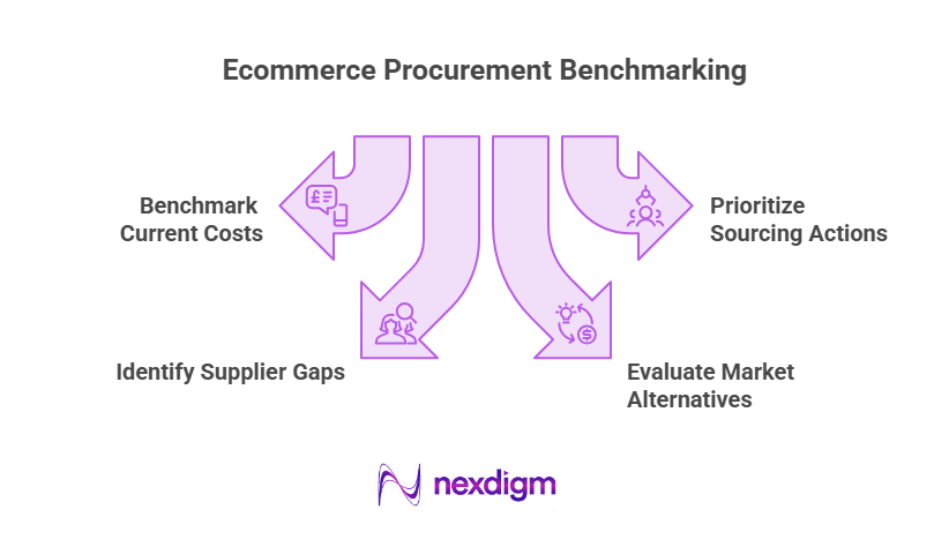
- Benchmark Current Costs: Compare prices, purchasing volumes, commercial terms, and service costs across relevant categories and suppliers.
- Identify Supplier Gaps: Examine supplier concentration, capabilities, geographic coverage, and competitive alternatives to understand where sourcing options may be limited.
- Evaluate Market Alternatives: Assess potential suppliers and sourcing markets based on cost, capacity, quality, service requirements, and supply considerations.
- Prioritize Sourcing Actions: Translate findings into practical opportunities such as renegotiation, supplier diversification, consolidation, or alternative sourcing.
By connecting benchmarking with sourcing decisions, Nexdigm helps e-commerce businesses identify where procurement can become more competitive while maintaining the supplier capability and resilience required to support growth.
Nexdigm’s Approach Adding Business Value for Stronger Ecommerce Sourcing
Effective sourcing can influence more than purchase prices. By addressing procurement gaps with the right supplier and sourcing strategy, Nexdigm helps e-commerce businesses:
- Improve Cost Efficiency: Better pricing, terms, and purchasing structures can reduce avoidable procurement costs across high-volume categories.
- Strengthen Supplier Resilience: Broader and better-evaluated supplier options can reduce excessive dependence on individual vendors or sourcing markets.
- Support Scalable Growth: Competitive sourcing arrangements can provide the capacity, service coverage, and flexibility needed as order volumes and markets expand.
- Improve Procurement Decisions: Reliable benchmarks and market intelligence give procurement teams stronger evidence for negotiations, supplier selection, and sourcing strategy.
Together, these benefits help businesses build a procurement model that is more competitive, resilient, and capable of supporting e-commerce growth.
Nexdigm’s Case
Nexdigm assessed an e-commerce procurement portfolio and identified a 17% potential cost-improvement opportunity across prioritized categories. Around 11% of spend showed significant supplier-price variation, while 8% presented opportunities for supplier diversification or alternative sourcing. The assessment enabled the business to focus negotiations, evaluate credible vendor alternatives, and strengthen sourcing resilience while pursuing targeted procurement savings.
To take the next step, simply visit our Request a Consultation page and share your requirements with us.
Harsh Mittal
+91-8422857704