

Ecommerce businesses depend on a network of suppliers and service providers to maintain product availability and fulfil customer orders. Manufacturers, distributors, packaging vendors, logistics partners, payment providers, and technology platforms can all influence the customer experience.
A disruption in one part of this network can affect inventory visibility, order processing, delivery commitments, and revenue. Procurement risk assessment must therefore extend beyond direct suppliers to the dependencies that keep ecommerce operations running.
Identify Dependencies Across the Fulfilment Network
The first step is to map the relationships between suppliers, warehouses, technology providers, and delivery partners. A business may have several vendors on paper but still rely on one underlying manufacturer, logistics hub, software platform, or specialist subcontractor.
These dependencies can remain hidden when supplier records focus only on direct contractual relationships. Procurement teams should establish which vendors support critical products or processes, where they operate, and what alternatives are available if a service becomes unavailable.
Recognise the Risks Behind Vendor Concentration
Supplier concentration is not always a problem. Consolidating orders with a reliable vendor can improve pricing and simplify coordination. The risk increases when the supplier has limited backup capacity, long replacement lead times, or control over a critical operational capability.
Technology-related dependencies also require attention. The US National Institute of Standards and Technology provides guidance on cybersecurity supply chain risk management, including identifying and mitigating risks associated with external products and service providers. Its principles can inform vendor assessments where ecommerce operations depend on technology infrastructure.
Connect Risk Assessment to Business Continuity
For ecommerce procurement risk mitigation, the objective is not to eliminate every supplier risk. It is to identify vulnerabilities that could cause significant operational or financial disruption and prepare proportionate responses.
An unavailable packaging supplier may delay dispatch, while a warehouse technology outage could prevent orders from being processed altogether. These risks require different controls, response times, and recovery arrangements.
Ecommerce Procurement Risk Mapping Framework
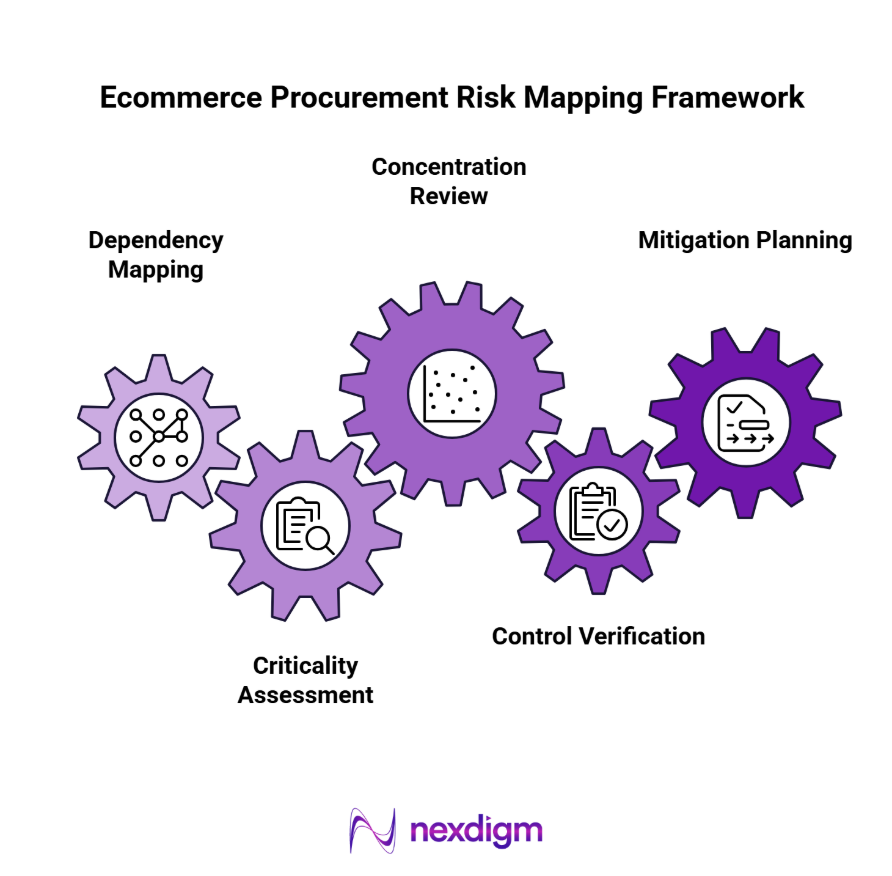
- Dependency Mapping: Document direct vendors, critical subcontractors, fulfilment partners, technology providers, and shared infrastructure to identify where apparently separate suppliers depend on the same underlying source.
- Criticality Assessment: Rank suppliers according to their impact on inventory availability, order processing, delivery performance, customer data, and revenue if their services become unavailable.
- Concentration Review: Measure spend, volume, and operational dependence by supplier, location, platform, and product category to identify single points of failure and limited substitution options.
- Control Verification: Review supplier continuity plans, cybersecurity practices where relevant, service-level commitments, recovery arrangements, financial stability indicators, and escalation procedures using available evidence.
- Mitigation Planning: Establish qualified alternatives, contingency inventory, documented workarounds, recovery targets, and periodic supplier reviews according to the severity and likelihood of each identified risk.
Turn Risk Findings Into Procurement Controls
Risk registers are useful only when they lead to action. High-priority dependencies may require alternative vendors, documented exit plans, additional stock protection, or contractual commitments on recovery and incident notification.
Controls should also be tested. A backup supplier that has never been qualified may not provide meaningful protection during a disruption. Regular reviews of vendor changes, fulfilment performance, and emerging dependencies help ensure the risk assessment remains relevant as the ecommerce model expands.
Nexdigm’s Case Study
An ecommerce retailer processing 40,000 orders monthly mapped dependencies across 32 critical vendors and found that two packaging categories relied on a single production source. Qualifying a backup vendor and revising replenishment thresholds reduced the share of critical packaging volume exposed to that source from 70% to 40%, based on the assessment.
To take the next step, simply visit our Request a Consultation page and share your requirements with us.
Harsh Mittal
+91-8422857704