

Ecommerce procurement extends beyond the products sold online. Retailers also purchase packaging, warehouse consumables, transportation, fulfilment services, software, payment processing, and customer-service support. These costs often sit in separate budgets, making it difficult to establish the true cost of processing and delivering an order.
The commercial challenge is to distinguish unavoidable fulfilment costs from expenses caused by supplier pricing, fragmented purchasing, inefficient operations, or poorly structured contracts.
Map the Spend Categories
Ecommerce procurement typically combines direct product costs with operating expenditure across the order lifecycle. A useful analysis separates merchandise, packaging, warehousing, transportation, technology, returns, and outsourced services.
The scale of the channel makes this distinction important. The U.S. Census Bureau estimated that US retail ecommerce sales reached approximately $1.23 trillion in 2025, an increase of 5.4% from 2024. This measures sales rather than procurement expenditure, but it illustrates the scale of the operating ecosystem supporting online transactions.
Examine Fulfilment Economics
Fulfilment costs depend on order characteristics, not just total sales. Small orders can require disproportionate picking and packing effort, while bulky products increase storage and transportation requirements. Split shipments, failed deliveries, returns, and seasonal peaks can add further expense.
Retailers should compare cost per order, cost per shipment, packaging cost per parcel, return-processing cost, and transport expenditure by delivery zone. These measures help identify whether rising spend reflects higher order volumes, a change in product mix, or deteriorating operational efficiency.
Identify Supplier-Level Variances
For ecommerce procurement spend analysis consulting, supplier comparisons should account for the commercial terms behind each invoice. Logistics providers may price by weight, volume, distance, delivery attempt, or service level. Technology vendors may charge by transaction, user, order volume, or module.
Comparing headline rates without normalising these terms can produce misleading savings estimates. Retailers should also examine minimum commitments, fuel or peak-season surcharges, service exclusions, renewal terms, and charges for returns or failed deliveries.
Ecommerce Procurement Spend Analysis Framework
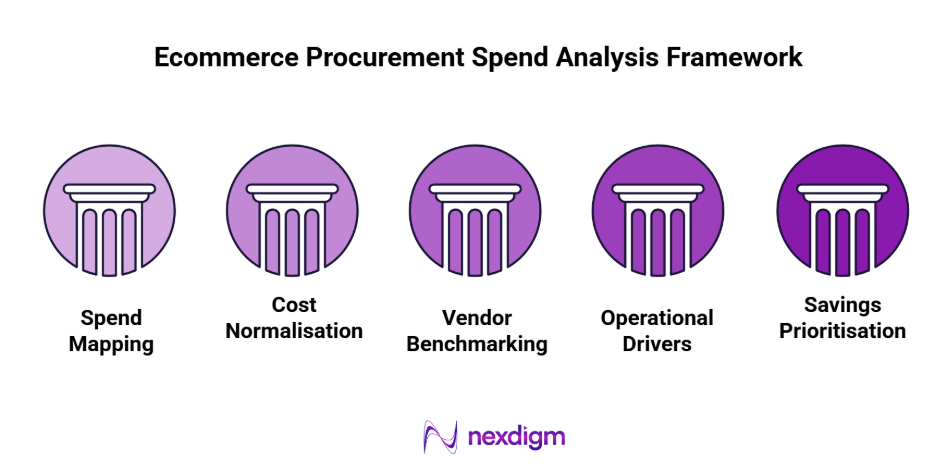
- Spend Mapping: Consolidate procurement data across merchandise, packaging, fulfilment, logistics, technology, and outsourced services to identify major expenditure categories and fragmented purchasing.
- Cost Normalisation: Compare equivalent orders, shipments, product specifications, delivery zones, and service levels so that differences in supplier pricing reflect genuine commercial variation.
- Vendor Benchmarking: Assess comparable quotations, contractual rates, surcharges, minimum commitments, payment terms, and service performance to identify suppliers with competitive total costs.
- Operational Drivers: Connect expenditure to order size, shipment frequency, packaging consumption, returns, failed deliveries, and peak-period demand to separate market pressures from process inefficiencies.
- Savings Prioritisation: Rank opportunities by addressable spend, expected savings, implementation effort, customer impact, and continuity risk before changing suppliers or fulfilment arrangements.
Convert Analysis Into Savings
The strongest opportunities may come from combining orders, revising packaging specifications, renegotiating delivery bands, or reducing unnecessary service charges. However, lower procurement costs should not compromise delivery reliability or customer experience.
Savings should be measured against a baseline that accounts for order volume, product mix, and service requirements. This prevents ordinary changes in ecommerce activity from being mistaken for procurement improvements.
Nexdigm’s Case Study
An online retailer reviewed ₹18 crore in annual fulfilment and packaging expenditure. Invoice analysis identified overlapping service charges and inconsistent courier pricing. A revised vendor allocation and contract review identified potential annual savings of 4%, equivalent to ₹72 lakh, subject to implementation and validation against actual shipment volumes.
To take the next step, simply visit our Request a Consultation page and share your requirements with us.
Harsh Mittal
+91-8422857704