

Vendor risk can change significantly after onboarding as suppliers introduce new technology, subcontractors, services, or operating locations. According to ISC2’s 2025 supply-chain risk survey, 70% of organizations conduct third-party risk assessments regularly, while 9% assess vendors only during onboarding.
The survey also found that 45% conduct supplier cybersecurity assessments annually, compared with just 17% quarterly. For e-commerce businesses with fast-changing supplier ecosystems, this highlights the importance of maintaining visibility beyond initial onboarding.
Ecommerce vendor risk and compliance research can help businesses identify emerging vendor dependencies, assess changing compliance requirements, and monitor service continuity as supplier relationships evolve. This enables organizations to focus attention on vendors and risk areas that could have the greatest impact on operations, customers, and business continuity.
The Growing Complexity of Ecommerce Vendor Risk
E-commerce businesses often depend on interconnected vendors across technology, logistics, fulfillment, payments, packaging, and customer services. As these relationships expand, risk can spread across multiple functions and markets. A supplier disruption, compliance lapse, or service failure may therefore affect more than one operational area. Maintaining a structured view of vendor dependencies helps businesses identify where vulnerabilities are concentrated and where stronger oversight may be required.
Where Ecommerce Vendor Exposure Builds
Vendor exposure does not arise from supplier numbers alone. It can build around critical services, concentrated dependencies, limited alternatives, changing compliance obligations, or inconsistent performance. For e-commerce businesses, understanding these pressure points is essential because a weakness in one vendor relationship can affect fulfillment, customer experience, technology availability, or regulatory compliance. Mapping these dependencies creates a clearer starting point for identifying which vendors require closer attention.
How Nexdigm Brings Clarity to Ecommerce Vendor Risk
Once key vendor dependencies are visible, the next step is understanding which exposures could materially affect the business. Nexdigm brings together several dimensions to create a more focused view of vendor risk. They are:
- Mapping Critical Dependencies: Nexdigm examines vendor importance, service coverage, geographic exposure, substitutability, and operational dependencies to identify relationships where disruption could have wider business consequences.
- Evaluating Changing Exposure: Its experts consider compliance requirements, service performance, supplier conditions, and operating changes to identify risks that may emerge after initial vendor onboarding.
- Prioritizing Risk Areas: Findings are evaluated against business criticality and potential impact, helping teams focus monitoring and mitigation efforts on the vendors requiring greater attention.
Through ecommerce vendor risk and compliance research, Nexdigm helps businesses move from a broad vendor landscape to a clearer understanding of where exposure is building and which risks warrant action.
Nexdigm’s Ecommerce Vendor Risk Framework
Nexdigm can structure ecommerce vendor risk and compliance research through a practical framework that connects vendor visibility with risk prioritization and action. The framework helps businesses assess suppliers consistently through the following steps:
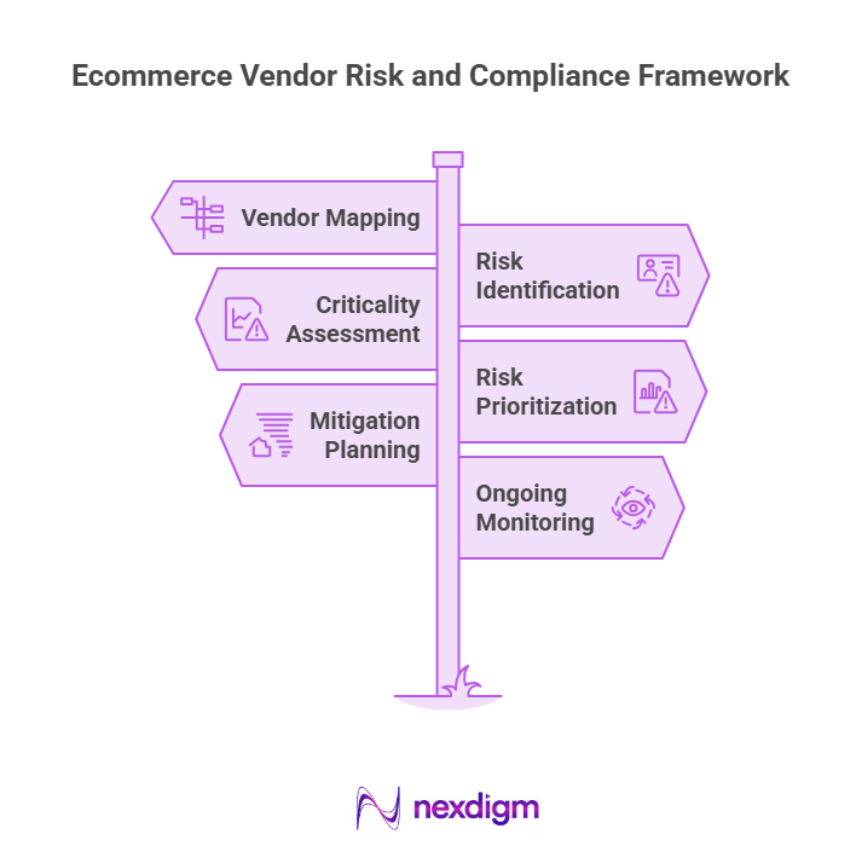
- Vendor Mapping: Identify critical vendors, services, markets, dependencies, and supplier relationships to establish a complete view of the e-commerce vendor ecosystem.
- Risk Identification: Evaluate compliance requirements, service performance, operational dependencies, geographic exposure, supplier concentration, and other factors that could create vendor vulnerability.
- Criticality Assessment: Assess each vendor against business importance, substitutability, customer impact, and potential disruption to determine the significance of identified risks.
- Risk Prioritization: Classify vendors and exposures according to severity and business impact, allowing teams to focus resources on the areas requiring greater attention.
- Mitigation Planning: Translate priority risks into appropriate responses, including remediation, enhanced monitoring, contingency planning, supplier diversification, or alternative sourcing.
- Ongoing Monitoring: Revisit vendor risk as supplier conditions, business requirements, regulations, and operating environments change to maintain visibility beyond initial onboarding.
This framework enables businesses to move from understanding where vendor risks exist to determine which risks matter most and how they should be managed.
What Sets Nexdigm’s Ecommerce Vendor Risk Expertise Apart
Vendor risk assessment can become fragmented when compliance, procurement, supplier performance, and operational risks are reviewed separately. Nexdigm brings these perspectives together to provide a more connected view of the vendor ecosystem:
- Business-Led Risk Perspective: Nexdigm considers vendor risk in relation to business criticality, customer impact, operational dependencies, and sourcing priorities rather than treating risk as an isolated compliance exercise.
- Procurement and Market Context: Supplier findings are evaluated alongside sourcing markets, supplier alternatives, commercial considerations, and market conditions to provide greater context for risk decisions.
- Integrated Risk View: Financial, operational, compliance, service, geographic, and dependency factors are considered together by experts, helping businesses identify risks that may not emerge through a single-dimensional review.
- Action-Oriented Insights: The focus extends beyond identifying risk to determining practical responses such as remediation, monitoring, diversification, contingency planning, or alternative sourcing.
This integrated approach of Nexdigm helps e-commerce businesses build a more commercially relevant and actionable understanding of vendor risk, supporting stronger supplier decisions as their ecosystems evolve.
Nexdigm’s Case
Nexdigm’s assessment identified 26% of vendors requiring closer risk oversight, while 17% showed elevated dependency on critical services and 10% had gaps in compliance documentation or controls. The review also found 8% of vendors with service-continuity concerns and 5% with limited sourcing alternatives. The findings enabled the business to prioritize high-impact vendors for remediation, enhanced monitoring, diversification, and contingency planning.
To take the next step, simply visit our Request a Consultation page and share your requirements with us.
Harsh Mittal
+91-8422857704