

Assessing economic viability for expansion is essential before entering markets with high investment requirements. It helps businesses evaluate whether expected returns justify the capital, operational costs, infrastructure needs, and financial risks involved. This assessment supports a practical market entry strategy by examining revenue potential, cost structures, payback period, funding needs, and long-term profitability.
In international expansion, economic viability for expansion ensures that companies do not rely only on market attractiveness but also consider financial sustainability. By analyzing investment requirements, demand outlook, pricing potential, and risk exposure, businesses can make informed decisions and enter new markets with greater confidence.
Recent investment trends highlight the need to assess economic viability for expansion before entering capital-intensive markets. Global foreign direct investment declined by 11% to about USD 1.5 trillion in 2025, showing weaker productive capital flows. At the same time, private infrastructure investment in developing markets reached USD 100.7 billion in 2024, rising 16% from the previous year.
Evaluating Capital Requirements Before Entering High-Investment Markets
Evaluating capital requirements helps businesses estimate setup costs, infrastructure investment, operational expenses, working capital, and funding needs before entering high-investment markets, ensuring financially sustainable market entry decisions.
-
Initial Setup Costs
Businesses estimate registration, licensing, office setup, equipment, and launch expenses required before entering high-investment markets.
-
Infrastructure Investment Needs
Companies assess facilities, technology systems, logistics networks, warehouses, and production capacity needed to support market operations.
-
Working Capital Requirements
Firms calculate funds needed for inventory, salaries, supplier payments, utilities, and daily operational expenses.
-
Regulatory and Compliance Costs
Businesses review taxes, permits, legal documentation, certifications, and compliance expenses linked to market entry.
Nexdigm’s Revenue Potential Assessment for International Expansion
Nexdigm’s Revenue Potential Assessment for International Expansion helps businesses estimate possible earnings before entering a new market. It involves analyzing market size, customer demand, pricing opportunities, sales channels, competitor performance, and growth trends. This assessment supports informed expansion decisions by showing whether the target market can generate sustainable revenue, justify investment, and align with the company’s market entry strategy.
Nexdigm’s Capital Requirement Analysis for High-Investment Market Expansion
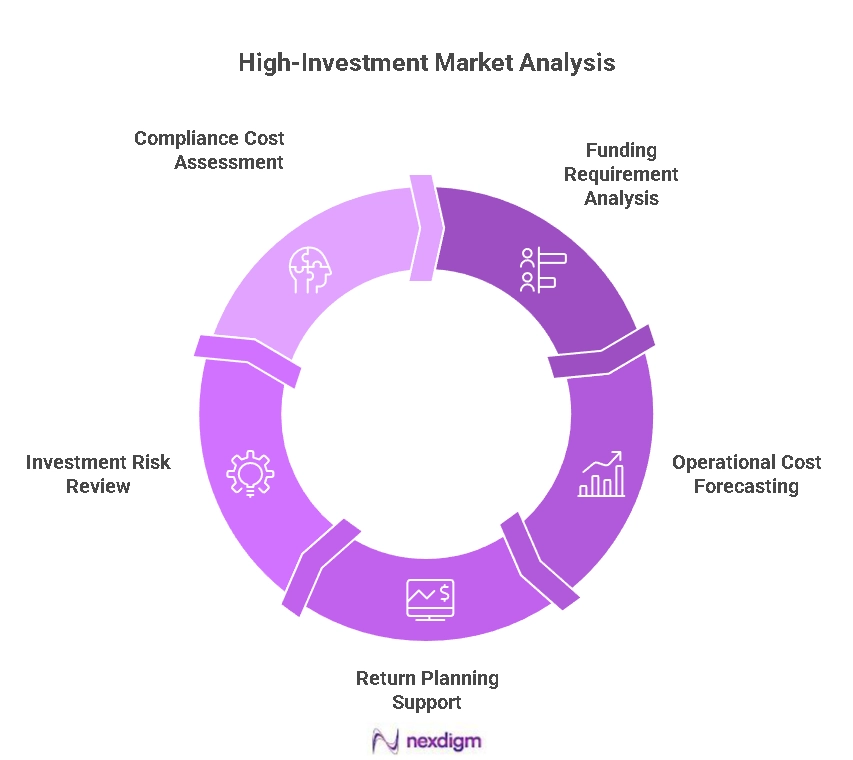
Nexdigm’s Capital Requirement Analysis for High-Investment Market Expansion helps businesses estimate setup costs, infrastructure needs, working capital, compliance expenses, and funding requirements before entering capital-intensive international markets:
-
Compliance Cost Assessment
Nexdigm reviews taxes, permits, legal documentation, certifications, and regulatory expenses linked to international market entry.
-
Funding Requirement Analysis
Nexdigm identifies capital gaps and evaluates suitable funding options, including loans, internal funds, partnerships, or joint ventures.
-
Operational Cost Forecasting
Nexdigm estimates recurring expenses such as rent, salaries, marketing, distribution, maintenance, administration, and local vendor costs.
-
Investment Risk Review
Nexdigm evaluates cost overruns, currency fluctuations, delayed returns, market uncertainty, and financial exposure before expansion.
-
Return Planning Support
Nexdigm compares expected revenue, margins, payback period, and investment returns against total capital requirements.
Nexdigm’s case:
Nexdigm supported a manufacturing company assess capital requirements before entering a high-investment international market. Nexdigm estimated an initial investment need of USD 18 million, including 42% for infrastructure, 28% for equipment, 18% for working capital, and 12% for regulatory and setup costs. The analysis also projected a five-year revenue potential of USD 65 million and a payback period of four years. Based on these insights, Nexdigm helped the company refine its expansion plan and reduce financial risk.
To take the next step, simply visit our Request a Consultation page and share your requirements with us.
Harsh Mittal
+91-8422857704