

Edge computing is gaining traction as organizations seek to process data closer to where it is generated. According to Omdia’s October 2026 survey of 570 IoT decision-makers across ten countries, 62% of organizations had adopted edge architectures for IoT deployments, while 78% of these deployments had progressed beyond the pilot stage.
Another 2026 enterprise AI infrastructure survey also found that more than 70% of respondents expected to scale AI-at-the-edge deployments by 2028, roughly doubling current adoption levels. These developments are expanding opportunities for infrastructure, software, networking, and technology providers.
Through edge computing vendor landscape research, organizations can help enterprises understand the competitive ecosystem, evaluate supplier positioning, and identify relevant technology partners.
Why Computing Is Moving Closer to the Point of Data Generation
As applications demand faster responses and greater processing efficiency, organizations are reconsidering where computing workloads should operate. Edge infrastructure enables local data processing, supports real-time decisions, and reduces dependence on centralized resources. Its relevance extends across industrial automation, telecom networks, connected facilities, and enterprise operations, creating demand for different combinations of hardware, software, connectivity, and managed services.
Market Developments Influencing Edge Computing Adoption
The expansion of edge computing is being shaped by three developments that influence both enterprise demand and vendor strategies:
- Industrial Intelligence: Smart manufacturing, robotics, and connected equipment are increasing demand for localized processing, machine monitoring, and real-time operational decisions.
- Telecom Network Evolution: 5G expansion and multi-access edge computing are creating opportunities for low-latency applications, distributed infrastructure, and network-based enterprise services.
- Enterprise AI Expansion: AI inference, video analytics, and distributed applications are encouraging organizations to deploy computing resources closer to users and data sources.
These developments are broadening the addressable market and creating opportunities for established technology companies and specialized edge computing providers.
Understanding Different Layers of the Edge Computing Ecosystem with Nexdigm
Edge computing is not a single product category. It brings together several technology layers, each supported by different types of suppliers. Our experts can help enterprises understand this ecosystem by examining providers across:
- Edge Hardware and Infrastructure: Companies supplying edge servers, gateways, processors, ruggedized computing systems, and micro data centre infrastructure.
- Edge Software and Platforms: Providers offering workload orchestration, application management, virtualization, container management, and distributed computing platforms.
- Connectivity and Network Solutions: Vendors supporting 5G, software-defined networking, network virtualization, and multi-access edge computing infrastructure.
- Edge Security and Managed Services: Companies delivering device protection, infrastructure monitoring, threat management, deployment, and ongoing operational support.
This ecosystem-level perspective helps organizations understand how different suppliers contribute to an end-to-end edge computing environment.
How Nexdigm Identifies Competitive Positioning Across Edge Markets
Supplier leadership can vary depending on the application, industry, and technology layer being considered. Our edge computing vendor landscape research can help enterprises examine competitive positioning through a market-oriented assessment of:
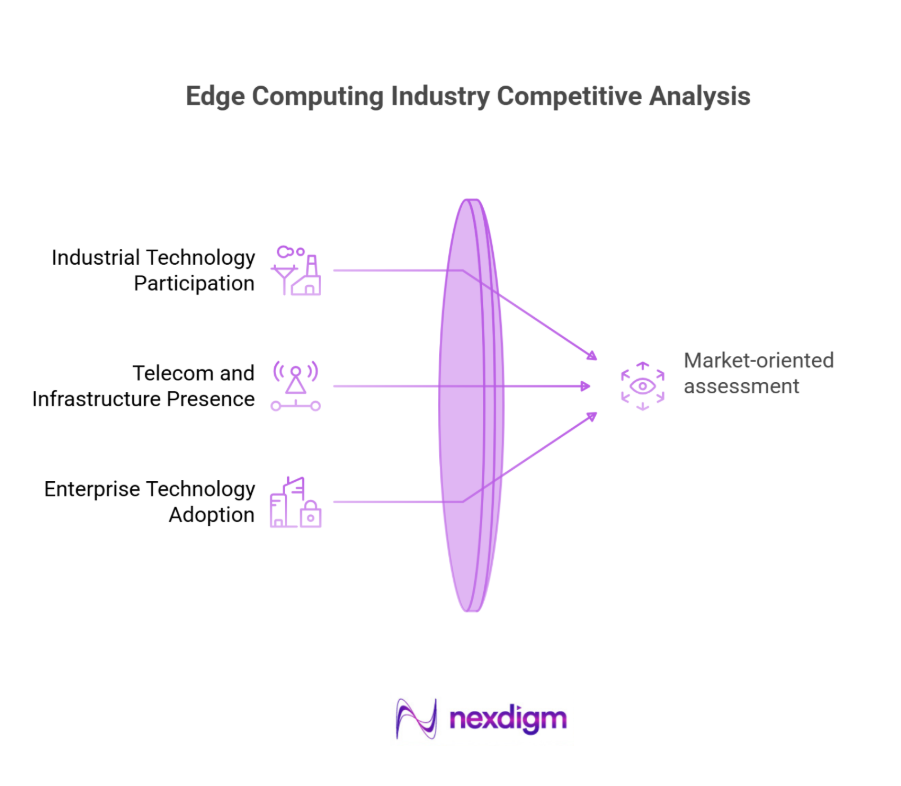
- Industrial Technology Participation: Identify providers serving manufacturing, energy, utilities, and industrial automation, with capabilities suited to operational technology environments.
- Telecom and Infrastructure Presence: Examine vendor relationships with network operators, data centre companies, and communications technology providers to understand their role in distributed infrastructure.
- Enterprise Technology Adoption: Assess providers supporting retail, healthcare, financial services, and geographically distributed business operations through edge-enabled applications.
This segmentation helps enterprises distinguish broad infrastructure providers from specialists serving particular industries or deployment environments.
Nexdigm’s Research-led View on Emerging Edge Computing Opportunities
As the ecosystem evolves, vendor competitiveness will increasingly depend on how providers respond to emerging technology requirements. Our edge computing vendor landscape research can help organizations track developments in edge AI, accelerated computing, hybrid cloud architectures, distributed orchestration, and autonomous infrastructure management. Our research can also examine product launches, strategic alliances, acquisitions, geographic expansion, and investment priorities. These insights help enterprises understand how the competitive landscape is changing and identify suppliers developing capabilities relevant to future infrastructure requirements.
Nexdigm’s Case
A retail organization operating across multiple locations sought to identify edge computing providers capable of supporting real-time inventory visibility, video analytics, and connected store operations. Nexdigm assessed 19 vendors across processing capabilities, network compatibility, security, deployment flexibility, and multi-site management. The evaluation found that 37% had limited integration with existing retail systems, while 26% lacked sufficient centralized monitoring capabilities. Based on the assessment, 6 vendors were shortlisted for further technical and commercial evaluation.
To take the next step, simply visit our Request a Consultation page and share your requirements with us.
Harsh Mittal
+91-8422857704