

An education technology company can have a large user base and still struggle to justify another round of investment. A school platform may be widely used but difficult to monetise. A test-preparation business may generate strong revenue but depend heavily on seasonal enrolments. A workforce-learning product may serve fewer users while earning recurring contracts from employers.
For investors, the more useful question is not which EdTech category is growing fastest. It is where additional capital can build a defensible business, improve learning or employment outcomes, and support profitable expansion.
EdTech Investment Trends: Growth Is No Longer Enough
India’s EdTech funding cycle offers a useful warning against equating sector demand with investment attractiveness. According to Inc42’s Annual Indian Startup Trends Report 2025, funding for Indian EdTech startups fell 56% year on year to US$249 million in 2025, compared with US$572 million in 2024. Funding totals do not measure customer demand directly, but the decline signals a more selective investment environment.
Capital allocation therefore needs to account for the quality of revenue, not just the size of the addressable market. Subscription renewals, institutional contracts and repeat purchases can offer greater visibility than one-off enrolments acquired through heavy discounting. The economics of customer acquisition, instructor delivery, and learner support should be assessed alongside headline growth.
Different categories also carry different risks. Consumer learning products may scale quickly but face high acquisition costs and learner churn. Institutional software can generate recurring revenue, although procurement cycles and implementation requirements may slow growth. Workforce training can address a defined employer’s need, but providers must demonstrate that the training improves skills relevant to the job.
Which EdTech Business Models Offer Better Investment Potential?
The investment case depends on how the company creates and captures value.
- Institutional software: Learning management, assessment, and administration tools can support recurring contracts. Investors should examine renewal rates, implementation costs, integration requirements, and dependence on a small number of large customers.
- Career and skills learning: Professional courses and certifications can command a clear purchase rationale when employers recognise the skills. The test is whether learners complete the programme and achieve outcomes that justify the price.
- Test preparation and tutoring: Demand may be strong around specific examinations, but seasonality, instructor capacity and customer acquisition costs influence margins.
- Workforce learning: Employer-funded training can generate repeat business where providers address compliance, technical capability or role-specific skills. Sales cycles may be longer, and buyers will expect measurable results.
A company should not be valued on recurring revenue alone. Revenue quality depends on retention, discounting, customer concentration, and the cost of delivering the service. A subscription that renews only because customers are locked into a contract is different from one renewed because users consistently benefit.
EdTech Investment Opportunity Study: Where Can Capital Create an Advantage?
An EdTech investment opportunity study should compare the market opportunity with the company’s ability to win and serve customers. A large learner population is not sufficient if willingness to pay is weak, or the product is easy to replace.
Investors should look for evidence of product-market fit: repeat usage, sustained renewals, low refund rates, clear customer references and outcomes that can be independently measured. Technology costs also deserve scrutiny. Personalisation and AI-enabled features may improve the learning experience, but they can add computing, content-review and support costs. The relevant question is whether the added capability improves retention, outcomes, or pricing power enough to justify the expense.
Scalability must be tested operationally. A platform may add users cheaply until it needs more instructors, individual support, or institution-specific integration. Growth forecasts should reflect these delivery costs rather than assume that every additional learner produces the same margin.
EdTech Investment Prioritisation Framework
The EdTech Investment and Scalability Framework compares opportunities across four dimensions:
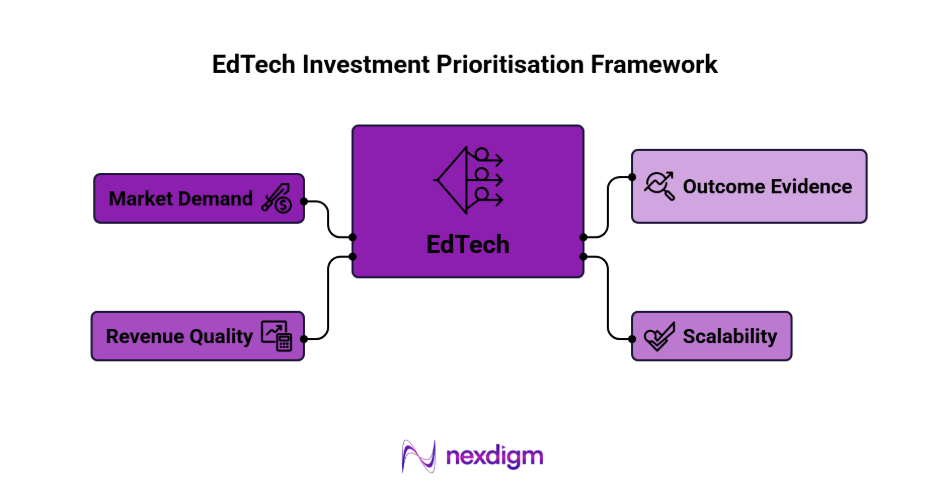
- Market Demand: Identify the buyer, purchasing trigger, competing solutions and evidence of willingness to pay.
- Revenue Quality: Assess recurring revenue, renewal behaviour, customer concentration, and contribution margin.
- Outcome Evidence: Examine completion, demonstrated skills, learning progress or operational improvements.
- Scalability: Test acquisition costs, technology expenses, support requirements and the ability to serve additional customers without equivalent cost increases.
The strongest investment candidate is not necessarily the business growing fastest today. It is the one where capital can strengthen a credible advantage and produce more durable economics.
Nexdigm Case Study: Comparing EdTech Investment Priorities
Nexdigm evaluated 18 EdTech opportunities across institutional software, career learning, test preparation and workforce training. The assessment compared revenue models, acquisition costs, retention indicators, buyer demand, and delivery requirements. Six opportunities progressed to detailed review, with institutional software and employer-funded learning showing the strongest fit between recurring demand and measurable customer value.
To take the next step, simply visit our Request a Consultation page and share your requirements with us.
Harsh Mittal
+91-8422857704