

A school wants to identify students falling behind in mathematics. A university needs to manage online courses more effectively. An employer wants new hires to complete technical training before starting work.
All three might purchase education technology, but their budgets, decision-makers and expectations are different. Treating them as one market makes it difficult to estimate demand, choose a pricing model, or decide which product to build.
For EdTech businesses, commercial opportunity depends less on the number of potential learners than on the problem being solved, the person paying for the solution and the evidence that it works.
EdTech Market Segmentation: Who Is Actually Buying?
India’s education system offers a large potential user base, but the market is divided among institutional buyers, individual learners and employers.
- K-12 schools may purchase digital content, assessment platforms, tutoring tools, or school-management software. Decisions can involve school leadership, teachers, parents, and, in public education, government procurement bodies.
- Higher education institutions may seek learning management systems, digital assessment, virtual laboratories, or student analytics. These products often need to work with existing academic and administrative systems, which can lengthen procurement and implementation.
- Individual learners evaluate course quality, price, convenience, and the credibility of a certificate. Exam preparation, tutoring and career-oriented courses can address clear needs, but providers must account for seasonal demand, customer acquisition costs, and learner retention.
- Employers buy training to improve workforce capability, meet compliance requirements, or prepare employees for specific roles. They may assess completion rates, demonstrated skills, and operational outcomes rather than simply counting course enrolments.
These segments need separate market estimates. A large student population is not equivalent to a large pool of paying customers.
Digital Learning Adoption: What Prevents Customers from Buying?
Technology access is only one barrier. UNESCO’s 2023 Global Education Monitoring Report noted that just 40% of primary schools worldwide were connected to the internet. It also highlighted limited robust evidence on the added value of education technology and warned that implementation costs can be underestimated.
For EdTech providers, this creates a practical commercial challenge. A product may require teacher training, reliable devices, technical support, or integration with existing systems. These costs influence both adoption and renewal.
The buyer’s expectations vary by use case. A school may want to identify learning gaps without adding administrative work for teachers. A university may prioritise system integration and assessment integrity. An employer may need evidence that training translates into job-relevant skills.
A polished product demonstration does not establish that the solution will be used consistently. Adoption depends on whether it fits the user’s daily work and produces an outcome for the buyer values.
EdTech Business Models: Which Use Cases Have Commercial Potential?
An EdTech market assessment should connect each use case to its buyer, budget and measurable value.
Promising categories may include:
- Assessment and learning analytics: Help educators monitor student progress and identify areas requiring intervention.
- Tutoring and exam preparation: Provide structured practice, feedback, and support for defined examinations.
- Higher education platforms: Improve course delivery, digital assessment and access to specialised learning resources.
- Workforce learning: Build job-specific skills and track competency, completion, or compliance.
Pricing needs to reflect how each segment purchases. Institutions may prefer annual licences or per student fees. Individual learners may pay per course or subscription. Employers may buy training by seat, cohort or programme.
Free alternatives can limit willingness to pay, especially when a product offers content without a clear advantage in teaching quality, convenience or outcomes. Providers need to show why their solution is worth adopting instead of existing tools or established teaching practices.
Nexdigm’s EdTech Market Entry and Validation Framework
The EdTech Commercial Opportunity Framework helps providers decide which segment to target first.
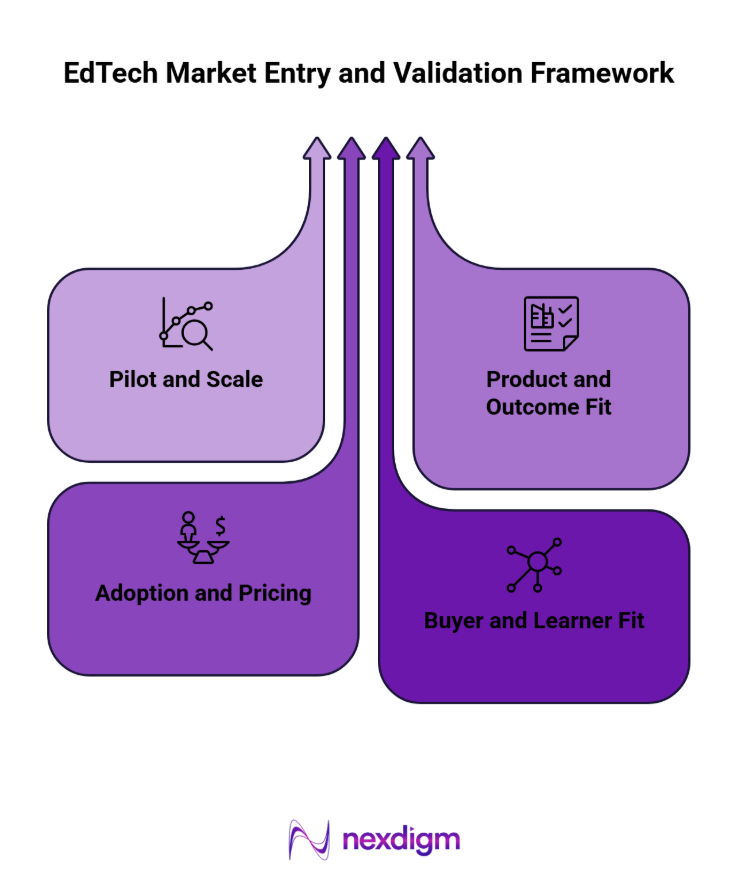
- Buyer and Learner Fit: Identify the target user, budget owner, purchasing process and problem that triggers demand.
- Product and Outcome Fit: Establish how the product improves learning, reduces administrative effort, or builds measurable skills.
- Adoption and Pricing: Assess technology readiness, onboarding requirements, willingness to pay, and the cost of customer acquisition.
- Pilot and Scale: Track active usage, learning progress, completion, renewal potential and delivery costs before expanding.
The strongest entry market is where a clear need meets an identifiable buyer and a viable delivery model. A smaller segment with measurable outcomes and manageable implementation can be more attractive than a much larger audience with uncertain willingness to pay.
Nexdigm Case Study: Prioritising EdTech Use Cases
Nexdigm assessed K-12, higher education and workforce-training opportunities for a digital learning provider. Buyer interviews, procurement requirements, competitor offerings and implementation costs pointed to three promising applications: school assessment reporting, higher education course delivery and role-based employee training. The client prioritised a focused institutional pilot to validate adoption, pricing, and measurable outcomes before expanding across segments.
To take the next step, simply visit our Request a Consultation page and share your requirements with us.
Harsh Mittal
+91-8422857704