

An underserved EdTech category is not necessarily an overlooked goldmine.
Sometimes there are few competitors because the market is genuinely early. Sometimes there are few competitors because customers are unwilling to pay, acquisition is too expensive, delivery costs are difficult to control, or existing workflows make adoption unnecessarily difficult.
That distinction has become more important as India’s EdTech market matures. IBEF estimates the market at ₹32,670 crore in 2025, with projections reaching ₹2,99,790 crore by 2034. Digital education is also projected to grow at a 24% CAGR between 2025 and 2030. Growth, however, does not make every segment commercially attractive.
The useful question is where growth can translate into durable economics.
Four EdTech Segments, Four Different Economic Models
Digital curriculum content has an obvious demand base, but information itself is increasingly difficult to monetise when learners can access free educational material across YouTube, DIKSHA, and other open platforms. A new content library therefore needs a clear reason for customers to pay.
Tutoring has a different constraint. The value proposition can be highly tangible, but live instruction introduces a labour component that rises with usage. The commercial model therefore depends heavily on tutor utilisation, pricing, student retention, and acquisition economics.
Assessment operates under a different set of conditions. Universities, schools, certification bodies, and employers may have recurring requirements around testing, diagnostics, identity verification, proctoring, reporting, and academic integrity. These are tied to institutional processes rather than discretionary learner consumption.
Learning management and institutional infrastructure create another dynamic. Once software becomes embedded in academic or administrative workflows, replacing it can require data migration, staff training, integration work, and process redesign. The resulting stickiness can support recurring revenue when the product continues to deliver operational value.
The four categories may all be called EdTech. Their economics are not interchangeable.
The Market Gap Has to Survive an Economic Test
A genuine whitespace should satisfy several conditions simultaneously.
- Urgent customer problem
The product addresses a problem that has operational, financial, regulatory, or academic consequences. - Identifiable budget
There is a defined buyer with an existing budget rather than a theoretical willingness to pay. - Limited competitive coverage
Incumbent products leave a meaningful functional or customer-segment gap. - Scalable delivery
Revenue can grow faster than the cost of delivering the underlying service. - Retention mechanism
The product becomes sufficiently useful or embedded that customers have a reason to renew. - Expansion pathway
The initial product can lead to additional users, modules, departments, or contracts.
This is particularly important in a market where funding has become more selective. IBEF reports that Indian EdTech funding rebounded to approximately ₹1,071 crore across 11 deals in H1 2025, driven partly by AI-led businesses.
Capital is still available. The question is what kind of EdTech economics can justify it.
Where the Commercial White Space May Actually Sit
The most interesting opportunities may not be the categories with the largest learner audiences.
A consumer content product can reach millions of users while competing against free alternatives. A specialised institutional product may serve fewer customers but command larger contracts, integrate into critical workflows, and generate recurring revenue.
That changes how opportunity should be assessed.
For each segment, the analysis should connect the customer problem to the buyer, the budget, the delivery model, the competitive environment, and the likelihood of long-term retention.
Nexdigm’s EdTech White-Space Opportunity Framework
An EdTech market opportunity assessment can evaluate potential niches through six commercial lenses:
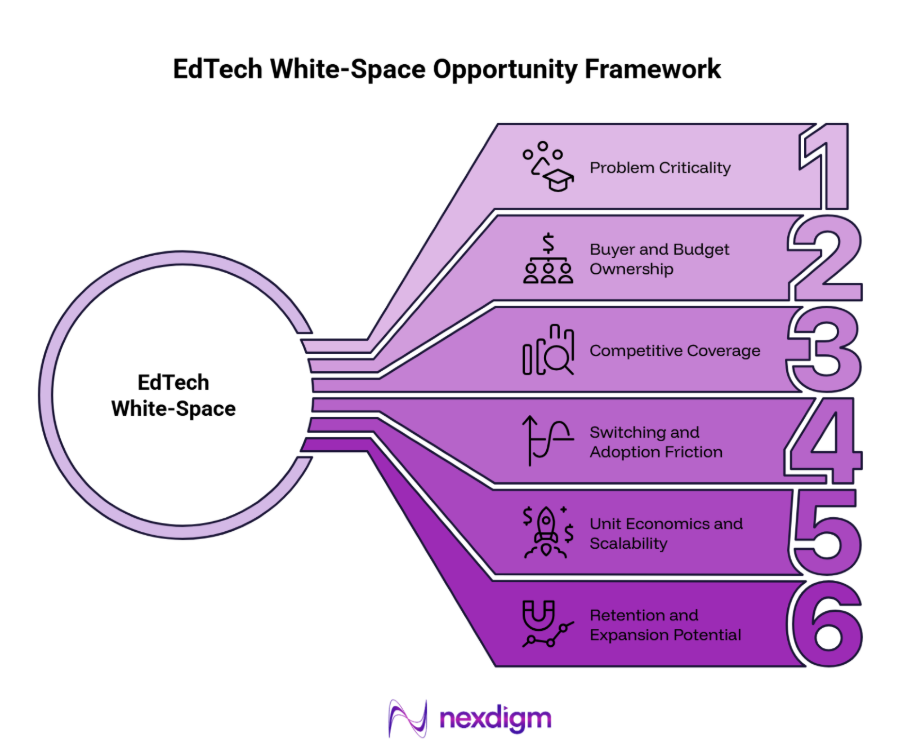
- Problem Criticality
Assess the severity, frequency, and consequences of the customer problem. Determine whether the solution addresses a mandatory operational requirement, measurable performance gap, compliance need, or discretionary enhancement. - Buyer and Budget Ownership
Identify the economic buyer, decision-making process, existing budget allocation, procurement requirements, and current spending on alternative solutions. - Competitive Coverage
Map incumbent providers, customer segments served, pricing structures, product capabilities, market concentration, and areas where existing solutions remain inadequate. - Switching and Adoption Friction
Evaluate implementation requirements, data migration, system integration, staff training, workflow disruption, procurement timelines, and other barriers that could slow adoption. - Unit Economics and Scalability
Assess acquisition cost, delivery cost, infrastructure requirements, support intensity, gross-margin potential, customer lifetime value, and whether incremental revenue can be generated without proportionate operating costs. - Retention and Expansion Potential
Examine renewal drivers, contract duration, additional-user opportunities, cross-selling, module expansion, and the potential for the initial product to become embedded across a customer’s wider operations.
The resulting assessment can distinguish between a market that is simply underserved and one where the gap is commercially actionable.
Nexdigm’s Case Study: Repositioning Capital Toward Institutional EdTech
An EdTech investor assessed 12 product concepts and found consumer test preparation facing CAC above ₹4,200 per user, while institutional assessment offered lower competitive density and software gross margins above 72%, prompting 85% of planned capital to shift toward B2B infrastructure.
For EdTech companies and investors, that is the purpose of opportunity assessment: to determine whether a visible market gap represents genuine commercial whitespace or simply an attractive-looking hole in the competitive landscape.
To take the next step, simply visit our Request a Consultation page and share your requirements with us.
Harsh Mittal
+91-8422857704