

Opening a new campus is a long-term commitment disguised as a growth decision. Land acquisition, construction, approvals, faculty recruitment and student services create costs well before a new institution reaches stable enrollment. If the location attracts fewer students than expected, fixed costs can weigh on the institution for years. If capacity is too limited, the campus may struggle to deliver the programme experience that attracted applicants in the first place.
A sound expansion decision begins with a market case, not an architectural plan. The institution needs to establish where demand exists, which programmes can attract it and whether the proposed campus can operate sustainably.
How to Select a Location for Education Campus Expansion
Location analysis should go beyond population size. A large city may offer a broad pool of prospective students, but it may also have high land prices, intense competition and expensive accommodation. A smaller city may have lower operating costs and unmet demand, yet offer a narrower faculty pool or fewer employer partnerships.
The assessment should consider:
- Student catchment: Number of eligible learners, school-leaver trends, household affordability and willingness to relocate.
- Competitive supply: Nearby institutions, programme availability, fee levels, admission selectivity and unused capacity.
- Accessibility: Public transport, road connectivity, student housing, safety and proximity to feeder schools or employers.
- Faculty availability: Access to qualified academic staff, specialist instructors and research or industry partners.
- Regulatory and land constraints: Land-use permissions, affiliation or approval requirements, building standards and infrastructure availability.
These factors should be assessed at a catchment level. A campus may appear well located on a map but remain difficult to reach at the times students need to travel. Conversely, a less prominent location can work when transport links, housing and a clearly differentiated programme offer make it accessible.
Programme Selection and Capacity Planning
Programme choice determines much of the infrastructure requirement. A business programme may need lecture rooms, digital resources and collaborative spaces. Engineering, healthcare and applied sciences may require costly laboratories, equipment, clinical access or specialist faculty. The same enrollment target can therefore imply very different capital and operating costs.
India’s higher education enrollment reached 4.50 crore in 2023–24, according to AISHE. This national growth provides context, not a location-specific guarantee. Institutions should test demand for each proposed programme against local competition, entrance requirements, willingness to pay and employment pathways.
Capacity planning also needs to distinguish between sanctioned seats and usable capacity. A campus may have classrooms for 1,000 students but lack sufficient laboratories, faculty, accommodation or support staff to serve that number properly. Expansion should model enrollment by cohort and account for progression, attrition and the time required to recruit faculty.
Education Campus Expansion Analysis: Testing the Investment Case
An Education campus expansion analysis should connect market demand with capital requirements and the path to operational stability. A site with high potential demand can still be unattractive if construction costs, financing or recruitment timelines make the project uneconomic.
The financial model should include land, design, construction, equipment, approvals, pre-opening costs, marketing and working capital. It should also account for recurring expenditure such as salaries, utilities, maintenance, technology, student support and campus security. Enrollment ramp-up assumptions deserve particular scrutiny because a new campus rarely operates at full capacity from its first intake.
A staged approach can reduce risk. Institutions may introduce a limited programme portfolio, use shared facilities or lease selected infrastructure while demand develops. However, these options must be checked against regulatory requirements and the academic experience the institution intends to offer.
Campus Expansion Feasibility Framework
The Education Campus Expansion Feasibility Framework helps compare locations and sequence investment.
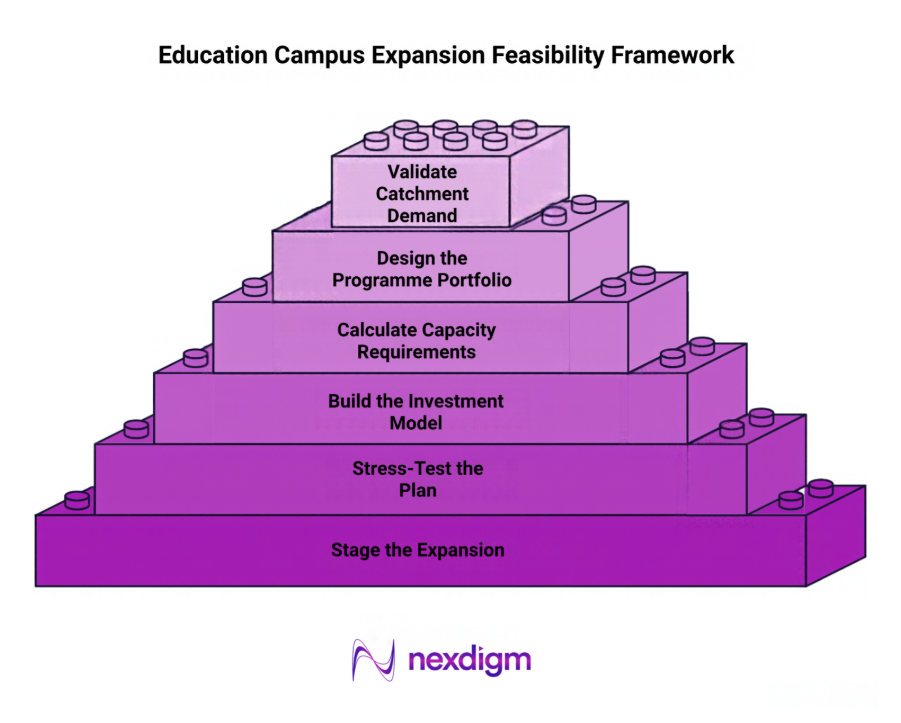
- Validate Catchment Demand: Estimate eligible students, competing supply, realistic enrollment and affordability.
- Design the Programme Portfolio: Select courses that match local demand, faculty availability and infrastructure requirements.
- Calculate Capacity Requirements: Model classrooms, laboratories, faculty, housing and support services across several enrollment scenarios.
- Build the Investment Model: Estimate capital expenditure, operating costs, revenue ramp-up, funding needs and break-even timing.
- Stress-Test the Plan: Examine slower admissions, cost overruns, delayed approvals and faculty recruitment constraints.
- Stage the Expansion: Identify which facilities and programmes must open immediately and which can follow demonstrated demand.
Expansion should proceed only when the institution has a credible path from market demand to operational delivery. A large campus is not a strategy if the student pipeline cannot support it.
Nexdigm Case Study: Evaluating a New Campus
Nexdigm compared three potential campus locations, assessing student catchments, competing institutions, land and construction costs, and programme-level demand. One location offered the strongest balance of enrollment potential and operating feasibility. The institution adopted a phased expansion plan, prioritising programmes with lower initial infrastructure requirements while reserving specialist facilities for a later stage.
To take the next step, simply visit our Request a Consultation page and share your requirements with us.
Harsh Mittal
+91-8422857704