

Students rarely choose an educational institution on one factor alone. A low fee may attract attention, but weak placement support can put a student off. A strong reputation may justify a higher price, unless relocation and accommodation make the total cost unaffordable. Flexible delivery may suit a working learner but offer too little practical exposure for a laboratory-based programme.
Understanding these trade-offs is more useful than asking students which feature they like best. Institutions need to know what prospective students value, what they are willing to compromise on and which conditions can prevent enrollment altogether.
How Students Compare Courses and Institutions
Curriculum is often the first test of relevance. Students want to understand what they will study, how specialised the programme is and whether the course builds practical skills alongside theoretical knowledge. Broad claims about industry readiness are less persuasive than a visible syllabus, project work, internships or opportunities to use relevant equipment and software.
Institutional reputation also matters, but it can mean different things to different audiences. Some applicants focus on accreditation and academic standing. Others place greater weight on employer recognition, alumni networks, faculty expertise or the experience of current students.
The Ministry of Education’s AISHE 2021–22 recorded approximately 4.33 crore students in higher education, demonstrating the scale of India’s education market. Yet national enrollment figures reveal little about individual consumer preferences. A college serving local commuters competes under different conditions from a specialist institution recruiting nationally.
Education Consumer Preference Assessment: The Trade-Offs Behind Choice
An Education consumer preference assessment should test how students balance the following considerations, rather than treating them as independent checkboxes.
- Curriculum and teaching: Course relevance, faculty access, practical learning, electives and academic support.
- Fees and financial flexibility: Tuition, scholarships, payment schedules, accommodation and the full cost of attendance.
- Career outcomes: Internship access, placement support, employer connections, graduate progression and the credibility of outcome claims.
- Location and accessibility: Commute time, safety, transport, housing, campus facilities and proximity to family or work.
- Learning experience: Class sizes, digital resources, administrative responsiveness, peer environment and access to mentoring.
The weight assigned to each factor will vary. A school-leaver comparing residential universities may care deeply about campus life and accommodation. A working professional choosing a postgraduate qualification may place greater value on evening classes, online access and schedule flexibility.
Preferences can also change during the decision process. A student may initially prioritise course content, then revise the shortlist after discovering the total fee or learning schedule. Institutions should therefore collect feedback at multiple stages, not just after admission.
How to Measure Preference Without Relying on Survey Answers Alone
Stated preference is useful, but behaviour provides a second layer of evidence. Website visits, course-page engagement, prospectus downloads, campus visits, application starts and offer acceptance can reveal which factors influence action.
Research should combine student interviews or surveys with admissions data and competitor comparisons. For example, if prospective students repeatedly ask about internships but rarely view the institution’s placement information, the problem may be discoverability rather than the absence of a placement service.
Institutions should avoid interpreting a survey response as a guaranteed purchase. Students may claim that they value practical learning while ultimately choosing the cheaper institution. The purpose of preference research is to understand the trade-off, including the price or inconvenience at which a preference stops influencing choice.
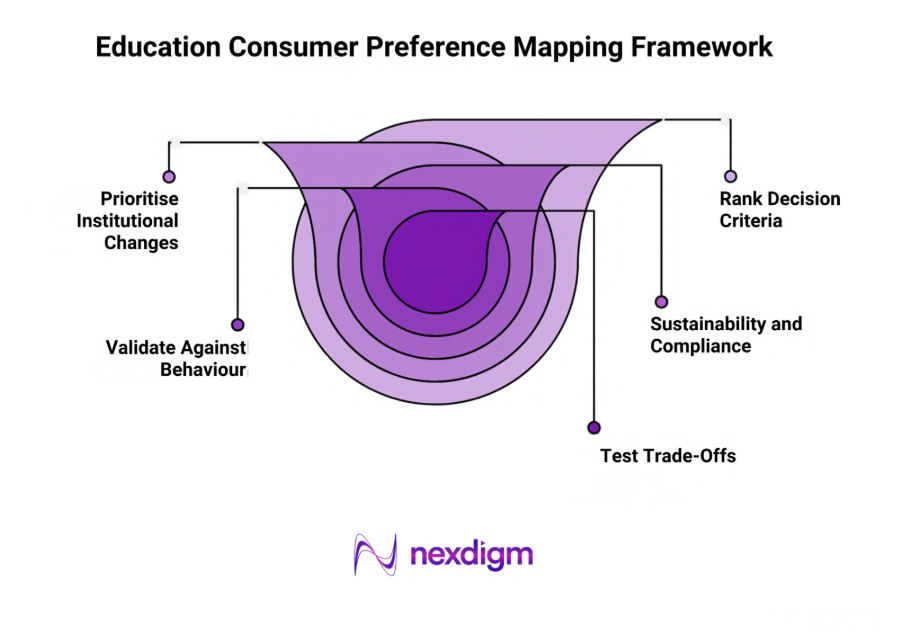
Education Consumer Preference Mapping Framework
The Education Consumer Choice Framework converts preference research into decisions about programmes, pricing and student experience.
- Define Student Segments: Separate applicants by programme, education stage, budget, geography and career objective.
- Rank Decision Criteria: Identify the factors that influence shortlisting, application and final acceptance.
- Test Trade-Offs: Compare student responses with realistic fee levels, delivery formats, travel requirements and competing offers.
- Validate Against Behaviour: Check survey findings against admissions data, campus visits, application completion and enrollment.
- Prioritise Institutional Changes: Invest in improvements that matter to target segments and can be delivered consistently.
The outcome should be a clear view of where the institution is competitive, where it loses applicants and which changes are likely to influence student choice. It should not become a list of every feature students say they want.
Nexdigm Case Study: Mapping Student Choice Factors
Nexdigm assessed preferences among prospective students considering 10 undergraduate and postgraduate programmes. Curriculum relevance and total cost were the strongest recurring decision factors, while location and internship access varied by student segment. The institution used the findings to revise programme communication and prioritise improvements to fee transparency and practical-learning information.
To take the next step, simply visit our Request a Consultation page and share your requirements with us.
Harsh Mittal
+91-8422857704