

Education demand is often measured through what families say they want. Spending behaviour can tell a different story.
India’s 2025 Comprehensive Modular Survey on Education, conducted across 52,085 households and 57,742 students, found that average household expenditure on school education was ₹7,111 per student. Course fees were the largest component, at ₹7,111, while urban households spent an average of ₹15,143 on course fees compared with ₹3,979 in rural areas.The survey also found that 27.0% of students were taking or had taken private coaching during the current academic year. The proportion was 30.7% in urban areas and 25.5% in rural areas.
Families Already Reveal Where Demand Exists
Household spending shows which education services have moved from preference to purchase. Course fees represent the largest education expenditure, but the surrounding spending categories also matter. Transportation, uniforms, textbooks and stationery all create recurring costs around the core education product. The urban-rural difference is particularly important because the same service can occupy very different portions of household budgets.
Private coaching provides another signal.
Nearly three in ten students in urban areas were taking or had taken private coaching during the current academic year. At the higher-secondary level, the national figure reached 37.8%, rising to 40.2% in urban areas.
This suggests that the strongest demand is often attached to a clearly understood academic problem.
Need Is Not Enough. The Buyer Has to Recognise It.
Families can have multiple education-related needs but prioritise only a few when deciding what to purchase.
Academic support may become urgent before an examination. Transport becomes valuable where commuting creates a practical constraint. Career counselling becomes more relevant at transition points. Digital learning may be attractive when it solves a specific access or subject problem.
The commercial opportunity depends on that trigger.
A service that families value but rarely purchase may have limited addressable demand. A less aspirational service that solves a recurring logistical or academic problem may support stronger and more predictable revenue.
Four Types of Education Demand
- Academic performance
Tutoring, test preparation, assessment and subject-specific support address performance gaps. Demand can become particularly strong around examinations or transition points. - Access and convenience
Transport, after-school care, hybrid learning and flexible scheduling respond to constraints on how education is accessed. - Career and transition decisions
Career counselling, aptitude assessment, admissions guidance and employability services become relevant when students move between educational stages. - Skills and enrichment
Language learning, coding, arts, sports and other supplementary programmes can attract demand where families perceive a clear developmental or career benefit.
The important distinction is between services that are broadly desirable and services for which households demonstrate a recurring willingness to spend.
Geography Changes What Families Need
The 2025 household survey demonstrates how sharply education expenditure differs between urban and rural households. Average course-fee expenditure in urban areas was almost four times the rural figure.
That difference can reflect variations in school type, household income, access and local education markets.
A service that works commercially in an affluent urban catchment may therefore require a different price, delivery model or distribution channel in a smaller city or rural market.
This is where demand assessment needs to become market assessment.
Turning Household Need Into a Commercial Opportunity
For companies considering education demand assessment consulting, the objective is to establish which needs are sufficiently important, frequent and affordable to support a viable service proposition.
Nexdigm’s Need-to-Demand Framework
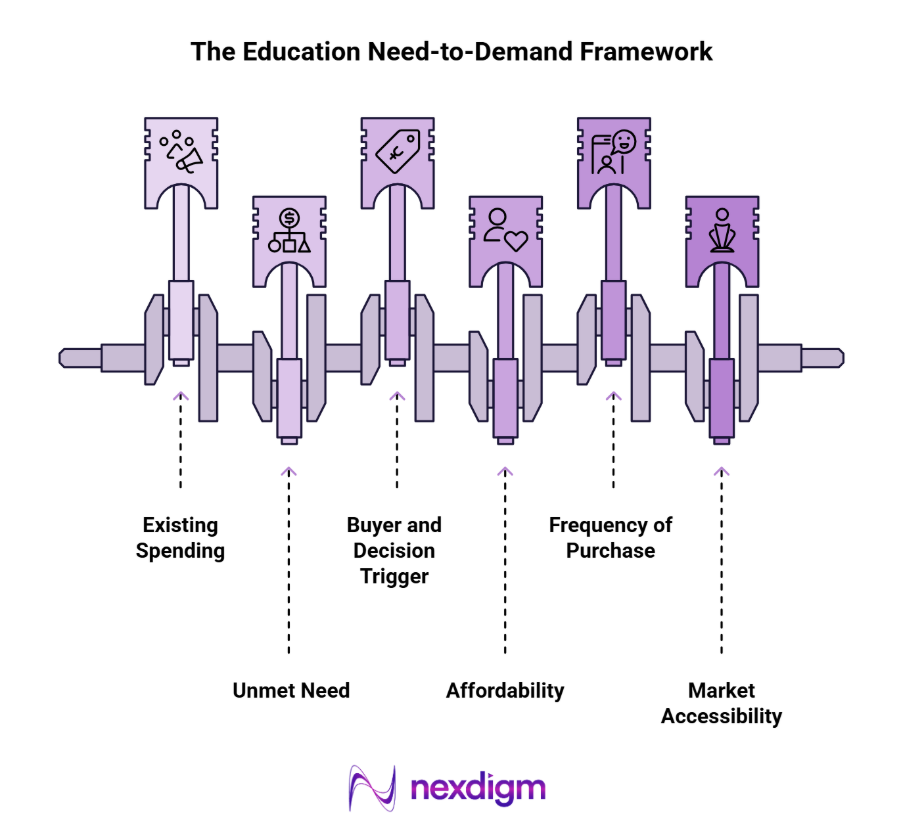
- Existing Spending
Assess current household expenditure across tutoring, test preparation, enrichment, counselling, digital learning, and other education services to establish where proven consumer demand already exists. - Unmet Need
Identify gaps in existing education provision, including underserved subjects, access constraints, service-quality issues, scheduling limitations, and needs that current providers do not adequately address. - Buyer and Decision Trigger
Determine who influences, approves, and pays for the purchase, and identify the events or circumstances that convert an underlying need into an actual buying decision. - Affordability
Evaluate willingness to pay against household income, existing education expenditure, price sensitivity, and competing spending priorities to determine commercially viable price points. - Frequency of Purchase
Assess purchase frequency, renewal behaviour, programme duration, and customer retention to distinguish recurring revenue opportunities from one-time or episodic demand. - Market Accessibility
Evaluate how effectively target customers can be reached through schools, institutions, digital platforms, physical locations, partnerships, referrals, and other distribution channels, while considering the cost and scalability of each route.
Nexdigm Finding the Spend Behind the Stated Need
An education-services provider surveyed 1,200 households across urban and peri-urban markets. While 64% expressed interest in weekend enrichment programmes, willingness to pay was concentrated around academic support priced below ₹1,000 per month. The provider redirected its initial service mix toward recurring exam-support programmes. Education demand is therefore better understood through the intersection of need, spending and purchasing behaviour. Families may express interest in many services, but the commercially relevant opportunity lies where the problem is sufficiently important to justify payment.
Nexdigm can support education providers and investors through household research, demand sizing, willingness-to-pay analysis, segmentation and market-entry feasibility assessment.
To take the next step, simply visit our Request a Consultation page and share your requirements with us.
Harsh Mittal
+91-8422857704