

Expansion can mean very different things for an education provider. A university may be considering a new campus, a school group may be evaluating a new city, and a training company may be deciding whether to launch a specialised programme online. Each option offers a different balance of market reach, investment, operating complexity and risk.
The best route is not necessarily the one that adds the most seats. It is the one that serves a credible source of demand without committing more capital or capacity than the market can support.
New Campus, New Programme or Digital Delivery?
A new campus can create access to a fresh catchment and strengthen the institution’s local presence. It also requires significant upfront expenditure on land, construction, approvals, faculty, equipment and student services. Enrollment may take several years to reach the level needed to support those costs.
Programme expansion often offers a more targeted route. An existing institution can introduce a new course or specialisation using some of its current infrastructure. The opportunity depends on faculty availability, regulatory approvals, curriculum relevance and whether prospective students see a meaningful difference from competing programmes.
Digital and blended delivery can extend reach beyond a physical campus. It may reduce the need for additional classrooms, but it does not eliminate the costs of course development, technology, learner support, assessment or student acquisition. A digital programme that attracts registrations but struggles with completion is not necessarily a scalable business.
These options should be compared as competing investment choices, not treated as interchangeable forms of growth.
What the Education Market Data Means for Expansion
India’s higher education enrollment reached 4.50 crore in 2023–24, according to the Ministry of Education. The gross enrollment ratio for the 18–23 age group reached 30%, compared with 23.7% in 2014–15. This suggests a larger higher education market over time, but the national figures conceal differences in local demand and programme supply.
School education offers a caution against assuming that more capacity will always be absorbed. NITI Aayog’s 2026 analysis found that school enrollment fell from 26.95 crore in 2014–15 to 24.69 crore in 2024–25. It also identified significant differences across states in enrollment indicators and educational continuity.
The implication for expansion planning is straightforward: a provider needs location-specific and programme-specific evidence. A growing urban catchment may support a new campus, while a district with declining school-age enrollment may require consolidation, differentiated offerings or investment in student retention rather than more seats.
Education Expansion Strategy Assessment: The Evidence Behind the Decision
An Education expansion strategy assessment should examine the full route from market entry to stable operations.
Start with the target student population and identify which learners the provider can realistically attract. Then examine competing institutions, fee levels, transport and housing, faculty availability, infrastructure requirements and the time needed to secure approvals.
The financial model should distinguish between capital expenditure and recurring operating costs. A new campus can look viable when judged only on construction cost per seat, yet become unattractive once faculty salaries, maintenance, marketing, utilities and low initial utilization are included.
Expansion decisions also benefit from explicit scenarios. A conservative case should account for slower admissions, higher costs or delayed launch. The expected case should use evidence from comparable programmes or locations. An upside case can test the value of stronger conversion, additional partnerships or higher capacity utilisation. These scenarios are more useful than a single forecast that assumes every operational milestone goes to plan.
Education Expansion Prioritisation Framework
The Education Expansion Feasibility Framework helps compare different growth routes on a common basis.
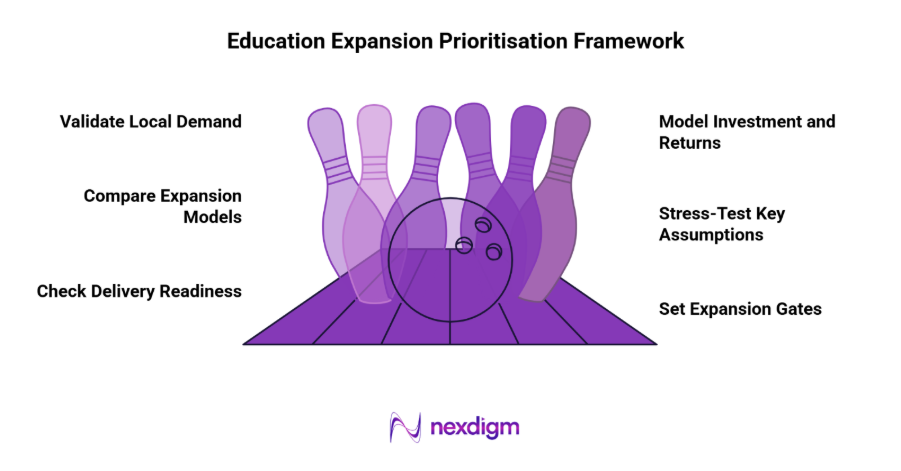
- Validate Local Demand: Estimate reachable students, programme preferences, affordability and likely enrollment.
- Compare Expansion Models: Assess new campuses, additional programmes, partnerships, blended delivery and online provision.
- Check Delivery Readiness: Review faculty, facilities, approvals, technology and student support requirements.
- Model Investment and Returns: Estimate capital needs, operating costs, utilization, revenue ramp-up and break-even timing.
- Stress-Test Key Assumptions: Examine slower enrollment, cost escalation, competitive responses and implementation delays.
- Set Expansion Gates: Tie further investment to evidence such as confirmed demand, approvals, launch readiness and enrollment conversion.
The framework also helps identify when expansion should be phased. A provider may begin with a limited programme portfolio, use shared facilities or establish employer partnerships before committing to a larger footprint.
Nexdigm Case Study: Selecting an Expansion Route
Nexdigm compared three expansion options for an education provider: a new campus, a specialist programme at existing facilities and a blended delivery model. The assessment found that the new campus required the highest initial investment and the longest enrollment ramp-up. The provider prioritised programme expansion and blended delivery before reconsidering physical expansion.
To take the next step, simply visit our Request a Consultation page and share your requirements with us.
Harsh Mittal
+91-8422857704