

India’s school education system serves a vast and diverse student population. In 2024–25, the country recorded 24.69 crore students across 14.71 lakh schools, with private schools accounting for 41% of students and government schools representing 49%. This scale creates continuing requirements for classrooms, laboratories, libraries, sports facilities, digital infrastructure, and other learning spaces.
Yet infrastructure requirements are not uniform across markets. Population growth, migration, new residential developments, changing school formats, curriculum requirements, and parent expectations can create different facility needs across catchments. An institution may also have significant physical infrastructure but limited utilization, making demand assessment important before further capital is committed.
A structured Education facility demand analysis can help education providers determine where capacity is likely to be required, which facilities the market values, and how infrastructure investments can be aligned with future enrollment.
How Enrollment Growth Shapes Facility Requirements
Growing enrollment can place pressure on classrooms and supporting infrastructure, while changes in curriculum and learning preferences can create demand for specialized facilities. New campuses may require comprehensive infrastructure planning, whereas established institutions may benefit more from targeted upgrades or better utilization of existing assets.
The challenge is to anticipate future requirements rather than respond only after capacity constraints emerge. This requires understanding student growth, catchment characteristics, existing supply, and the infrastructure offered by competing institutions.
From Classrooms to Complete Learning Environments
Education facilities increasingly extend beyond conventional classrooms. Laboratories, libraries, sports infrastructure, technology-enabled spaces, transportation, arts facilities, and collaborative learning areas can influence the attractiveness of an institution.
The right investment mix depends on the school format, student profile, curriculum, affordability, and competitive environment. Understanding these factors can help institutions avoid both under-investment and unnecessary infrastructure expenditure.
How Nexdigm Helps Translate Demand into Facility Planning
Nexdigm brings together education-sector research, catchment analysis, demand forecasting, competitive benchmarking, capacity assessment, and strategic advisory to help institutions evaluate future infrastructure requirements.
Its approach looks beyond current enrollment to assess demographic growth, emerging student demand, existing facility utilization, competing school infrastructure, parent expectations, and the requirements of different education models. This enables institutions to determine where infrastructure gaps may emerge and which investments are most closely aligned with future market demand.
For education providers planning new campuses, expanding existing institutions, or upgrading learning environments, Nexdigm conducts an an Education facility demand analysis that provides a market-led basis for determining what to build, where to build it, how much capacity to create, and when investment should be made.
Nexdigm’s Education Facility Demand Analysis
Nexdigm’s Education facility demand analysis connects projected enrollment with campus requirements, competitive infrastructure, catchment characteristics, and investment priorities. Its assessment can include:
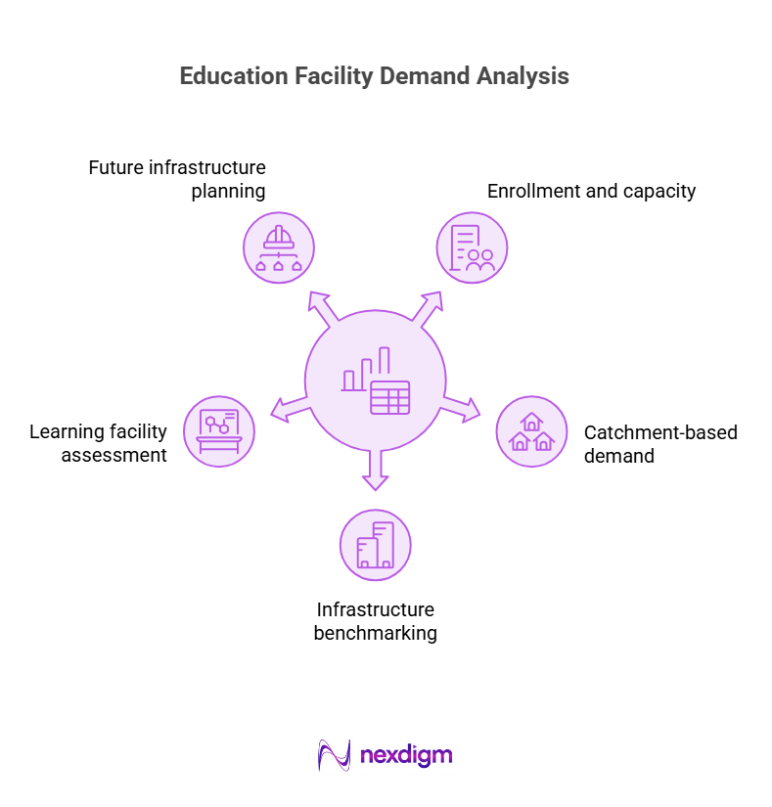
- Enrollment and Capacity Forecasting: Evaluation of current enrollment, grade-wise demand, demographic trends, and projected student populations to estimate future classroom and campus capacity requirements.
- Catchment-Based Demand Assessment: Nexdigm analyzes household concentration, population growth, residential development, accessibility, and student demographics to identify locations where additional education infrastructure may be required.
- Infrastructure Benchmarking: Comparison of competing institutions across classrooms, laboratories, libraries, sports facilities, technology infrastructure, transport, and other amenities to identify market expectations and potential infrastructure gaps.
- Learning Facility Assessment: Considering curriculum requirements, student segments, parent preferences, and emerging education models to determine which specialized or technology-enabled facilities can strengthen an institution’s proposition.
- Future Infrastructure Planning: Nexdigm combines enrollment projections, competitive supply, demographic trends, and institutional plans to determine the scale and timing of future infrastructure requirements.
Together, these dimensions help institutions move from a broad estimate of student growth to a clearer view of what facilities are required, where they are needed, and when investment should occur.
Nexdigm’s Analysis Converting Facility Demand into Infrastructure Strategy
Nexdigm helps education providers translate market demand into practical infrastructure strategies, connecting enrollment projections, catchment dynamics, facility requirements, and investment considerations.
- Build: Nexdigm identifies markets where projected enrollment growth and capacity gaps indicate potential requirements for new campuses and supporting infrastructure.
- Expand: Evaluation of existing institutions to determine whether rising enrollment and catchment demand justify additional classrooms, facilities, or student capacity.
- Upgrade: Nexdigm benchmarks existing facilities against competitors and parent expectations to identify infrastructure upgrades that can improve institutional positioning and market relevance.
- Phase: Aignment of infrastructure development with projected enrollment growth, helping institutions sequence investments and reduce the risk of creating excess capacity.
- Optimize: Nexdigm assesses existing facility utilization to identify underused assets, bottlenecks, and opportunities to improve capacity before undertaking additional capital expenditure.
This approach helps institutions build infrastructure around demonstrated and projected market need, rather than relying solely on current enrollment or standardized facility assumptions.
Nexdigm’s Case
Nexdigm supported an education stakeholder evaluating expansion across 9 potential catchments. Its assessment narrowed the opportunity to 3 priority markets, while evaluating 7 school-format options. The findings helped the client focus infrastructure and expansion planning on markets with stronger student demand, capacity gaps, and competitive potential.
To take the next step, simply visit our Request a Consultation page and share your requirements with us.
Harsh Mittal
+91-8422857704