

Education is financed through a combination of public expenditure, household spending, institutional revenues, scholarships, education loans, philanthropy, and private investment. In India, the scale of the education system creates a substantial funding requirement: more than 260 million students are enrolled across school and higher education, supported by over 1.5 million schools and 43,000 higher education institutions.
Funding patterns also vary significantly by education segment and household. Government spending remains critical to access and infrastructure, while tuition and other household expenditure play a major role in private education. Scholarships and loans can expand access to higher-cost programs, while private capital increasingly supports EdTech, education infrastructure, vocational training, and new institutional models.
For education providers, investors, policymakers, and financial institutions, an Education funding market assessment can help map the flow of capital, identify funding gaps, understand affordability constraints, and evaluate where funding models can support sustainable education-market growth.
Why Education Funding Is Becoming a Strategic Market Question
The availability of funding can directly influence who can access education, which institutions can expand, and which education models can scale. Public investment may strengthen infrastructure and access, while tuition revenues support institutional operations. Scholarships and loans can reduce affordability barriers, and private capital can accelerate technology adoption, capacity expansion, and new education ventures. Understanding how these funding sources interact is therefore essential for assessing both education access and commercial opportunity.
Funding Gaps Can Shape Market Opportunity
Strong student demand does not always translate into enrollment when families cannot afford tuition, accommodation, transportation, or other education costs. Similarly, institutions may identify expansion opportunities but face capital constraints when developing campuses, technology infrastructure, or new programs. Recent affordability research highlights this distinction: average household expenditure per student on school course fees was ₹15,143 in urban areas compared with ₹3,979 in rural areas.
How Nexdigm’s Supports Education Funding Concept
Nexdigm combines education-sector research, affordability analysis, market intelligence, competitive benchmarking, investment research, and strategic advisory to understand the financial forces shaping education markets.
Its Education funding market assessment examines public and private education expenditure, household spending, institutional models, private investment, EdTech funding, and the economics of different education segments.
Nexdigm’s research also identifies rising private investment and policy support as structural factors contributing to education-market development. This allows stakeholders to assess funding as a factor influencing access, enrollment, institutional growth, affordability, and market sustainability.
Nexdigm’s Education Funding Market Assessment
Nexdigm’s Education funding market assessment examines the funding ecosystem from both demand and supply perspectives. The following areas are being focused during the process:
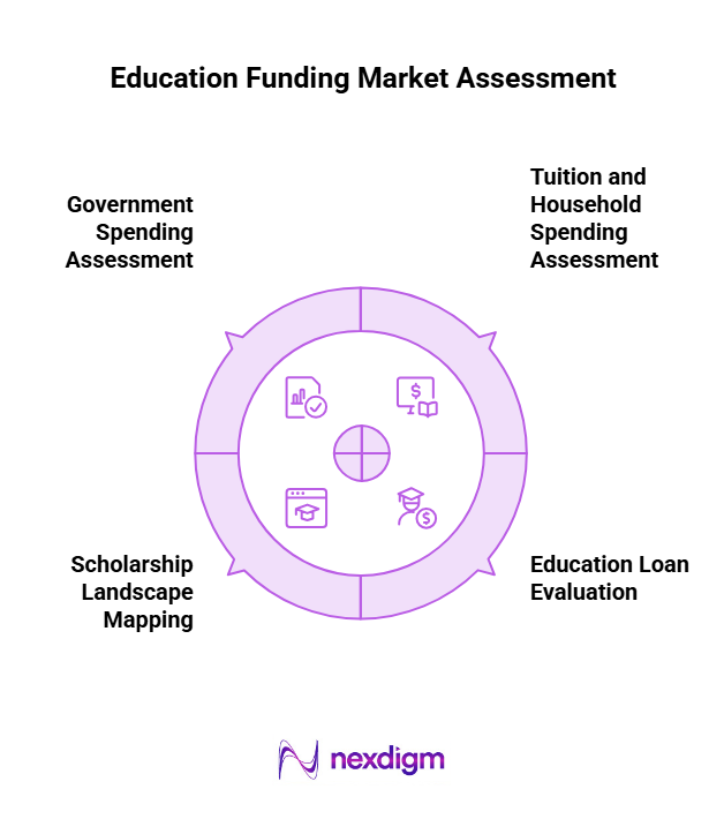
- Government Spending: Nexdigm evaluates public education expenditure, government schemes, infrastructure programs, and policy priorities to understand where public funding is being directed and where gaps may remain.
- Tuition and Household Spending: Assessment of fee levels, household education expenditure, affordability, and willingness to pay to determine which education opportunities are financially accessible across different student segments.
- Scholarship Landscape: Mapping of scholarships, grants, fee waivers, and institutional aid to understand how financial assistance influences access, student choice, and enrollment conversion.
- Education Loans: Evaluation of loan availability, financing requirements, repayment considerations, and borrower segments to understand how education credit can expand access to higher-cost programs.
These dimensions provide a structured view of where education funding originates, who receives it, where gaps exist, and how funding availability can influence market growth.
Nexdigm’s Assessment in Turning Funding Gaps to Sustainable Education Models
Nexdigm’s assessment help stakeholders move from understanding funding availability to designing education models that balance learner affordability, institutional sustainability, and investment potential. It helps them with:
- Identifying Funding Gaps: Nexdigm maps where affordability constraints or limited capital may prevent students from accessing education or institutions from expanding capacity.
- Evaluating Funding Options: Nexdigm compares tuition, scholarships, education loans, government support, employer sponsorship, and private capital to determine which mechanisms best address specific market needs.
- Structure Sustainable Models: Nexdigm assesses how different funding combinations can balance student affordability with institutional revenues, operating costs, and long-term financial sustainability.
- Prioritizing Opportunities: Nexdigm ranks education segments and markets based on demand, affordability, funding availability, competitive conditions, and growth potential to guide investment priorities.
This approach enables stakeholders to move beyond funding availability towards building education models that are accessible, financially sustainable, and scalable. It also enables institutions, investors, and policymakers to prioritize opportunities that support long-term learner outcomes, business viability, and sector growth.
Nexdigm’s Case
Nexdigm supported a private university network assessing affordability across five programs and multiple campuses. Price-sensitivity modelling indicated that tuition restructuring and curriculum changes could improve enrollment conversion by 19%, while revised program positioning increased student satisfaction by 23%. The findings helped connect student demand with realistic funding and pricing considerations.
To take the next step, simply visit our Request a Consultation page and share your requirements with us.
Harsh Mittal
+91-8422857704