

Education system in India operates at substantial scale, with 24.69 crore students across 14.71 lakh schools in 2024–25. Private schools account for 41% of students, creating significant demand for additional and upgraded education infrastructure across established urban centers, expanding suburban catchments, and emerging education markets.
However, infrastructure investment cannot be based on student population alone. The attractiveness of a location depends on demographic growth, household affordability, existing institutional capacity, accessibility, competitive supply, and the ability of a proposed campus to achieve sustainable utilization.
For education groups, infrastructure developers, school operators, and investors, an Education infrastructure development assessment can help identify where new capacity is required, what type of infrastructure the market can support, and whether the underlying opportunity justifies investment.
Understanding Infrastructure Readiness Before Expansion
Establishing new education infrastructure requires more than identifying areas with large student populations. Market success depends on demand sustainability, catchment quality, accessibility, affordability, competitive intensity, and existing institutional capacity. A structured assessment helps determine where new infrastructure can achieve strong utilization, long-term viability, and sustainable returns.
Assessing Market Conditions for Education Infrastructure Development
Infrastructure investments are most successful when supported by a clear understanding of market fundamentals and growth potential.
- Demand Sustainability Analysis: Review demographic growth and enrollment trends to determine whether future student demand can support new capacity.
- Catchment and Accessibility Assessment: Evaluate the reach of potential student populations and ease of access to understand enrollment viability.
- Capacity and Investment Alignment: Analyze existing infrastructure availability alongside market requirements to identify commercially viable development opportunities.
A comprehensive market evaluation helps align infrastructure expansion plans with sustainable demand and long-term investment objectives.
Leveraging Nexdigm’s Market Intelligence for Infrastructure Decisions
Education infrastructure investments require a clear understanding of market dynamics, demand potential, competitive conditions, and long-term growth prospects. Making informed decisions requires moving beyond assumptions and evaluating opportunities through a structured, data-driven lens.
Leveraging its industry-focused research, Education infrastructure development assessment and advisory expertise, Nexdigm helps stakeholders assess where infrastructure demand exists, how markets are evolving, and which opportunities are best positioned for sustainable success.
By combining market insights with strategic analysis, Nexdigm helps education stakeholders make infrastructure decisions that are aligned with both current market realities and future growth opportunities.
Nexdigm’s Education Infrastructure Development Assessment
As education markets become increasingly diverse and competitive, identifying the right locations for infrastructure investments requires more than evaluating student demand alone. Nexdigm helps education stakeholders make informed infrastructure development decisions through:
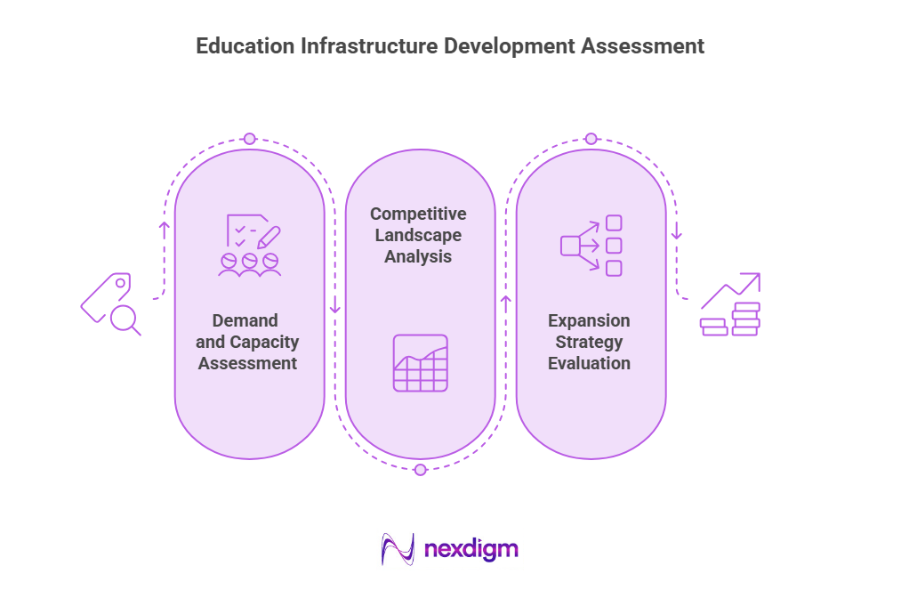
- Demand, Catchment, and Capacity Assessment: Evaluating student demand patterns, catchment characteristics, existing institutional capacity, and enrollment potential to identify markets that can support new education infrastructure.
- Education Market and Competitive Landscape Analysis: Assessing existing schools, fee positioning, market saturation, infrastructure gaps, and competitive dynamics to understand the attractiveness of potential locations.
- Investment Viability and Expansion Strategy Evaluation: Analyzing affordability, accessibility, utilization potential, and long-term market fundamentals to support sustainable infrastructure planning and capital allocation decisions.
Through this Assessment, Nexdigm helps education groups, developers, operators, and investors identify viable expansion opportunities and develop infrastructure strategies aligned with market demand, capacity requirements, and long-term growth potential.
Nexdigm’s Assessment Insights for Education Infrastructure Expansion
An education infrastructure assessment provides clarity on where opportunities exist, but long-term success depends on how institutions translate those insights into expansion strategies. Education stakeholders must balance market demand, capacity requirements, investment priorities, and future growth objectives to develop expansion plans that remain sustainable as market conditions evolve.
- Prioritizing High-Potential Markets: Focus expansion efforts on locations where demand growth, catchment strength, and infrastructure gaps support long-term enrollment sustainability.
- Aligning Capacity with Market Needs: Define the scale, institution format, and infrastructure requirements needed to meet projected demand without creating excess capacity.
- Creating Long-Term Growth Pathways: Develop phased expansion strategies that balance immediate opportunities with future market developments and evolving education requirements.
- Optimizing Infrastructure Investment Priorities: Evaluate capital requirements, market attractiveness, and expansion risks to prioritize investments and allocate resources across the most viable opportunities.
A well-defined expansion roadmap helps education stakeholders convert market insights into sustainable growth strategies, supporting infrastructure investments that deliver long-term educational and commercial value.
Nexdigm’s Case
Nexdigm supported a leading UK-based educational institute assessing India’s international K-12 opportunity. The study found the segment expanding at a 14% CAGR, identified metropolitan markets with high school concentration, and assessed 25+ ecosystem stakeholders. The findings helped the client formulate its India market-entry strategy.
To take the next step, simply visit our Request a Consultation page and share your requirements with us.
Harsh Mittal
+91-8422857704