

An institution can have enough classrooms on paper and still lack the capacity to deliver a good education. Laboratories may be oversubscribed, hostels may be full, internet access may be unreliable and specialist equipment may be unavailable when students need it. Infrastructure gaps are often less about the total size of a campus than about whether the right facilities are available in the right places.
This distinction matters for schools, colleges, universities and education investors. Building additional capacity is expensive. Before committing capital, decision-makers need to establish where existing infrastructure constrains access, learning quality or enrollment growth.
Education Infrastructure Gaps Across India
India’s education system combines a vast school network with a large and expanding higher education sector. UDISE+ 2024–25 recorded approximately 14.71 lakh schools and more than 1 crore teachers. The Ministry of Education’s AISHE 2023–24 reported higher education enrollment of 4.50 crore students. These figures demonstrate the scale of the system, but national totals can obscure sharp differences in infrastructure between states, districts and institutions.
Digital access is one example. UDISE+ reported internet facilities in 63.5% of schools in 2024–25. That means connectivity remains a constraint for a substantial share of schools, even as digital learning tools become more common. Infrastructure planning must account for the quality and reliability of access, not merely whether a connection has been reported.
Physical facilities present a separate challenge. Functional toilets, safe drinking water, accessible classrooms, libraries, science laboratories, workshops and sports areas affect the day-to-day student experience. Higher education institutions may face different pressures, including hostel capacity, research equipment, clinical training facilities and specialist laboratories.
Where Capacity Gaps Become Most Visible
Infrastructure pressure usually appears through operational symptoms before it becomes an obvious enrollment problem.
- Overcrowded teaching spaces: Timetables become difficult to manage, practical sessions are shortened or students receive less access to faculty.
- Insufficient student accommodation: Students face long commutes, higher living costs or difficulty accepting places away from home.
- Limited specialist facilities: Laboratories, workshops, libraries or clinical placements cannot support the planned intake.
- Uneven digital infrastructure: Slow connectivity, insufficient devices and unreliable learning systems restrict access to course material.
- Accessibility and basic services: Inadequate ramps, sanitation, lighting, water or safe common spaces can exclude students or compromise the learning environment.
The same symptom can have different causes. A full laboratory may indicate that additional capacity is needed, but it could also reflect poor scheduling or equipment downtime. A hostel shortage may justify construction, but transport improvements or partnerships with nearby accommodation providers could relieve some pressure at lower cost.
Education Infrastructure Market Assessment: Matching Assets to Demand
An Education infrastructure market assessment should compare actual student demand with the capacity that can be used reliably. Counting seats, rooms or devices is only the starting point. The assessment needs to establish utilisation, condition, accessibility, maintenance requirements and the effect of each constraint on student access.
Location is important. A school may have adequate facilities but remain difficult to reach for students in nearby villages. A university may attract applicants from several states but lack accommodation that makes relocation affordable. Infrastructure investments can improve access, yet the benefit depends on who can use the asset and whether recurring operating costs are funded.
Planning should also distinguish between new construction and rehabilitation. Repairing a roof, restoring a laboratory or improving connectivity may create usable capacity faster than building a new facility. Conversely, facilities operating near full utilisation with sustained unmet demand may require expansion.
Education Infrastructure Gap Assessment Framework
The Education Infrastructure Readiness Framework helps prioritise investments against service needs.
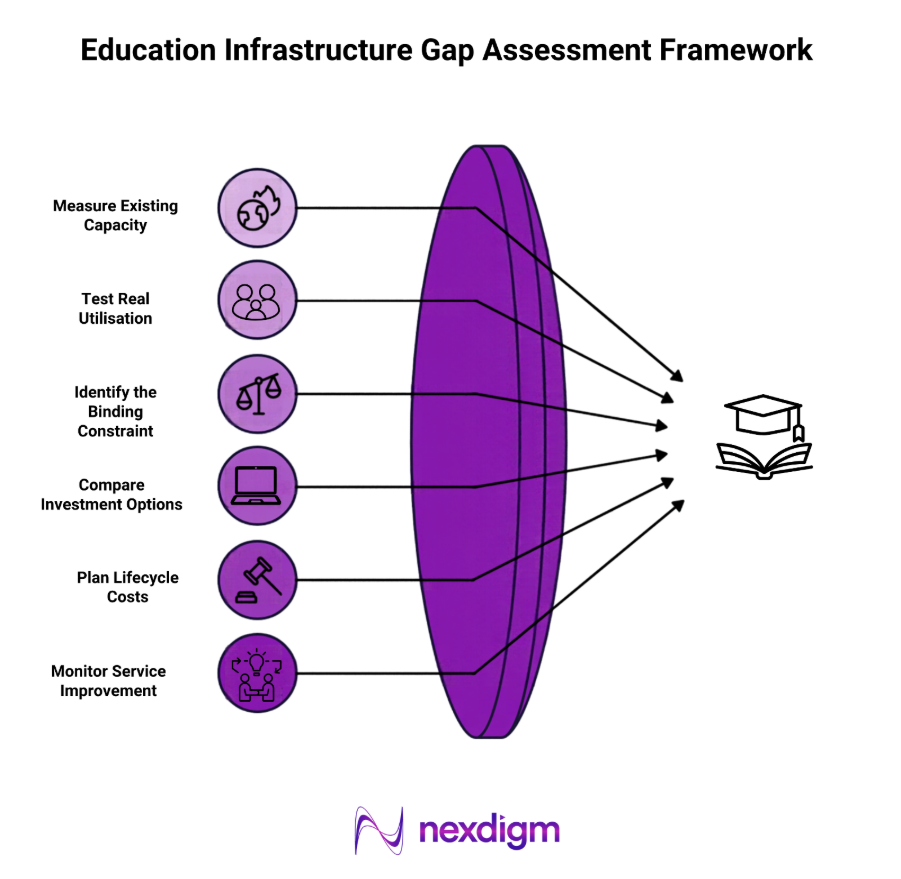
- Measure Existing Capacity: Inventory facilities, equipment, connectivity, condition and accessibility.
- Test Real Utilisation: Compare timetables, occupancy, downtime and peak-period demand.
- Identify the Binding Constraint: Determine which shortage most directly limits access or learning quality.
- Compare Investment Options: Assess repair, scheduling changes, shared facilities, leasing and new construction.
- Plan Lifecycle Costs: Include maintenance, utilities, staffing, replacement and future operating expenditure.
- Monitor Service Improvement: Track reduced congestion, improved access, facility uptime and student outcomes.
Nexdigm Case Study: Prioritising Infrastructure Investment
Nexdigm assessed infrastructure across nine academic departments at a higher education institution. The review identified capacity pressure in laboratory access, student accommodation and digital connectivity, but also found underused teaching space at selected times. The institution prioritised laboratory upgrades and connectivity improvements before committing to a larger construction programme.
To take the next step, simply visit our Request a Consultation page and share your requirements with us.
Harsh Mittal
+91-8422857704