

India’s school education system recorded 24.69 crore students across 14.71 lakh schools in 2024–25, according to Nexdigm’s K-12 market assessment research. Government schools represented 69% of schools and 49% of students, while private schools represented 26% of schools and 41% of students. These figures highlight the scale of capacity required across the education ecosystem.
However, total seats do not necessarily indicate adequate capacity. An institution may have substantial infrastructure but low utilization, while another may face classroom constraints, faculty shortages, or growing demand within its catchment. For education providers, investors, and policymakers, understanding the relationship between student demand and available institutional resources is therefore critical.
An Education institution capacity assessment can help evaluate whether seats, faculty, facilities, and operational resources are aligned with current and future student demand.
Evaluating Capacity Utilization and Growth Readiness
Institutional capacity is not defined solely by seat availability. Factors such as classroom utilization, faculty-to-student ratios, infrastructure adequacy, technology readiness, and operational efficiency influence an institution’s ability to support sustainable enrollment growth. Assessing these variables helps stakeholders understand whether existing resources can accommodate future demand while maintaining educational quality, student experience, and overall institutional performance.
Identifying Capacity Gaps and Expansion Opportunities
Student demand often develops unevenly across locations, academic programs, and demographic segments. As a result, some institutions experience underutilization while others face capacity constraints. A comprehensive assessment can identify seat shortages, faculty gaps, infrastructure limitations, and underserved markets. These insights help education providers prioritize investments, optimize resource allocation, and evaluate opportunities for expansion in high-potential locations.
Nexdigm Supporting Data-Driven Capacity Planning in Education
As education markets continue to evolve, institutions must balance enrollment growth with academic quality, infrastructure readiness, and operational efficiency. Nexdigm brings industry-focused experience in supporting education providers, investors, and stakeholders through data-driven market intelligence and strategic assessments. Through its Education institution capacity assessment, Nexdigm evaluates student demand, institutional resources, utilization patterns, and competitive dynamics to help organizations identify capacity gaps, prioritize investments, and develop sustainable growth strategies aligned with long-term market requirements.
The Need For Education Institution Capacity Assessment
As student demand, demographic patterns, and education preferences continue to evolve, institutions must ensure that their resources are sufficient to support both current and future enrollment requirements. Capacity imbalances can lead to overcrowding, underutilized infrastructure, faculty constraints, or missed growth opportunities. A structured Education institution capacity assessment provides a clearer understanding of how institutional resources align with market demand, enabling more informed planning, investment, and expansion decisions.
Nexdigm’s Education Institution Capacity Assessment
Nexdigm’s Education institution capacity assessment evaluates demand against institutional resources to identify capacity gaps, utilization opportunities, and requirements for sustainable expansion. The assessment can cover:
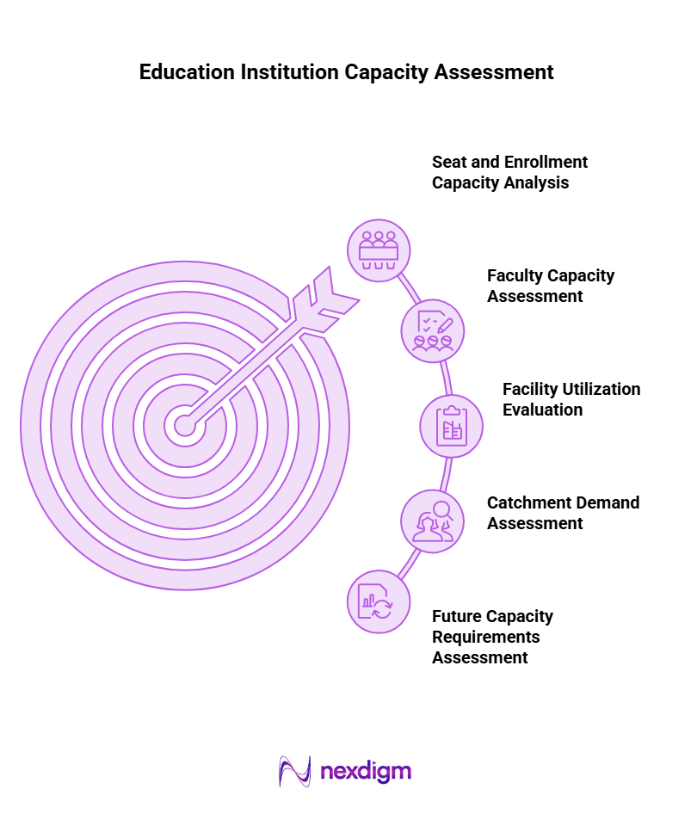
- Seat and Enrollment Capacity: Nexdigm compares sanctioned or available seats with current enrollment, grade-level demand, and projected student growth to identify capacity surpluses, shortages, and opportunities for expansion.
- Faculty Capacity: Nexdigm assesses faculty availability, student-to-teacher considerations, workload, staffing requirements, and future enrollment needs to determine whether teaching resources can support planned institutional growth.
- Facility Utilization: Nexdigm evaluates classrooms, laboratories, libraries, sports infrastructure, transport, and other facilities to understand utilization levels and identify infrastructure constraints affecting additional student intake.
- Catchment Demand: Nexdigm assesses school-age populations, household profiles, migration, affordability, and competing institutions to determine whether local student demand supports additional institutional capacity.
- Future Capacity Requirements:
Nexdigm combines demographic projections, enrollment trends, competitive supply, and institutional plans to estimate future capacity requirements and support phased expansion decisions.
These dimensions provide institutions with a structured view of whether their existing resources can meet demand and where targeted capacity improvements may be required.
Benefits of Nexdigm’s Capacity Assessment
Nexdigm’s assessment can translate institutional data and market intelligence into practical capacity decisions.
- Identify Capacity Gaps: Highlight locations, grades, or facilities where demand is likely to exceed available resources.
- Optimize Existing Assets: Identify underutilized classrooms, facilities, and institutional resources before committing to new infrastructure.
- Plan Faculty Requirements: Align staffing requirements with projected enrollment and planned capacity expansion.
- Improve Utilization: Evaluate current enrollment against available seats to identify opportunities for more efficient resource deployment.
- Prioritize Capital Investment: Determine which infrastructure investments are supported by underlying student demand and future enrollment potential.
These benefits help institutions understand whether capacity expansion is justified by demand and whether available resources can support sustainable enrollment. And also, assess capacity within the context of wider market and competitive dynamics.
Nexdigm’s Case
Nexdigm supported a leading UK-based educational institute evaluating its entry into India’s international K-12 market. The study involved 25+ ecosystem stakeholder interviews, assessment of programs for students aged 5–17, and analysis of schools, fees, curricula, business models, and regulatory requirements. The recommendations supported the client’s India market-entry strategy.
To take the next step, simply visit our Request a Consultation page and share your requirements with us.
Harsh Mittal
+91-8422857704