

A growing education market can attract investment without producing attractive returns for every provider. Institutions may add students while costs rise just as quickly. New campuses require substantial upfront capital, digital platforms need sustained learner engagement, and specialised programmes depend on qualified faculty and equipment. Growth becomes commercially meaningful when the delivery model can expand without compromising quality or financial viability.
Investors and education operators therefore need to assess more than enrollment trends. They must understand which parts of the market have durable demand, how revenue is generated and what prevents a successful model from being replicated.
Where Education Investment Opportunities Are Emerging
India’s higher education enrollment reached 4.50 crore in 2023–24, up from 3.42 crore in 2014–15, according to AISHE. Female enrollment reached 2.24 crore in 2023–24, reflecting wider participation over the period. These figures establish the size and long-term expansion of the sector, but they do not determine the commercial potential of a particular business.
Investment opportunities need to be examined at the level of the service and its customer. Potential areas include specialised vocational programmes, employer-linked training, education technology, student housing, assessment services, academic support and infrastructure that addresses a documented capacity constraint.
Each has a different economic profile. A digital product may reach more users without constructing additional classrooms, but customer acquisition, content development, technology maintenance and retention can limit profitability. A physical institution may have more predictable tuition revenue but face high fixed costs and a slower path to capacity utilisation.
What Separates Scalable Education Models From Expensive Growth?
A scalable model has a repeatable way to attract students, deliver a credible educational experience and generate enough revenue to support continued operations. It does not simply add enrollment.
Five commercial questions help distinguish the stronger opportunities:
- Is demand durable? Look for recurring student or employer needs rather than temporary interest driven by a trend.
- Can the offer be differentiated? A recognised qualification, strong employer relationships, specialised instruction or superior student support may be harder to replicate than a broad course catalogue.
- Do unit economics improve with scale? Examine revenue and delivery cost per student, acquisition cost, utilisation and the additional resources needed for each new cohort.
- Can quality be maintained? Growth may require more faculty, student support, assessment capacity or facilities, even when the business is digitally delivered.
- Are outcomes credible? Completion, progression, placement and employer feedback can support trust, provided claims are measured consistently and transparently.
The critical issue is the relationship between growth and delivery cost. If each additional student requires a proportionate increase in expensive resources, scale may improve total revenue without materially improving margins. If a model relies on under-resourced teaching or overstated outcomes, apparent efficiency can create reputational and regulatory risk.
Education Investment Opportunity Study: Evaluating Commercial Potential
An Education investment opportunity study should connect market demand with the practical ability to capture it. National enrollment figures can establish context, but an investment decision requires a defined customer segment, a realistic catchment or distribution channel, and evidence that customers will pay.
The analysis should compare alternatives. A provider may be able to serve a market through a new campus, a partnership with an existing institution, a digital programme or a hybrid delivery model. The lowest-capital option is not automatically best; it must still meet quality, regulatory and customer expectations.
Investment timing matters. New campuses and specialist facilities can require lengthy approvals and construction. Digital services may launch faster but still need time to build trust, secure institutional contracts and demonstrate retention. Financial projections should reflect these differences instead of assuming immediate demand capture.
Education Investment Prioritisation Framework
The Education Investment Opportunity Framework helps screen opportunities before committing substantial capital.
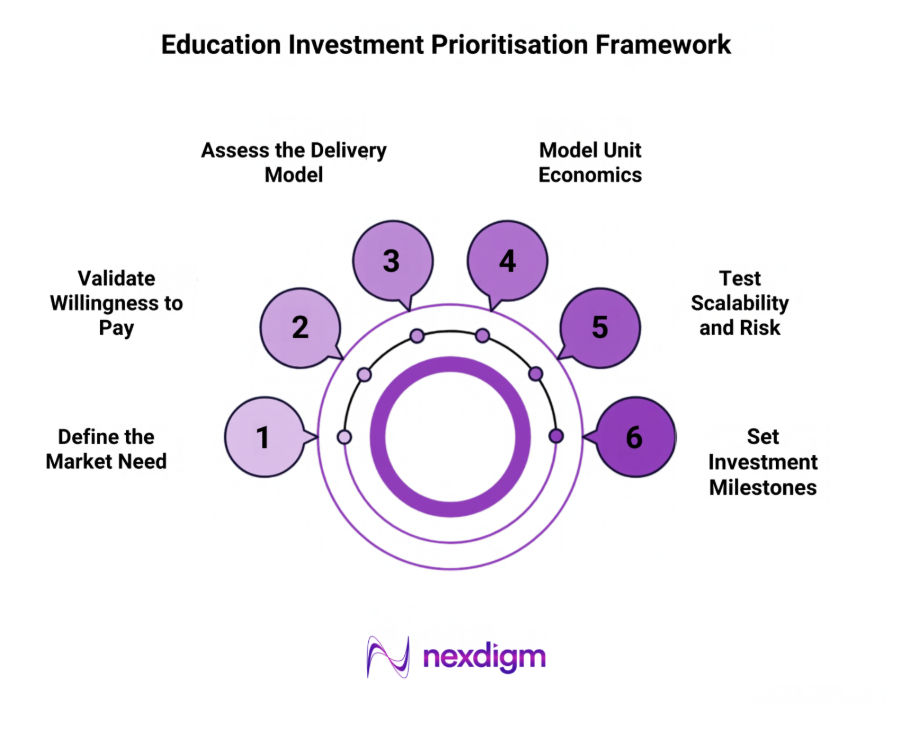
- Define the Market Need: Identify the learner or institutional problem, target segment, catchment and alternatives already available.
- Validate Willingness to Pay: Test fees, procurement budgets, demand persistence and the strength of competing offers.
- Assess the Delivery Model: Determine the faculty, technology, facilities, partnerships and regulatory conditions required to serve customers.
- Model Unit Economics: Estimate acquisition cost, revenue per learner, delivery cost, capacity utilisation and the funding required during ramp-up.
- Test Scalability and Risk: Examine whether quality, margins and outcomes can be maintained as enrollment grows.
- Set Investment Milestones: Link further spending to evidence such as enrollment conversion, completion, renewals and operational performance.
The strongest opportunity is not necessarily the largest market. It is the one where demand, differentiation, delivery capability and financial returns reinforce one another.
Nexdigm Case Study: Screening Education Investment Options
Nexdigm evaluated 15 education investment opportunities across digital learning, vocational training, student services and physical infrastructure. Five advanced to detailed assessment, while three met the initial criteria for demand visibility, feasible delivery and scalable economics. Investment was prioritised for two opportunities with lower initial capital requirements and identifiable institutional or employer buyers.
To take the next step, simply visit our Request a Consultation page and share your requirements with us.
Harsh Mittal
+91-8422857704