

Education demand is often measured through enrolment. For an institution deciding whether to enter, expand or launch a new offering, enrolment is only the starting point.
India’s school system covered 24.69 crore students across 14.71 lakh schools in 2024–25, with private schools accounting for 41% of students and 26% of schools. The scale is substantial, but the distribution of demand across geographies, income groups, institution types and educational stages is far from uniform.
Higher education adds another layer. AISHE 2023–24 recorded 4.50 crore students, with a gross enrolment ratio of 30.0 for the 18–23 age group. The system included 1,289 universities and 48,246 colleges.
For education providers, the relevant market is therefore defined by more than the number of potential students.
Demand Has Several Layers
A market assessment needs to distinguish between people who could theoretically use an education service and those who can realistically become customers.
For a school, this may mean analysing children within a defined catchment, household affordability, competing schools and available seats. For a university, the relevant population may be narrower still, depending on programme, academic eligibility, geography and fee levels.
The same distinction applies to education products and services. A tutoring provider, vocational institution or digital-learning company may address a specific student segment rather than the entire education population.
This makes segmentation central to market sizing.
The Education Market Can Be Read Through Five Questions
- Who is the learner?
Age, academic stage, location, household profile and educational needs define the addressable population. - Who pays?
Parents, students, employers, governments and institutions may all represent different customer groups, with different willingness and ability to pay. - What alternatives already exist?
Existing schools, colleges, coaching providers, online platforms and vocational institutions determine the competitive environment. - What does the customer value?
Academic outcomes, employability, convenience, affordability, infrastructure, reputation and programme relevance can influence purchasing decisions. - Can the model scale?
Faculty availability, infrastructure, technology, regulation and operating economics determine whether demand can be converted into sustainable institutional growth.
The answers will differ considerably by education segment.
Enrolment Growth Does Not Mean Every Market Is Growing Equally
The higher education system illustrates why aggregate growth requires further analysis. Total enrolment increased from 3.42 crore in 2014–15 to 4.50 crore in 2023–24, while GER rose from 23.7% to 30.0%.
At the same time, programme-level demand is uneven. Undergraduate students represented approximately 76.8% of higher-education enrolment in 2023–24, while STEM enrolment reached 1,01,88,988 students. Women accounted for approximately 44% of STEM enrolment.
For an institution planning expansion, these differences matter. A broad increase in higher-education participation does not automatically establish demand for a particular programme, campus or delivery model.
Affordability Can Redefine the Addressable Market
Student demand also needs to be considered alongside the economics of participation.
Two markets may have similar student populations but very different addressable demand if household income, fee tolerance, financing availability or competing low-cost alternatives differ.
This is particularly relevant for private education providers. In school education, private institutions serve 41% of students despite representing 26% of schools nationally.
The commercial opportunity therefore depends on the relationship between demand and purchasing capacity, not demand alone.
From Market Size to Institutional Strategy
For organisations evaluating education market assessment services, the objective is to translate student demand into decisions about where to operate, which segments to serve, what programmes to offer and how much capacity to build.
Nexdigm’s Education Market Assessment Approach
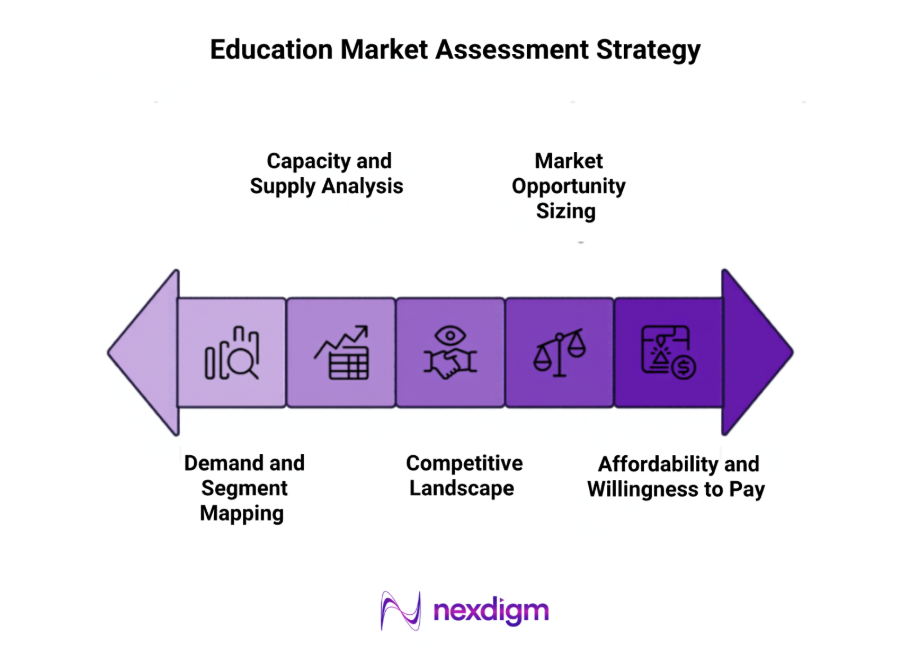
- Demand and Segment Mapping
Size the learner population by geography, age, academic stage, income and relevant customer characteristics. - Competitive Landscape
Map institutions, programmes, pricing, capacity and positioning to identify underserved or highly competitive segments. - Affordability and Willingness to Pay
Assess household economics, fee sensitivity and financing conditions to distinguish theoretical demand from commercially addressable demand. - Capacity and Supply Analysis
Assess existing seats, institutions, faculty and infrastructure to identify supply gaps and expansion opportunities. - Market Opportunity Sizing
Translate demand, competition, affordability and capacity into an addressable market estimate and institutional growth priorities.
Nexdigm’s Case Study: Turning Student Demand into a Market Decision
An education provider assessed three urban markets using student population, household affordability, competitor capacity and programme demand. Across three urban markets, evaluation of student demographics, affordability, competitor seat supply, and course demand revealed a clear winner: Market A showed a 22% capacity deficit against projected enrollment, whereas faster-growing Market B faced 40% higher competitor saturation.
Nexdigm can support education providers with market sizing, demand assessment, competitive analysis, affordability research and expansion feasibility studies.
To take the next step, simply visit our Request a Consultation page and share your requirements with us.
Harsh Mittal
+91-8422857704