

A large student population does not automatically make an education market attractive. A city may have thousands of prospective learners but limited ability to pay for a new programme. Another market may be smaller yet offer stronger demand for specialised courses, fewer credible competitors and a customer base willing to pay for better outcomes.
For education providers considering new programmes, locations or services, the useful question is not simply where education demand is growing. It is where demand can be converted into sustainable enrollment and revenue.
Education Market Growth: What the Latest Data Reveals
India’s higher education enrollment reached 4.50 crore students in 2023–24, up from 3.42 crore in 2014–15, according to the Ministry of Education’s All India Survey on Higher Education. The gross enrollment ratio for the 18–23 age group reached 30% in 2023–24, compared with 23.7% in 2014–15.
These figures indicate a larger higher education market over the decade. They do not establish that every state, discipline or institution has comparable growth potential. Demand depends on local demographics, programme availability, affordability, employment expectations and the number of competing seats.
School education presents a more complex picture. NITI Aayog’s 2026 analysis of UDISE+ data found that total school enrollment declined from 26.95 crore in 2014–15 to 24.69 crore in 2024–25. Over the same period, the share of enrollment in private unaided schools rose from 31.7% to 38.8%. This combination points to a market in which demographic pressure and changing institutional preferences can coexist.
For providers, national growth figures are a starting point. The investment decision requires a much more specific view of the target market.
Three Conditions That Make an Education Market Attractive
- Demand depth determines whether enough prospective students exist for a programme to operate at viable capacity. Relevant indicators include age-group demographics, school completion, progression into higher education, employer demand and unmet demand for particular qualifications.
- Affordability determines how much of that potential demand can become paying enrollment. Tuition is only one part of the cost. Transport, accommodation, devices, examination fees and the income a learner gives up while studying may all influence the decision. A market with strong interest but limited purchasing power may require scholarships, flexible payment options or a lower-cost delivery model.
- Competitive intensity shapes the cost of acquiring students and the price a provider can charge. The number of institutions matters, but so does their positioning. A district may contain many general-degree colleges and still lack specialised technical training, credible career services or flexible programmes for working adults.
These conditions should be considered together. High demand can be offset by severe competition, while low competition may simply indicate that a market cannot support the proposed offer.
Education Market Attractiveness Analysis: Comparing Opportunity and Risk
An Education market attractiveness analysis should compare specific combinations of geography, programme, student segment and delivery model rather than rank entire states using one headline indicator.
A useful comparison asks:
- How much demand is reachable? Estimate the eligible student population within a realistic catchment, then account for progression rates and programme preferences.
- What can learners afford? Compare household budgets, competing fees, scholarship availability and the full cost of participation.
- Who already serves the market? Map competitors by programme, capacity, price, reputation and outcomes.
- What differentiates the offer? Identify gaps in curriculum, flexibility, student support, employer connections or delivery quality.
- Can the economics work? Model enrollment ramp-up, acquisition costs, faculty requirements, operating expenses and break-even capacity.
The evidence may point towards an underserved district, a specialist programme in a competitive city or an online offer serving learners beyond a single location. The answer depends on the interaction between demand and the provider’s ability to serve it.
Education Market Attractiveness Framework
The Education Market Attractiveness Framework converts market research into a practical prioritisation process.
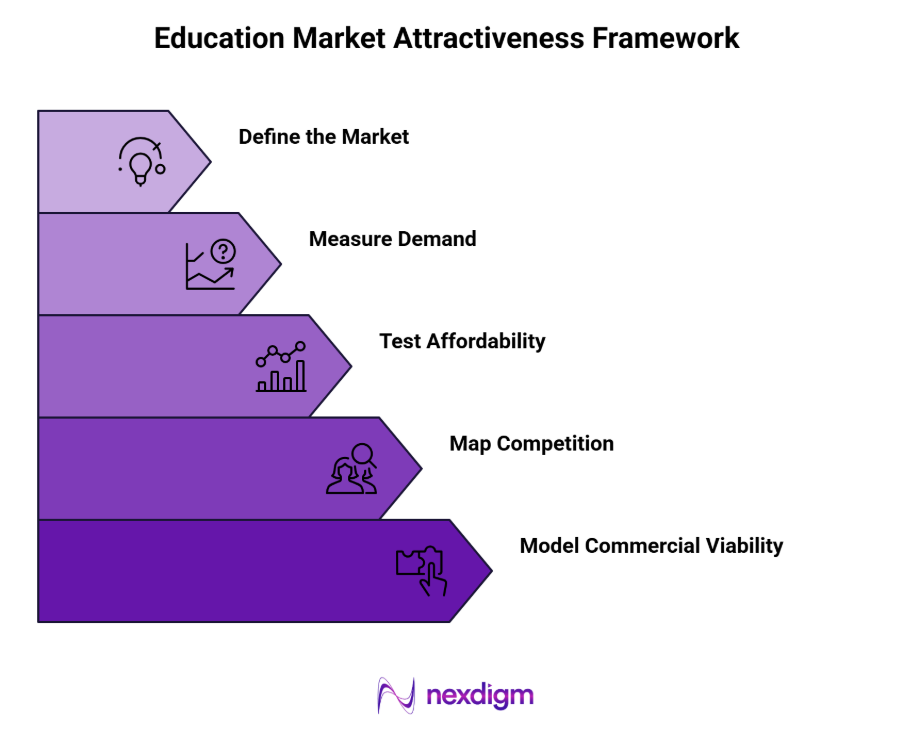
- Define the Market: Specify the learner segment, programme category, geography and delivery model.
- Measure Demand: Estimate eligible learners, progression, willingness to enrol and relevant unmet needs.
- Test Affordability: Assess fees, total study costs, financing options and price sensitivity.
- Map Competition: Compare provider positioning, capacity, programme quality and customer access.
- Model Commercial Viability: Test enrollment scenarios, operating costs, differentiation and expected returns.
A market should advance when its demand is sufficiently large, financially reachable and commercially defensible. A ranking without these underlying tests risks turning an attractive demographic into an expensive expansion decision.
Nexdigm Case Study: Screening Education Markets
Nexdigm assessed eight regional markets for a private education provider, comparing student demand, fee affordability, competitor capacity and programme economics. Three markets advanced to detailed evaluation. One offered the strongest near-term opportunity for a specialised programme, while another required a lower-cost delivery model to address affordability constraints.
To take the next step, simply visit our Request a Consultation page and share your requirements with us.
Harsh Mittal
+91-8422857704