

Entering a new education market can offer access to growing student populations, emerging learner needs, and underserved segments. However, market size alone does not guarantee success. Demand must be assessed alongside household affordability, regulatory requirements, competitive supply, institutional capacity, and the fit between the proposed education model and local expectations.
India demonstrates the scale of the opportunity. The country has more than 260 million students across school and higher education, supported by over 1.5 million schools and 43,000 higher education institutions. Rising education aspirations, private investment, digital adoption, and policy support are contributing to continued market development.
For education groups, international institutions, EdTech companies, investors, and new market entrants, an Education market entry assessment can help determine whether a market is attractive, which segments should be targeted, and what needs to be considered before committing resources.
Is There Enough Demand to Enter?
A growing student population is only the starting point for assessing market attractiveness. Enrollment trends, demographic growth, household formation, migration, learner preferences, and existing education participation can reveal the addressable student base.
Demand can also vary significantly by geography and segment. Organizations can assess these differences at the catchment, city, state, or national level to identify locations and learner cohorts where the proposed education model has stronger potential.
Can the Market Support the Proposed Model?
An education model that succeeds in one market may not automatically translate to another. Curriculum preferences, tuition affordability, institutional reputation, infrastructure expectations, language, delivery models, and competitive positioning can all influence adoption.
Understanding these factors before entry can help providers adapt their proposition rather than simply replicate an existing model. This makes market research important for reducing entry risk and improving the likelihood of sustainable enrollment.
Nexdigm’s Approach to Assessing Education Markets
Expanding into a new education market requires more than identifying student demand. Nexdigm helps education providers, investors, institutions, and EdTech companies evaluate these factors through a structured market entry assessment approach which involves:
- Student Demand Assessment: Evaluating enrollment trends, demographic growth, learner preferences, participation rates, and emerging education needs to identify target segments and market opportunities.
- Household Economics and Affordability Analysis: Assessing income levels, education expenditure, tuition affordability, financing availability, and willingness to pay to determine the commercial viability of education offerings.
- Regulatory and Policy Evaluation: Examining licensing requirements, accreditation norms, foreign participation rules, policy developments, and compliance obligations that may influence market entry strategies.
By combining education-sector expertise with market intelligence and strategic advisory, Nexdigm helps organizations assess market attractiveness and develop market entry strategies aligned with demand, regulation, affordability, and competitive conditions.
Why Education Providers Partner with Nexdigm
Education providers partner with Nexdigm when market-entry decisions require sector knowledge combined with commercial and competitive intelligence. Nexdigm’s capabilities cover K-12, higher education, vocational education, EdTech, international education, and related segments.
Our expert-led research can integrate market sizing, stakeholder insights, affordability, competitive benchmarking, regulatory analysis, and strategic advisory, enabling clients to make evidence-based decisions about new markets and expansion.
Nexdigm’s Education Market Entry Assessment Framework
Nexdigm follows a structured Education Market Entry Assessment to help education providers, investors, EdTech companies, and institutions evaluate market attractiveness and identify sustainable growth opportunities. This is done by:
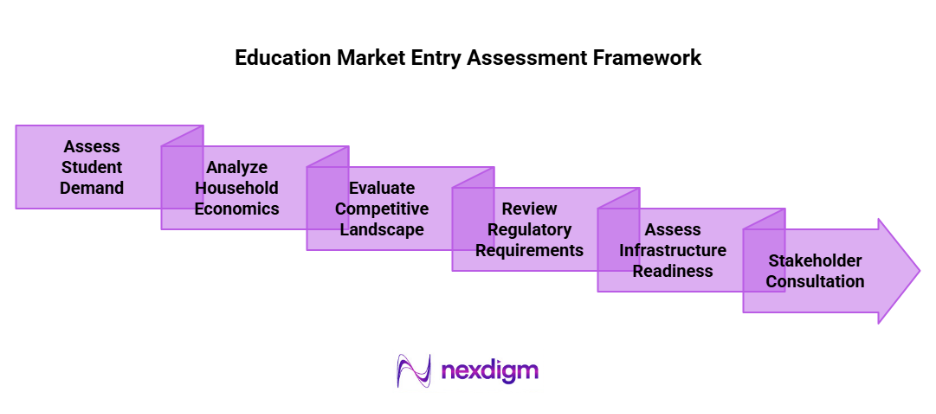
- Assessing Student Demand: Evaluating enrollment trends, demographic growth, learner preferences, participation rates, and education needs to determine the size and attractiveness of the target market.
- Analyzing Affordability and Household Economics: Assessing income levels, education spending patterns, tuition affordability, financing availability, and willingness to pay to understand commercial viability.
- Evaluating the Competitive Landscape: Analyzing existing institutions, program offerings, fee structures, capacity levels, market positioning, and competitive intensity to identify market gaps and differentiation opportunities.
- Reviewing Regulatory and Policy Requirements: Examining licensing requirements, accreditation standards, operational regulations, and policy frameworks that may influence market entry and expansion plans.
- Assessing Infrastructure and Delivery Readiness: Evaluating education infrastructure, technology readiness, faculty availability, operational requirements, and delivery models required for successful market implementation.
- Conducting Stakeholder Consultation: Engaging students, parents, educators, employers, and industry participants to validate assumptions, understand expectations, and gather local market insights.
Through this step-by-step assessment, Nexdigm helps stakeholders move from market exploration to informed entry decisions, enabling them to target the right segments, mitigate risks, and develop sustainable education growth strategies.
Nexdigm’s Education Market Entry Assessment Case
Nexdigm supported a leading UK-based educational institute evaluating entry into India’s international K-12 market. The study assessed a segment growing at 14% CAGR, covered students aged 5–17 years, and incorporated insights from 25+ ecosystem stakeholders. Analysis of competitors, programs, regulations, and business models helped the client formulate its India market-entry strategy.
To take the next step, simply visit our Request a Consultation page and share your requirements with us.
Harsh Mittal
+91-8422857704