

Education partnerships are increasingly moving beyond traditional academic collaborations. Universities, schools, training providers, employers, technology companies, and international institutions are working together to strengthen curricula, expand learning opportunities, improve employability, and develop new delivery models.
India’s education ecosystem with more than 260 million students and over 43,000 higher education institutions offers significant scope for such collaborations. The value of a partnership, however, depends on how well it addresses a specific market or institutional need.
Academic exchanges may strengthen international exposure, while employer partnerships can improve curriculum relevance and placement outcomes. Technology collaborations can expand digital delivery, and industry-linked programs can help institutions respond to changing workforce requirements.
Why Education Partnerships Are Becoming More Strategic
Education institutions increasingly need capabilities that cannot always be developed independently. Employers can provide industry exposure and skills insights, technology companies can strengthen digital delivery, and international institutions can support curriculum development and student mobility.
Partnerships can therefore influence both institutional competitiveness and learner outcomes. Their effectiveness depends on partner capabilities, shared objectives, commercial models, geographic reach, and the ability to translate collaboration into measurable academic or market outcomes.
The Right Partner Depends on the Intended Outcome
Not every partnership creates the same value. An institution seeking international student mobility may prioritize overseas universities, while a vocational provider may require strong employer networks. An EdTech company may seek schools or universities with established learner bases.
Evaluating partnerships through demand, capability, strategic fit, competitive positioning, and commercial feasibility can help stakeholders focus resources on relationships with stronger potential.
Nexdigm’s Industry Specific Assistance to Enhance Education Partnerships
Nexdigm combines education sector research, stakeholder analysis, market intelligence, competitive benchmarking, and strategic advisory to assess partnership opportunities across the education ecosystem.
Our industrial expertise and research-based Education partnership ecosystem assessment can map institutions, employers, technology providers, investors, training organizations, and other stakeholders while examining learner demand, institutional capabilities, competitive dynamics, and market trends.
This enables stakeholders to understand not only who potential partners are, but also what each partnership could contribute to enrollment, learning outcomes, employability, market access, technology adoption, or institutional growth.
Nexdigm’s Education Partnership Ecosystem Assessment
Nexdigm’s Education partnership ecosystem assessment evaluates partnership opportunities across several dimensions:
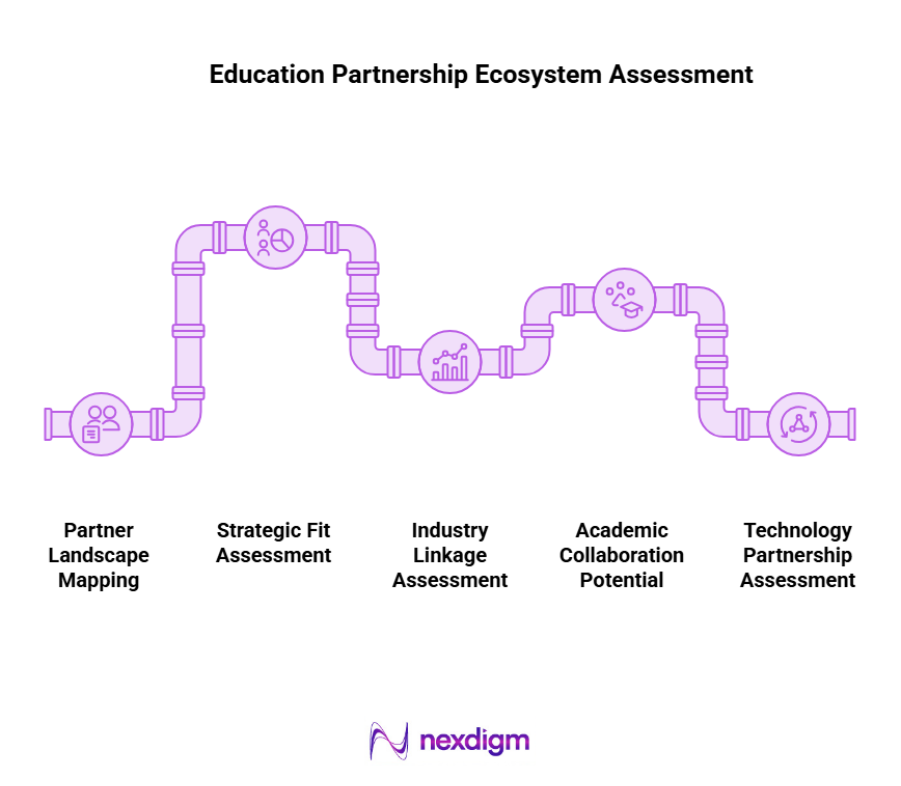
- Partner Landscape Mapping: Nexdigm identifies universities, schools, employers, EdTech companies, training providers, technology firms, investors, and international institutions relevant to the client’s strategic objectives.
- Strategic Fit Assessment: Evaluating partner capabilities, target learners, geographic presence, academic strengths, technology capabilities, reputation, and strategic objectives to determine alignment.
- Industry Linkage Assessment: Examining employer requirements, skills gaps, hiring trends, internships, apprenticeships, and industry engagement to identify opportunities for stronger education-to-employment linkages.
- Academic Collaboration Potential: Nexdigm assesses opportunities around curriculum development, faculty exchange, joint programs, certifications, research, credit transfer, and international academic collaborations.
- Technology Partnership Assessment: Evaluating digital platforms, AI, learning technologies, assessment tools, content providers, and infrastructure partners to identify opportunities for technology-enabled education delivery.
Assessing these dimensions help stakeholders move from a broad list of potential collaborators to partnerships with clear strategic rationale and measurable value.
How Nexdigm Converts Partnership Insights into Strategic Value
With the insights gained from assessment, Nexdigm helps stakeholders identify collaboration opportunities that enable partnerships to generate measurable educational and commercial value, by:
- Curriculum Alignment: Connecting institutions with employers and industry experts to strengthen curriculum relevance, incorporate emerging skill requirements, and better align academic programs with workforce needs.
- Student Employability: Identifying partnerships that provide internships, apprenticeships, industry projects, certifications, mentoring, placements, and practical learning opportunities that enhance graduate employability outcomes.
- International Expansion: Assessing opportunities for collaboration with overseas institutions to support student mobility, joint degrees, academic exchange, curriculum development, and global market access.
- Digital Transformation: Identifying technology partners that can support digital learning initiatives through platforms, analytics, AI solutions, digital content, assessments, and student engagement tools.
- New Program Development: Connecting with partners that can contribute subject-matter expertise, faculty resources, infrastructure, certifications, industry knowledge, and market access for new academic offerings.
By evaluating partnership opportunities across academic, industry, technology, and international ecosystems, Nexdigm helps stakeholders build collaborations that strengthen educational outcomes, enhance institutional competitiveness, support innovation, and create long-term strategic value.
Nexdigm’s Case
Nexdigm supported a leading UK-based educational institute evaluating its entry into India’s international K-12 market. The engagement included 25+ ecosystem stakeholders, assessment of programs for students aged 5–17 years, competitive benchmarking, and regulatory analysis. The findings helped the client formulate recommendations for its India market-entry strategy, including the broader ecosystem and partnership considerations.
To take the next step, simply visit our Request a Consultation page and share your requirements with us.
Harsh Mittal
+91-8422857704