

Education policy can reshape markets well beyond changes in curriculum or institutional rules. In India, the National Education Policy (NEP) 2020 has introduced reforms spanning school structure, multidisciplinary higher education, vocational learning, digital education, and learner mobility. The sector serves more than 260 million students across school and higher education, supported by over 1.5 million schools and 43,000+ higher education institutions.
For education providers, technology companies, investors, and institutions, policy changes can create new demand while simultaneously introducing compliance requirements, investment needs, and competitive risks. A reform may benefit one education segment while increasing costs or requiring strategic adaptation in another.
An Education policy impact assessment helps stakeholders translate policy developments into market implications by evaluating affected segments, demand shifts, regulatory requirements, investment needs, competitive changes, and emerging opportunities.
Policy Changes Can Reshape Education Demand
Policy reforms can influence what students learn, how institutions deliver programs, which qualifications gain relevance, and where new education services emerge. Changes such as greater emphasis on vocational education, digital learning, multidisciplinary programs, and skill-based education can create opportunities for institutions and technology providers.
The impact, however, varies by geography, institution type, learner segment, and implementation readiness. Understanding these differences is essential for identifying which stakeholders are positioned to benefit and which may face adjustment costs.
The Market Impact Extends Beyond Compliance
Policy implementation can affect curriculum design, faculty requirements, infrastructure, technology investment, accreditation, pricing, and institutional operating models. Education providers may need to redesign programs or invest in capabilities before they can capture emerging demand.
For investors and market entrants, these changes can influence barriers to entry and competitive positioning. Assessing both the opportunities and risks provides a more realistic view of how policy can translate into market outcomes.
How Nexdigm Helps Stakeholders Evaluate Policy-Led Market Shifts
Nexdigm combines education-sector research, regulatory analysis, market intelligence, stakeholder consultation, competitive benchmarking, and strategic advisory to understand how policy developments can influence education markets.
Its Education policy impact assessment identifies government investment as important structural growth drivers while also examining regulatory complexity, institutional requirements, market opportunities, and changing learner preferences.
This allows stakeholders to move beyond understanding what a policy says to assessing what it means for demand, competition, investment, operating models, and future growth.
Nexdigm’s Education Policy Impact Assessment Framework
Nexdigm’s Education policy impact assessment framework can evaluate policy changes through multiple market and stakeholder lenses. This takes place through:
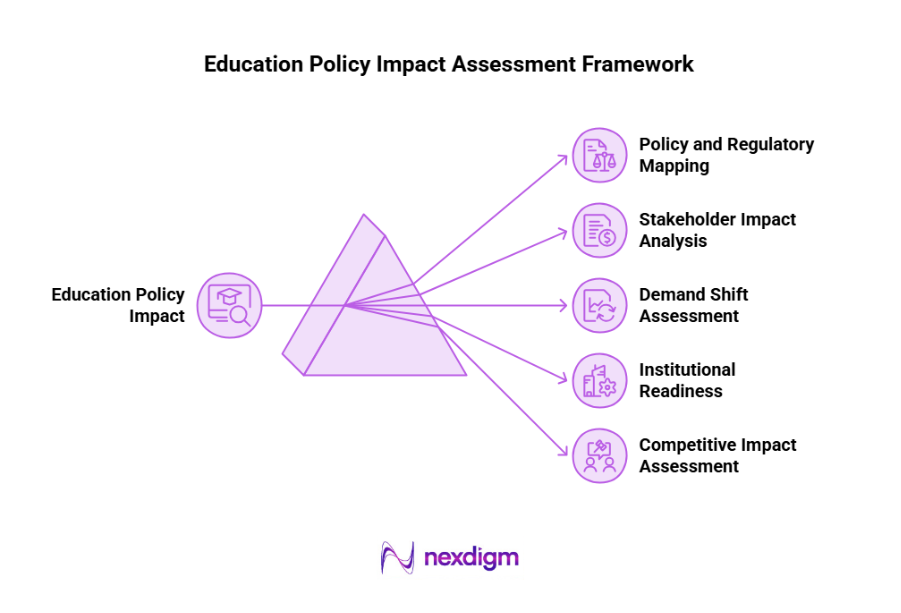
- Policy and Regulatory Mapping: Examining new policies, regulations, implementation guidelines, accreditation requirements, and compliance obligations to identify changes that could affect education providers and investors.
- Stakeholder Impact Analysis: Assessing how reforms may affect students, parents, institutions, educators, EdTech companies, training providers, and investors, identifying potential beneficiaries and groups requiring strategic adaptation.
- Demand Shift Assessment: Understanding how policy changes may influence learner preferences, enrollment, program selection, delivery models, and demand for emerging education offerings.
- Institutional Readiness: Assessing infrastructure, faculty, technology, curriculum, operational capabilities, and investment requirements to determine how prepared institutions are to implement policy-driven changes.
- Competitive Impact: Benchmarking institutions and providers to understand how policy changes could alter competitive positioning, market entry barriers, program differentiation, and addressable market opportunities.
This framework helps stakeholders understand not only who is affected by a policy, but also how the resulting market changes can influence strategic and investment decisions.
How Nexdigm Converts Education Policy Insights into Strategic Decisions
The findings from Nexdigm’s policy assessment help education stakeholders understand the practical implications of regulatory and policy changes, enabling them with:
- Portfolio Repositioning: Identifying academic programs, curricula, delivery models, and service offerings that may require modification to align with evolving policy priorities, student expectations, and market requirements.
- Investment Planning: Assessing infrastructure, technology, faculty, operational, and capital investment requirements needed to implement policy-driven changes while ensuring scalability, efficiency, and compliance.
- Competitive Strategy: Evaluating how regulatory and structural changes may influence competitive positioning, helping organizations identify differentiation opportunities and strengthen their market advantage.
- Partnership Development: Identifying collaboration opportunities among educational institutions, technology providers, government agencies, employers, and training organizations to support policy implementation and shared objectives.
- Risk Mitigation: Anticipating potential compliance challenges, implementation barriers, affordability concerns, and adoption risks, enabling organizations to make informed decisions and reduce strategic uncertainty.
By translating policy developments into actionable business insights, Nexdigm enables education stakeholders to adapt strategies, prioritize investments, manage risks, and capitalize on emerging opportunities in a rapidly evolving regulatory environment.
Nexdigm’s Case
Nexdigm supported a leading UK-based educational institute assessing entry into India’s international K-12 market. The study found India’s international schooling segment expanding at a 14% CAGR, assessed programs for students aged 5–17, and involved 25+ ecosystem stakeholders. Its analysis of local education policies and regulatory requirements helped the client formulate its India market-entry strategy.
To take the next step, simply visit our Request a Consultation page and share your requirements with us.
Harsh Mittal
+91-8422857704