

An underserved education market is not always a place without schools or colleges. It may be a district where students have access to general degrees but few industry-linked programmes, a city where working adults cannot find flexible qualifications, or a student segment that faces barriers related to cost, transport or accessibility.
For education providers, these gaps can reveal opportunities to develop programmes, extend services or establish partnerships. The challenge is distinguishing unmet need from demand that cannot be served sustainably.
Where Are Education Gaps Most Visible?
India’s school education system recorded 24.69 crore students across approximately 14.71 lakh schools in 2024–25, according to UDISE+ data presented in NITI Aayog’s 2026 analysis. Yet the distribution of enrollment, infrastructure and educational continuity varies substantially across states and school stages.
NITI Aayog’s analysis found that gross enrollment ratios at the higher secondary stage were particularly low in several states, including Bihar, Meghalaya and Nagaland. Such differences can signal barriers to progression, but they do not by themselves establish that a new private institution would be commercially viable. Affordability, transport, household circumstances, existing capacity and the availability of teachers all influence whether students can access additional provision.
Higher education presents a different set of gaps. AISHE 2023–24 recorded 4.50 crore students nationally, with STEM enrollment reaching 1.02 crore. These aggregate figures can guide broad market screening, but programme-level opportunity depends on the mix of local institutions, available seats, faculty expertise, employer demand and student preferences.
The important question is not simply where educational participation is low. It is why the gap exists and which intervention could address it.
Finding Opportunities Beyond Geographic Shortages
Opportunity mapping should examine the education system from several directions.
- Student segments: Working learners, first-generation college students, students with disabilities, learners in remote areas and those seeking a second qualification may face different barriers. A single delivery model rarely serves them all equally well.
- Programme gaps: A region may have many general education providers but limited access to vocational qualifications, specialised STEM courses, language support, career services or professional upskilling.
- Access constraints: Long travel times, high accommodation costs, limited internet access and rigid class schedules can prevent enrollment even when a programme exists nearby.
- Quality and outcome gaps: Students may have access to an institution but lack adequate practical training, career guidance, academic support or reliable progression pathways.
These gaps can call for different responses. A new campus may be appropriate where a large catchment lacks accessible capacity. A partnership, mobile training unit, digital service or satellite centre may be more suitable where demand is dispersed.
Education Sector Opportunity Mapping: From Need to Commercial Potential
Education sector opportunity mapping combines geographic, demographic and competitive evidence to identify where unmet demand can be served.
The analysis should overlay student populations with current provision, affordability, transport and infrastructure. It should also examine who pays. In some markets, families are the primary buyers; in others, employers, institutions, public programmes or scholarship providers may fund participation.
A gap is commercially attractive only when the delivery model can address it at an acceptable cost. For example, a rural district may show limited access to specialised training, but a permanent centre could struggle if learners are widely dispersed. Partnerships with existing institutions or employers may lower costs and create a more reliable route to enrollment.
This is where market mapping becomes more than a geographic exercise. It helps connect the type of need, the target population, the delivery model and the likely source of revenue.
Education Opportunity Mapping Framework
The Education Sector Opportunity Mapping Framework provides a structured approach to identifying and prioritising underserved markets.
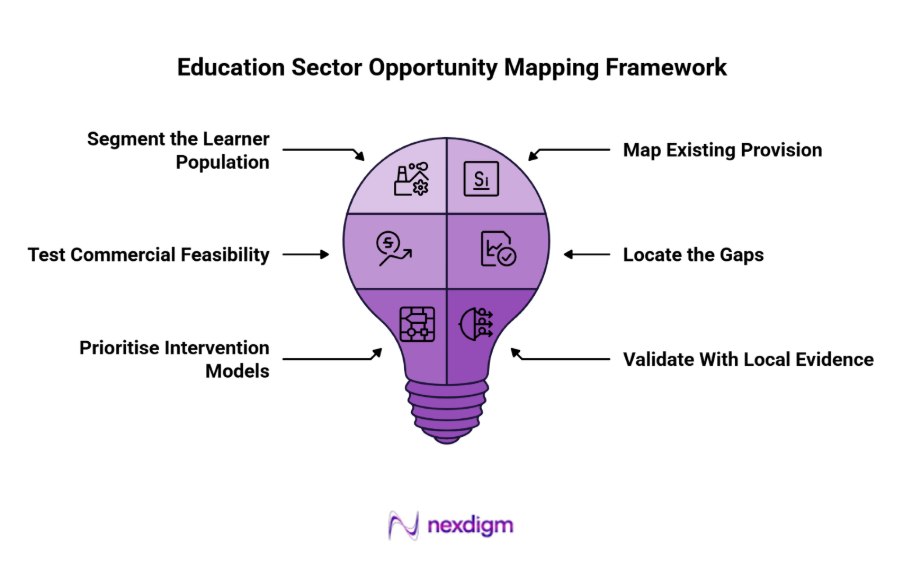
- Segment the Learner Population: Group students by age, education stage, geography, affordability and learning objectives.
- Map Existing Provision: Catalogue institutions, programmes, capacity, delivery formats and relevant support services.
- Locate the Gaps: Identify unmet demand, access barriers, missing programmes and weak progression pathways.
- Test Commercial Feasibility: Assess willingness to pay, funding sources, operating costs and potential partnerships.
- Prioritise Intervention Models: Compare new facilities, programme additions, digital delivery and shared infrastructure.
- Validate With Local Evidence: Use stakeholder interviews, school and institution data, employer feedback and pilot demand.
The map should lead to a shortlist of actionable opportunities, each supported by evidence about the students served, the need addressed and the resources required.
Nexdigm Case Study: Prioritising Underserved Segments
Nexdigm mapped education provision across 14 districts, comparing student demographics, programme availability, travel constraints and affordability. The analysis identified 4 underserved combinations of geography and programme type. Two advanced to feasibility assessment, with a partnership-based training model prioritised in areas where dispersed demand made a standalone centre less attractive.
To take the next step, simply visit our Request a Consultation page and share your requirements with us.
Harsh Mittal
+91-8422857704