

Students may use digital payments, messaging apps and video platforms every day, yet hesitate when an institution asks them to adopt a new learning portal. Familiarity with technology does not automatically translate into acceptance of education services. Students judge each service by its usefulness, reliability, cost and the effort required to use it.
For education providers, adoption is therefore a question of behaviour as much as technology. The opportunity lies in identifying which services solve an immediate problem and which introduce friction without a clear benefit.
Education Services Gaining Student Adoption
Digital services tend to gain traction when they fit naturally into activities students already perform. Online application portals, digital fee payments, recorded lectures and learning management systems can reduce administrative effort or make learning resources easier to access.
Several service categories deserve particular attention:
- Digital admissions and payments: Online applications, document submission, fee payments and admission updates can reduce queues and uncertainty when systems are reliable.
- Learning management systems: Centralised access to assignments, course materials, deadlines and feedback can make academic administration easier to manage.
- Recorded and supplementary learning: Videos, digital readings and practice assessments allow students to revisit difficult topics outside scheduled classes.
- Career and skill services: Internship portals, career guidance, professional courses and digital credentials can attract students when their relevance to employment is clear.
- Student support platforms: Online counselling appointments, help desks and academic advising can improve access, provided students trust the service and understand how to use it.
India’s higher education enrollment reached 4.50 crore in 2023–24, according to the Ministry of Education’s All India Survey on Higher Education. The scale of the system creates a substantial potential user base, but adoption varies with institutional resources, connectivity, student needs and the quality of implementation.
Why Students Resist New Education Services
Resistance is often blamed on low digital literacy. That explanation can overlook more practical barriers. A platform may require repeated logins, work poorly on mobile devices or force students to navigate several systems to complete one task. If a service adds work without making an existing process easier, students have little reason to use it consistently.
Trust matters, too. Students may be reluctant to share personal information through an unfamiliar application, particularly when the institution has not explained how their data will be used. Services related to counselling or wellbeing require clear privacy protections and credible support, not just an online booking interface.
Access remains uneven. UDISE+ 2024–25 reported that 63.5% of schools had internet access, leaving more than one-third without a reported connection. School-level infrastructure does not directly measure connectivity among college students, but it demonstrates why education services cannot assume universal access to reliable digital infrastructure.
Education Service Adoption Analysis: What to Measure
A useful Education service adoption analysis separates availability from actual use. A service may be installed across an institution but remain irrelevant to most students.
Track these indicators:
- Awareness: Do students know the service exists and understand what it does?
- Activation: Can they register, log in and complete the first task without assistance?
- Repeat usage: Do students return when the service is needed, or revert to manual alternatives?
- Task completion: Does the service successfully resolve the issue it was designed to address?
- Barriers and abandonment: Where do students encounter technical, financial, accessibility or trust-related problems?
These measures help distinguish a launch problem from a product problem. Low initial use may reflect inadequate communication. High initial use followed by rapid abandonment suggests that the service experience needs closer examination.
Education Service Adoption Strategy Framework
The Student Service Adoption Framework provides a practical sequence for improving uptake.
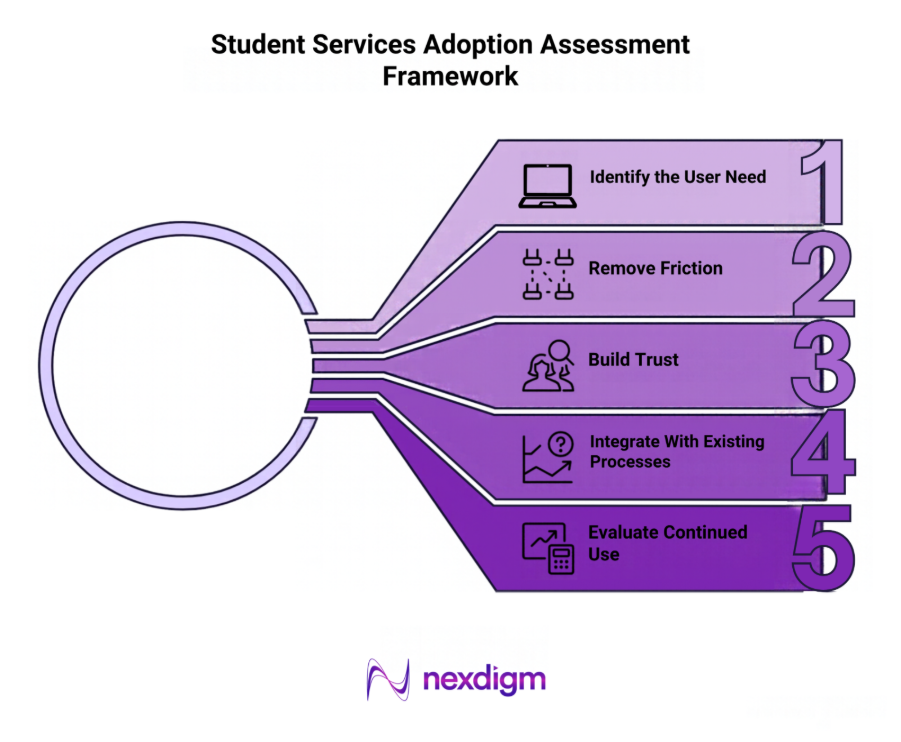
- Identify the User Need: Start with a recurring student task or problem, rather than a technology feature.
- Remove Friction: Reduce unnecessary steps, improve mobile usability and provide accessible instructions.
- Build Trust: Explain privacy, eligibility, support channels and the limits of the service.
- Integrate With Existing Processes: Avoid requiring students to switch repeatedly between disconnected systems.
- Evaluate Continued Use: Measure task completion, repeat adoption and student feedback before expanding deployment.
Nexdigm Case Study: Prioritising Student-Facing Services
Nexdigm assessed eight student-facing services at a higher education institution. Digital payments, admissions updates and centralised course materials showed the strongest repeat-use potential. Three services were prioritised for improvement after testing identified login friction and unclear instructions as barriers to adoption. The institution sequenced further investment around student usage and task-completion data.
To take the next step, simply visit our Request a Consultation page and share your requirements with us.
Harsh Mittal
+91-8422857704