

A market estimate can look impressive and still be commercially useless. An education service may be relevant to millions of students, but only a fraction may need it, be able to access it, or be willing to pay for it. Treating the entire student population as the addressable market can inflate revenue expectations and lead to investment in the wrong product or geography.
A credible market estimate moves from the population that could theoretically use a service to the customers a provider can realistically reach and convert.
Why Total Enrollment Is Not the Same as Market Size
India’s higher education system enrolled 4.50 crore students in 2023–24, according to the Ministry of Education’s All India Survey on Higher Education. School education recorded 24.69 crore students in 2024–25, according to UDISE+ data cited in NITI Aayog’s 2026 school education report.
These numbers describe the scale of education participation. They do not measure demand for a particular service, such as admissions software, student counselling, specialised test preparation, learning analytics or career guidance.
A service aimed at final-year engineering students has a narrower audience than one designed for all college students. A premium counselling service may be relevant to many families but affordable to far fewer. An institutional software product may technically serve thousands of colleges, yet only a subset may have the budget, procurement capacity and operational need to purchase it.
The market estimate must reflect these boundaries from the beginning.
TAM, SAM and SOM for Education Services
Market sizing is more useful when it distinguishes three levels of opportunity.
- Total addressable market (TAM) represents the full potential demand if the service could reach every relevant customer within its defined market. For an education technology provider, this might be all institutions meeting a specified size or programme profile.
- Serviceable available market (SAM) narrows the opportunity to customers the provider can serve with its current product, geography, delivery model, pricing and regulatory position. A platform available only in selected languages or integrated with a limited set of student information systems cannot claim the entire institutional market as immediately serviceable.
- Serviceable obtainable market (SOM) estimates the portion the provider can realistically win over a defined period. This depends on competition, sales capacity, customer acquisition, conversion, implementation resources and the time required for institutions to adopt the service.
These estimates should be calculated from the customer’s perspective as well as the provider’s. A school might be eligible to purchase a digital service but lack the connectivity, staff capacity or budget needed to implement it.
Education Service Market Potential Study: Building a Defensible Estimate
An Education service market potential study should combine population data with evidence of need, purchasing ability and market access.
The most useful inputs depend on the service, but commonly include:
- Define the target customer: Specify student age, education stage, institution type, geography and the problem the service solves.
- Estimate eligible demand: Use official enrollment statistics, institution counts, programme participation or other relevant population data.
- Measure the need: Assess how many target customers experience the problem and how urgently they need a solution.
- Test willingness to pay: Compare budgets, existing spending, alternatives, price sensitivity and procurement behaviour.
- Account for competition: Identify substitutes, existing suppliers, switching costs and unmet customer requirements.
- Estimate achievable penetration: Model customer acquisition, sales conversion, delivery capacity and realistic adoption over time.
A bottom-up calculation is often more revealing than applying a generic percentage to national enrollment. For example, an institutional service can be sized by estimating the number of eligible schools or colleges, the proportion with a relevant need, expected annual contract value and achievable adoption. Each assumption can then be tested against evidence.
Education Service Market Sizing Framework
The Education Service Market Sizing Framework provides a consistent basis for comparing market opportunities.
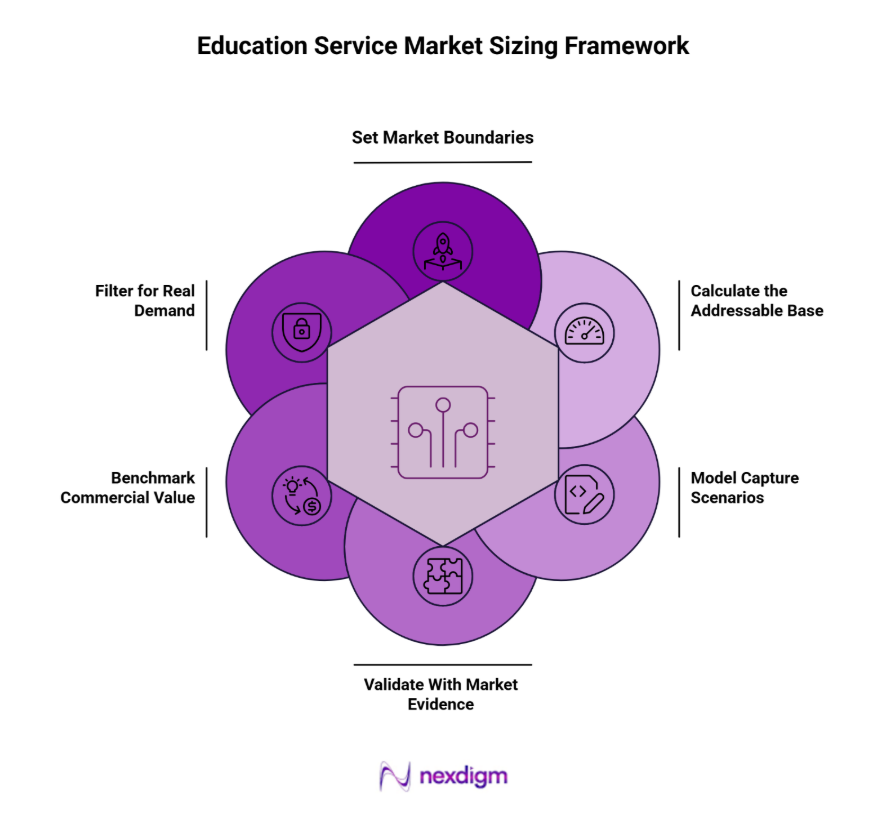
- Set Market Boundaries: Define customer, geography, service category and time horizon.
- Calculate the Addressable Base: Establish the relevant population of students, families or institutions.
- Filter for Real Demand: Apply eligibility, need, affordability and access constraints.
- Benchmark Commercial Value: Estimate realistic pricing, purchase frequency and revenue per customer.
- Model Capture Scenarios: Test conservative, expected and stronger adoption cases.
- Validate With Market Evidence: Compare estimates with customer interviews, competitor data, pilot results and actual conversion.
The result should be a range, not a false-precision number. A transparent estimate with clearly stated assumptions is more useful for investment decisions than a large headline figure unsupported by purchasing evidence.
Nexdigm Case Study: Recalculating Serviceable Demand
Nexdigm assessed the potential market for a student support platform using institution counts, student segments, affordability and existing service availability. The initial population-based estimate narrowed substantially after budget and adoption filters were applied. The provider used the revised market range to focus sales on institution types with clearer need and purchasing capacity.
To take the next step, simply visit our Request a Consultation page and share your requirements with us.
Harsh Mittal
+91-8422857704