

The automotive industry is undergoing a fundamental transformation as electrification reshapes the way vehicles are designed, manufactured, and powered. While much of the conversation has focused on batteries and charging infrastructure, an equally significant shift is taking place within the drivetrain ecosystem. Motors, inverters, gearboxes, and integrated drive units are becoming increasingly important in determining vehicle efficiency, performance, and overall value.
As automakers accelerate their transition toward electrified mobility, manufacturers, suppliers, and investors are seeking to understand where the most attractive opportunities are emerging. Hence, a comprehensive Electric drivetrain market analysis redefines component architectures, increases the importance of power electronics, drives system integration, and creates new opportunities for innovation across the mobility value chain.
The Electric Drivetrain Shift
Electrification is transforming the traditional drivetrain from a mechanical system into a highly integrated combination of electrical, electronic, and software-driven technologies. As vehicle manufacturers focus on improving efficiency, performance, and energy management, components such as motors, inverters, gearboxes, and control systems are becoming increasingly critical to drivetrain design and value creation. This transition is driving investment across:
- Electric motors
- Power inverters
- Reduction gearboxes
- Integrated e-axles
- Thermal management systems
- Control software and digital platforms
From an industry perspective, electrification is shifting value away from mechanical engineering excellence alone toward a combination of electrical engineering, software intelligence, and system integration expertise.
Understanding the Transformation of the Drivetrain Ecosystem
Electrification is changing how modern drivetrains are designed and optimized. As vehicle platforms evolve, demand is shifting toward advanced motors, power electronics, integrated systems, and software-driven solutions. To understand where opportunities are emerging, it is important to examine the four keyways electrification is reshaping the drivetrain ecosystem.
Increasing Dependence on High-Efficiency Electric Motors
The electric motor has become the heart of vehicle propulsion. Manufacturers are continuously pursuing higher power density, reduced weight, improved efficiency, and lower dependence on critical raw materials. Some key developments include:
- Permanent magnet synchronous motors (PMSM)
- Induction motors
- Axial flux motor technologies
- Rare-earth material optimization
- Advanced cooling architectures
As automakers seek longer driving ranges without increasing battery size, motor efficiency has emerged as a crucial competitive factor.
Elevating the Role of Power Electronics
Power electronics, particularly inverters, have become critical components of electric drivetrains. They manage the flow of energy between the battery and the motor, improving efficiency, performance, and vehicle control. As EV adoption grows, advancements in power electronics are enabling faster energy conversion, better thermal management, and enhanced driving range, making them a key area of innovation and investment.
Transforming Gearbox Requirements
Electric vehicles generally require fewer gears than conventional vehicles. However, gearbox innovation remains essential. Some emerging gearbox trends include:
- Single-speed transmission dominance
- Compact reduction gear solutions
- Lightweight materials adoption
- Noise, vibration, and harshness (NVH) optimization
The objective is not complexity but maximizing efficiency, reliability, and packaging flexibility.
Accelerating System Integration
The most significant change is the move toward integrated drive units. Rather than treating motors, inverters, and gearboxes as separate systems, manufacturers are increasingly combining them into:
- E-axles
- Integrated drive modules
- Smart propulsion units
This integration reduces:
- Vehicle weight
- Manufacturing complexity
- Wiring requirements
- Overall system cost
Simultaneously, it enhances energy efficiency and enables faster assembly processes.
Where Does the Drivetrain Growth Lie?
As electrification accelerates, growth opportunities within the drivetrain market are increasingly concentrated in technologies that improve efficiency, integration, and vehicle performance. Rather than focusing solely on traditional mechanical components, manufacturers and suppliers are investing in solutions supporting growth, such as:
- Electric Motor Localization: As EV production expands globally, localizing motor manufacturing helps reduce supply chain dependencies, lower costs, improve sourcing efficiency, and support regional production strategies.
- Advanced Inverter Manufacturing: Advanced inverters improve energy conversion efficiency, vehicle performance, and battery utilization, creating significant opportunities for innovation and value creation.
- Integrated E-Axle Solutions: E-axles combine motors, inverters, and gear systems into compact units, enhancing efficiency, reducing weight, and simplifying vehicle assembly.
How Is Electrification Reshaping the Drivetrain Market?
Electrification is shifting value from traditional mechanical systems toward integrated electric propulsion technologies. Electric motors, inverters, power electronics, and e-axles are becoming increasingly important as manufacturers focus on efficiency, performance, and system integration.
At Nexdigm, this transition requires a strategic evaluation of technology trends, investment priorities, supply chain readiness, and market opportunities. Through its market intelligence and advisory capabilities, Nexdigm helps organizations align business strategies with the evolving demands of the electric drivetrain ecosystem.
Nexdigm In Creating Value for Electric Drivetrain Markets
For businesses operating within the electric mobility ecosystem, technical innovation alone is not enough. Success increasingly depends on strategic decision-making across finance, operations, compliance, taxation, and market expansion. This includes:
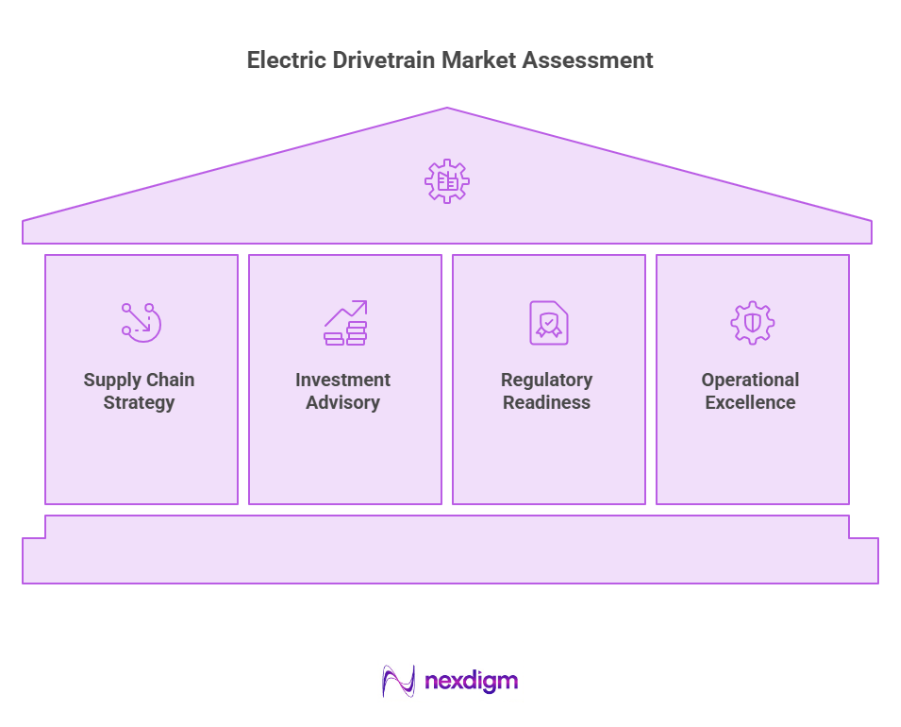
Supply Chain and Localization Strategy
Nexdigm can help organizations assess:
- Localization opportunities
- Vendor ecosystem development
- Manufacturing footprint optimization
- Market entry strategies
As governments promote domestic EV manufacturing, companies must balance incentives, compliance requirements, and operational efficiency.
Investment and Transaction Advisory
The drivetrain ecosystem is witnessing significant merger, acquisition, and investment activity. Nexdigm’s advisory capabilities can support:
- Target identification
- Commercial due diligence
- Financial evaluation
- Integration planning
This enables stakeholders to make informed investment decisions in a rapidly evolving market.
Tax and Regulatory Readiness
Electric drivetrain manufacturers often operate across multiple jurisdictions and regulatory environments. Nexdigm can assist organizations in:
- International tax planning
- Transfer pricing alignment
- Regulatory compliance
- Incentive utilization
- Cross-border expansion management
These considerations become increasingly important as production networks globalize.
Operational Excellence and Risk Management
The electrification transition introduces new supply chain dependencies, technology risks, and sourcing challenges. Nexdigm can support businesses through:
- Risk assessments
- Internal control frameworks
- Process optimization
- Cost management strategies
- ESG and sustainability alignment
Such capabilities help organizations scale efficiently while maintaining resilience. Through its integrated expertise across strategy, market intelligence, risk advisory, operations, and transformation, Nexdigm helps businesses build future-ready models in an increasingly electrified mobility landscape.
Nexdigm’s Case
Nexdigm supported an automotive player in assessing electric-drivetrain opportunities as India’s traction-motor market reached $1.26 billion, with integrated e-drive systems gaining relevance. The study mapped motors, inverters, gearboxes, and integration economics, strengthening localization priorities and creating scalable drivetrain value pools.
To take the next step, simply visit our Request a Consultation page and share your requirements with us.
Harsh Mittal
+91-8422857704