

Electric vehicle adoption is making drivetrain performance a critical differentiator for automakers. Global electric car sales exceeded 20 million in 2025, representing one in four new cars sold worldwide, while global electric car production reached nearly 22 million units, up more than 25% year-on-year. China accounted for nearly 75% of global electric car production, highlighting both the scale and concentration of the EV supply ecosystem.
As OEMs expand EV portfolios, selecting the right drivetrain supplier involves more than comparing component prices. Motor efficiency, inverter performance, manufacturing scalability, quality systems, localization, engineering capabilities, and long-term strategic alignment increasingly influence sourcing decisions. Electric drivetrain supplier benchmarking provides a structured way to evaluate these dimensions and identify suppliers capable of supporting future vehicle programs.
Why Drivetrain Supplier Benchmarking Matters
EV drivetrains directly influence vehicle efficiency, range, performance, and cost. As OEMs evaluate multiple suppliers, comparing specifications alone may not reveal differences in technology maturity, manufacturing readiness, quality, scalability, or supply resilience. Electric drivetrain supplier benchmarking provides a structured view of these factors, helping procurement and engineering teams identify suppliers that can meet current program requirements while remaining capable of supporting future EV platforms.
The Need for a Broader Supplier View
Supplier evaluation becomes more complex as EV drivetrain technologies evolve and sourcing decisions span engineering, manufacturing, and commercial priorities. A supplier may lead on efficiency yet face capacity constraints, while another may offer scale but lag in technology. Electric drivetrain supplier benchmarking helps OEMs assess these trade-offs systematically, creating a clearer basis for supplier selection, negotiations, and long-term sourcing strategy.
How Nexdigm Can Support EV Drivetrain Supplier Benchmarking
For OEMs and mobility companies, supplier selection increasingly requires a fact-based comparison of technical capability, commercial competitiveness, manufacturing readiness, and strategic alignment. Nexdigm can support this assessment through a structured benchmarking approach which involves assessing of:
- Technology and engineering capability: Benchmarking of motor, inverter, drivetrain architecture, efficiency, thermal management, software capabilities, patents, R&D intensity, and product-development track record.
- Manufacturing and operational readiness: Evaluation of production capacity, plant footprint, automation, quality systems, utilization, scalability, localization, lead times, and ability to support planned production volumes.
- Commercial and strategic positioning: Comparing pricing, cost structures, customer concentration, geographic presence, partnerships, financial indicators, expansion plans, and strategic fit with the OEM’s sourcing objectives.
Nexdigm’s structured benchmarking approach enables OEMs to identify capable EV drivetrain suppliers, reduce sourcing risks, and make confident, data-driven procurement decisions.
Nexdigm’s Structured Assessment to Assess Supplier Capabilities
Nexdigm’s approach brings technical, operational, commercial, and strategic parameters together to create a holistic view of drivetrain suppliers. Rather than assessing suppliers against isolated specifications, the assessment can cover:
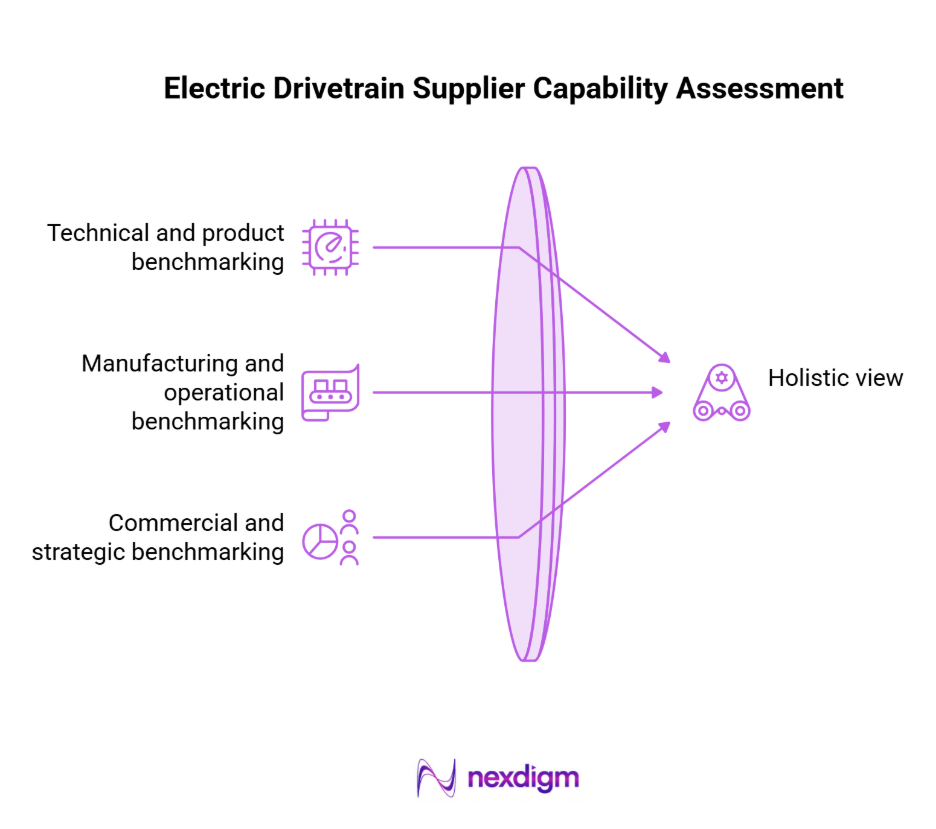
- Technical and product benchmarking: Comparing drivetrain architecture, motor and inverter efficiency, power density, thermal performance, durability, software capabilities, technology maturity, and product-development capabilities.
- Manufacturing and operational benchmarking: Assessing production capacity, plant capabilities, automation, utilization, quality performance, localization, scalability, and supply-chain resilience to determine production readiness.
- Commercial and strategic benchmarking: Evaluating cost competitiveness, pricing structures, customer portfolio, geographic footprint, financial position, partnerships, R&D investments, and strategic alignment with the OEM’s requirements.
By combining these dimensions, Nexdigm can help OEMs identify relative strengths, capability gaps, scalability constraints, and strategic opportunities across their supplier landscape. The resulting assessment can provide a fact-based foundation for supplier shortlisting and longer-term drivetrain strategy.
How Experts of Nexdigm Convert Assessment Insights Into Supplier Sourcing Decisions
The value of benchmarking extends beyond supplier comparison. Nexdigm’s assessment can help OEMs translate supplier-level findings into actionable sourcing decisions by:
- Prioritizing suppliers: Identifying potential suppliers best positioned for specific vehicle platforms, production volumes, technology requirements, or geographic markets.
- Identifying improvement areas: Highlighting capability, cost, capacity, quality, or technology gaps that may influence supplier selection or development plans.
- Strengthening sourcing strategy: Using benchmark findings to support negotiations, supplier segmentation, sourcing allocation, and longer-term drivetrain partnership decisions.
- Assessing future readiness: Evaluating whether suppliers have the technology roadmap, capacity expansion plans, and investment capabilities required to support evolving EV programs.
- Managing supplier risk: Identifying dependencies related to capacity, component sourcing, geographic concentration, quality performance, or financial resilience that could affect program continuity.
This enables OEMs to move from a static supplier comparison toward a more informed and forward-looking sourcing strategy.
Nexdigm’s Case
An automotive OEM benchmarked five EV drivetrain suppliers across technical, manufacturing, commercial, and strategic parameters. Nexdigm’s assessment identified a 15% capability gap between leading and lower-ranked suppliers, highlighted 20% potential sourcing-cost improvement, and improved supplier shortlisting efficiency by 30%. These insights supported stronger negotiations, sourcing allocation, and long-term supplier strategy.
To take the next step, simply visit our Request a Consultation page and share your requirements with us.
Harsh Mittal
+91-8422857704