

Electric vehicles (EVs) have moved far beyond the early-adopter phase. Governments are promoting clean mobility, automakers are investing billions in electrification, and consumers are becoming increasingly familiar with EV technology.
A comprehensive Electric vehicle market assessment reveals that while the sector has established a strong foundation, the path toward sustained mass adoption will require coordinated efforts from manufacturers, policymakers, infrastructure providers, and investors.
As the market evolves, success will increasingly depend on how effectively industry stakeholders address challenges related to infrastructure, affordability, policy support, and consumer confidence.
EV Market Readiness
The readiness of an EV market extends beyond vehicle availability and consumer interest. It depends on the combined strength of demand, charging infrastructure, pricing accessibility, and policy support, all of which influence the pace and sustainability of adoption.
In simple terms, even the most advanced EVs cannot achieve adoption unless consumers have the confidence, affordability, and infrastructure needed to make the transition from conventional vehicles. This makes it important to assess the key drivers shaping EV market growth and large-scale adoption.
A Four-Pillar Framework for Assessing EV Market Potential
Assessing EV market potential requires a broader view than vehicle sales alone. Organzations like Nexdigm recommend evaluating opportunities across four key pillars: demand, infrastructure, policy support, and economic viability to identify sustainable growth opportunities and investment priorities:
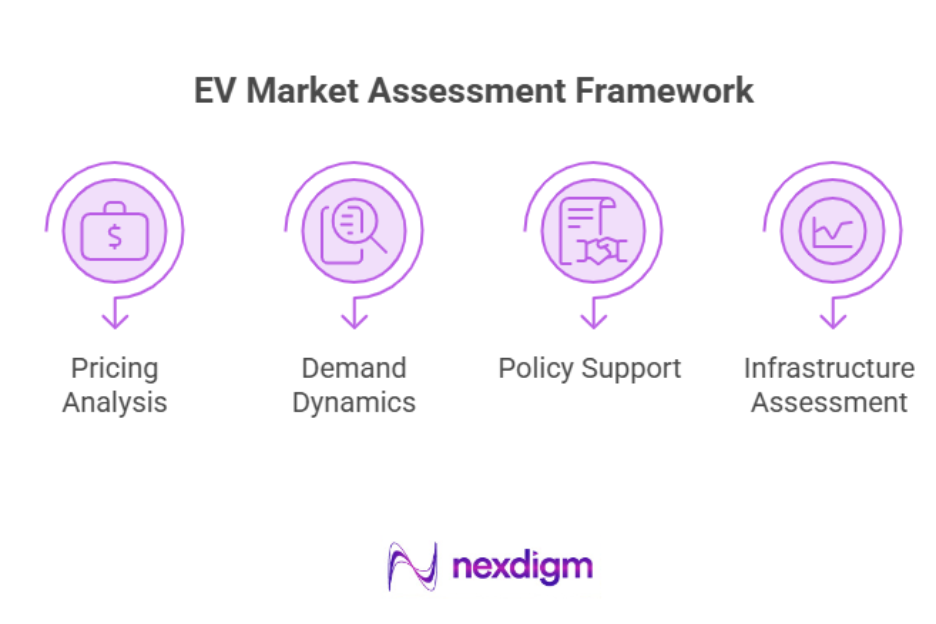
Demand Dynamics
Consumer interest in electric vehicles continues to rise as environmental awareness and fuel-cost concerns influence purchasing decisions. Several demand drivers are accelerating adoption:
- Increasing fuel price sensitivity
- Sustainability-conscious consumers
- Growing EV model availability
- Enhanced battery performance
- Improved driving range
However, consumer expectations have evolved. Today’s buyers are asking more sophisticated questions:
- How convenient is charging?
- What is the resale value?
- What are long-term maintenance costs?
- How reliable is battery performance?
A detailed Electric vehicle market assessment indicates that demand is shifting from curiosity-driven purchases to value-based purchasing decisions. This transition represents a positive sign of market maturity. At Nexdigm, market demand analysis increasingly points toward a more informed and selective EV customer. The next growth wave is expected to come from:
- Urban Professionals: Consumers seeking sustainable transportation without compromising convenience.
- Fleet Operators: Organizations focused on improving operating efficiency and reducing fuel dependence.
- Corporate Buyers: Businesses pursuing ESG commitments and carbon reduction goals.
- Mid-Income Households: Consumers evaluating EV ownership through a total cost of ownership lens rather than only upfront price.
Understanding these customer segments and their evolving demand enables businesses to build targeted growth strategies rather than relying on broad adoption assumptions.
Infrastructure Assessment
Vehicle demand can grow only as fast as charging infrastructure develops. One of the biggest challenges facing EV expansion remains charging accessibility. Key concerns include:
- Public charger availability
- Charging speed
- Geographic coverage
- Grid reliability
- Urban charging congestion
While significant investments have been made globally, infrastructure deployment remains uneven. In many markets, charging infrastructure growth has not fully kept pace with vehicle adoption. A Nexdigm-oriented evaluation suggests that infrastructure success should not be measured purely by charger count. Instead organizations should focus on:
- Utilization Rates: High charger density alone does not guarantee effectiveness.
- Location Intelligence: Strategic placement can significantly improve charging accessibility.
- Interoperability: Seamless user experiences across charging networks improve adoption rates.
- Grid Integration: Long-term EV scalability requires strengthening power infrastructure alongside charging networks.
These considerations are becoming essential components of any forward-looking Electric vehicle market assessment.
Pricing Analysis
Despite falling battery costs and increasing competition, affordability remains a major factor influencing purchase decisions. Consumers often compare:
- EV purchase price
- Internal combustion vehicle price
- Financing costs
- Running expenses
- Residual value
Although total ownership costs are often favorable for EVs, higher upfront costs continue to influence purchasing behavior. Manufacturers therefore face a dual challenge related to maintaining profitability and delivering affordability.
The companies most likely to succeed will be those that provide compelling value propositions rather than competing solely on technology specifications. Nexdigm’s strategic assessment approach emphasizes the importance of communicating long-term value by thorough evaluation of:
- Battery lifecycle economics: Assesses the total value delivered by a battery throughout its usable life, including replacement and residual value considerations.
- Maintenance savings: Evaluates lower servicing and repair requirements compared to conventional vehicles, helping reduce long-term ownership and operating costs.
- Energy cost advantages: Compares electricity costs with traditional fuel expenses to determine potential savings across different usage and charging scenarios.
- Fleet operating efficiencies: Examines productivity gains, route optimization opportunities, and utilization improvements that enhance overall fleet performance and profitability.
- Financing accessibility: Assesses the availability of loans, leasing options, incentives, and flexible financing programs that improve vehicle affordability and adoption.
Customers increasingly make decisions based on economic outcomes rather than vehicle novelty. This shift creates opportunities for manufacturers and investors that can effectively demonstrate long-term savings.
Policy Support
Government policies continue to play a fundamental role in EV market development. Support mechanisms often include:
- Purchase incentives
- Tax benefits
- Infrastructure funding
- Manufacturing incentives
- Emission reduction mandates
Policy frameworks provide confidence for both consumers and industry participants. However, uncertainty around incentive structures can impact investment decisions and consumer adoption rates. Nexdigm recommends that businesses continuously monitor:
- Incentive Changes: Understanding policy shifts helps companies anticipate market fluctuations.
- Localization Requirements: Governments increasingly encourage domestic manufacturing and sourcing.
- Sustainability Reporting Expectations: Environmental disclosures are becoming more important across industries.
- Emerging Compliance Frameworks: Proactive compliance planning can strengthen long-term competitiveness.
Policy awareness is therefore not merely a regulatory exercise but a strategic growth enabler to help businesses grow strategically.
Is the EV Market Ready?
Yes, but readiness varies significantly across regions, vehicle categories, and infrastructure maturity levels. The market possesses strong momentum, rising awareness, and increasing product availability. However, scaling further requires addressing affordability concerns, charging accessibility gaps, and policy consistency.
From Nexdigm’s perspective, EV market readiness extends beyond vehicle adoption and requires a clear understanding of infrastructure, consumer demand, policy support, and investment viability. Through strategic market assessments and ecosystem analysis, Nexdigm helps organizations identify growth opportunities and navigate the evolving electric mobility landscape with confidence.
Nexdigm’s Strategic View on EV Market Development
From a Nexdigm perspective, future market leaders will be defined by their ability to balance growth with ecosystem readiness. Successful organizations will focus on:
- Data-driven demand forecasting
- Infrastructure partnership models
- Affordability enhancement strategies
- Regulatory alignment
- Supply chain resilience
- Customer experience optimization
Through a structured and data-driven approach, Nexdigm enables businesses to align investment decisions with evolving market realities and position themselves for success in the next phase of electric growth.
Nexdigm’s Case
Nexdigm supported an automotive player in assessing India’s EV scale-up opportunity as July 2026 retail sales reached upto 66% YoY, with penetration nearing 12%. The study aligned demand, infrastructure, pricing, and policy priorities, helping the firm with stronger fundamentals support and scalable EV growth.
To take the next step, simply visit our Request a Consultation page and share your requirements with us.
Harsh Mittal
+91-8422857704