

The EV supply chain is expanding across new production and demand centers, creating different levels of capacity and sourcing dependence. In 2025, the United States recorded around 1.2 million EV sales, while Europe remained one of the largest regional EV markets. India’s electric-car sales increased by more than 40%, and Southeast Asia saw EV sales more than double, with electric cars reaching nearly 20% of regional new-car sales.
At the same time, countries such as Indonesia, Thailand, and India are investing in battery and EV manufacturing. These shifts make electric vehicle supply chain intelligence important for identifying where capacity is developing, where dependencies remain, and which markets could offer practical sourcing alternatives.
EV Supply Chain Risks Are Becoming More Regional
EV manufacturing is spreading across countries, but supply capabilities are not developing at the same pace. Battery cells, critical minerals, semiconductors, and specialized components can remain concentrated even when vehicle assembly becomes more distributed. This creates potential gaps between where EVs are produced and where key inputs are available, making supplier concentration, capacity availability, logistics, and import dependence important factors to monitor.
Sourcing Alternatives Are Gaining Importance
As EV production expands, manufacturers and suppliers are increasingly evaluating alternative sources to reduce exposure to concentrated supply networks.
- Emerging Production Markets: Countries such as India, Indonesia, and Thailand are building EV and battery ecosystems, creating potential alternatives for selected components and materials.
- Regional Supply Development: New manufacturing investments can bring suppliers, processing capacity, and infrastructure closer to major EV demand centers.
These developments can create opportunities for businesses to diversify sourcing while improving visibility into future supply availability.
Nexdigm’s Expertise in EV Supply Chain Intelligence
Nexdigm brings together automotive market research, trade intelligence, company intelligence, competitive analysis, and supply-chain assessment to evaluate the evolving EV ecosystem.
Our expertise covers battery and component suppliers, critical materials, manufacturing capacity, trade flows, production hubs, EV demand, sourcing relationships, and market-entry conditions.
By connecting these factors, Nexdigm helps businesses identify where supply-chain dependencies are building, which markets are developing relevant capabilities, and where commercially viable sourcing alternatives may exist.
The Need for EV Supply Chain Intelligence
As EV production expands across markets, businesses face growing complexity across batteries, critical materials, components, suppliers, and manufacturing capacity. EV supply chain intelligence helps connect these moving parts, revealing concentrated dependencies, emerging capacity, sourcing alternatives, and potential supply gaps. This gives businesses a clearer basis for strengthening sourcing strategies, evaluating investments, and building resilient EV supply networks.
What Nexdigm’s EV Supply Chain Intelligence Helps Businesses Assess
Understanding EV supply-chain risk requires more than identifying a supplier or country. Nexdigm’s EV Supply Chain Intelligence connects multiple market signals to:
- Assess supplier shares, geographic exposure, critical materials, component sourcing, and import reliance to identify areas of potential vulnerability.
- Track battery plants, component facilities, manufacturing investments, production capacity, and supplier ecosystems to identify emerging supply hubs.
- Compare supplier capabilities, costs, trade flows, infrastructure, market access, and production readiness across potential alternative markets.
- Compare EV demand, manufacturing capacity, battery requirements, and component availability to identify potential supply-demand imbalances.
- Evaluate EV adoption, local production, supplier presence, investment activity, and regulatory conditions to prioritize markets for expansion or partnerships.
This approach turns fragmented EV supply-chain information into a structured view of dependencies, capacity, alternatives, and strategic opportunities.
Nexdigm’s EV Supply Chain Risk Assessment Framework
Nexdigm structures the assessment across the key stages of the EV value chain, connecting materials, components, suppliers, production capacity, trade flows, and demand. This helps businesses evaluate both current exposure and potential future risks through the following steps:
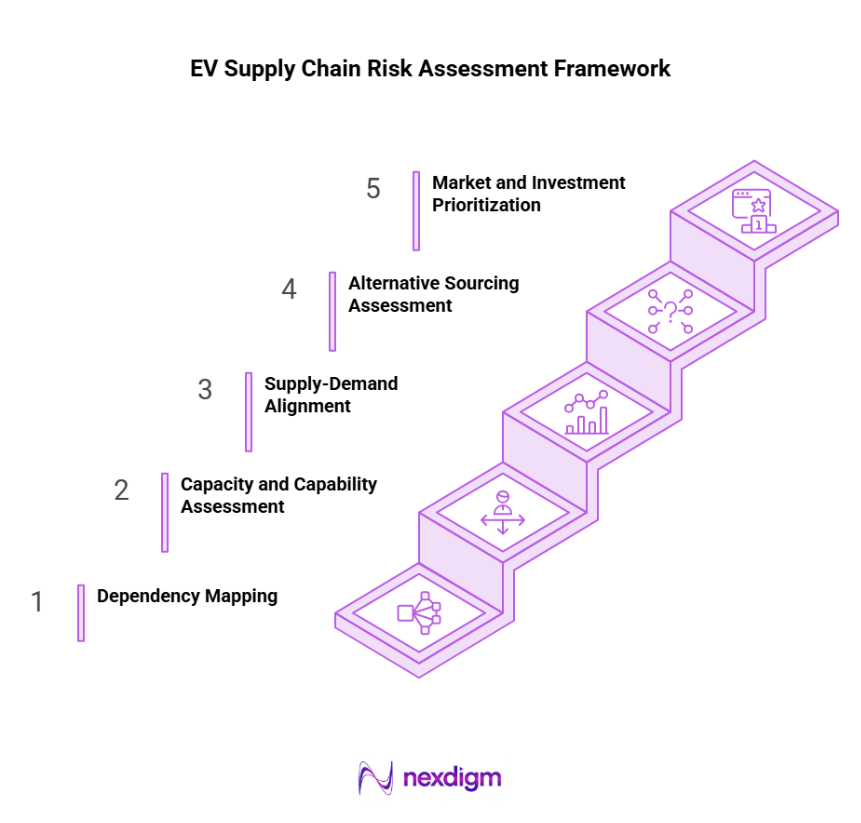
- Dependency Mapping: Identify concentration across critical materials, batteries, components, suppliers, and origin countries to determine where reliance on limited sources could create exposure.
- Capacity and Capability Assessment: Evaluate existing and planned manufacturing capacity, supplier capabilities, production investments, technology, and infrastructure to understand where supply strength is developing.
- Supply-Demand Alignment: Compare EV sales, vehicle production, battery demand, component requirements, and regional capacity to identify potential shortages, surpluses, or future sourcing pressure.
- Alternative Sourcing Assessment: Screen alternative suppliers and countries based on trade activity, production readiness, cost conditions, infrastructure, logistics, and market access.
- Market and Investment Prioritization: Combine supply-chain, demand, competitive, and market-access indicators to rank markets, suppliers, production hubs, and investment opportunities.
This framework moves from identifying dependencies to evaluating capacity and alternatives, giving businesses a structured basis for strengthening EV sourcing strategies and reducing supply-chain exposure.
Nexdigm’s Case
Nexdigm supported an automotive-sector client by assessing EV supply-chain exposure across 14 markets and 20 critical product categories. The analysis identified more than 30% growth in selected battery-material flows, while three supplier countries accounted for over 50% of targeted imports. It also identified six alternative sourcing markets, helping the client strengthen sourcing diversification and supply-chain planning.
To take the next step, simply visit our Request a Consultation page and share your requirements with us.
Harsh Mittal
+91-8422857704