

With Electronic Health Record adoption exceeding in developed markets, the focus in healthcare has shifted from implementation to performance optimization and value realization. Electronic health record benchmarking now plays a critical role in evaluating how effectively organizations use EHR systems to improve clinical outcomes, efficiency, and data integration.
EHR usage continues to deepen, with over 85% of hospitals in markets like Western Europe and Australia operating fully digital record systems. Studies from HIMSS show that more than 70% of providers are advancing toward higher interoperability maturity levels. Additionally, nearly 65% of healthcare organizations are integrating EHRs with analytics and AI tools, highlighting a shift from adoption to optimization making Electronic health record benchmarking critical for evaluating performance, efficiency, and innovation.
Linked closely with competitive intelligence, it enables healthcare providers to compare capabilities, identify gaps, and track best practices. This approach supports informed decision-making, helping organizations enhance interoperability, optimize workflows, and maintain a competitive edge in an increasingly digital healthcare environment.
Electronic Health Record Benchmarking for Competitive Performance Evaluation
Electronic health record benchmarking for competitive performance evaluation involves comparing EHR usage, efficiency, interoperability, and outcomes across organizations to identify gaps, improve workflows, and enhance data-driven decision-making and competitive positioning.
Workflow Efficiency Measurement
Examines impact of EHRs on clinical and administrative processes, identifying delays, redundancies, and opportunities for streamlined operations.
Clinical Outcome Evaluation
Measures how EHR usage contributes to patient outcomes, safety, and quality of care through better data access and decision support.
User Adoption and Experience
Analyzes clinician and staff engagement with EHR systems, identifying usability challenges and adoption barriers affecting performance.
Compliance and Data Security
Reviews adherence to regulations and data protection standards, ensuring secure handling of patient information within EHR systems.
Continuous Improvement and Optimization
Identifies opportunities to enhance EHR performance through updates, training, and integration with advanced analytics and AI tools.
Nexdigm Driving Value from High EHR Adoption Through Advanced Analytics
Nexdigm Driving Value from High EHR Adoption Through Advanced Analytics focuses on helping healthcare organizations move beyond basic EHR usage to extract meaningful insights. By applying advanced analytics, AI, and data integration, Nexdigm enables improved clinical decision-making, operational efficiency, and patient outcomes. Its approach enhances data utilization, identifies performance gaps, and supports predictive insights, allowing organizations to maximize ROI and achieve measurable value from widespread EHR adoption.
Nexdigm Improving Decision-Making Through Integrated EHR Analytics
Nexdigm improves decision-making through integrated EHR analytics by combining clinical, operational, and financial data to deliver real-time insights, enabling faster, data-driven decisions and improved healthcare outcomes:
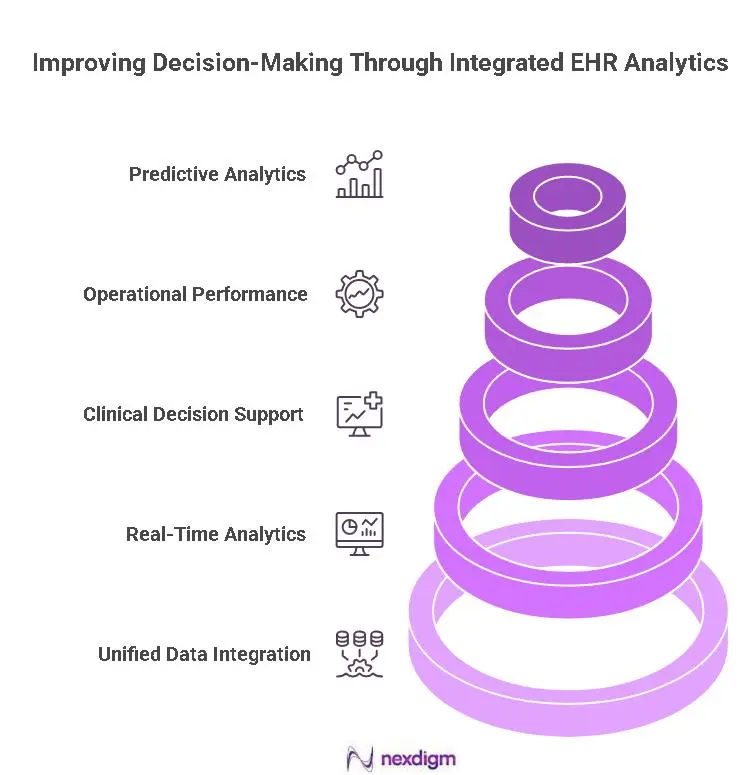
Unified Data Integration
Integrates clinical, operational, and financial data from EHR systems to create a single, reliable source for comprehensive healthcare insights.
Real-Time Analytics and Dashboards
Provides live data visualization and dashboards, enabling faster monitoring of performance and timely, informed decision-making across healthcare functions.
Clinical Decision Support
Uses analytics to assist clinicians with evidence-based recommendations, improving diagnosis accuracy, treatment planning, and overall patient care outcomes.
Operational Performance Insights
Analyzes workflows and resource utilization to identify inefficiencies, optimize processes, and enhance productivity in administrative and clinical operations.
Predictive and Prescriptive Analytics
Leverages historical and real-time data to forecast trends, anticipate risks, and recommend actions for proactive healthcare management.
Nexdigm’s case:
A healthcare client engaged Nexdigm to improve operational efficiency and data-driven decision-making through analytics-led process transformation. Nexdigm’s analytics-driven pricing strategy helped a hospital network achieve a 15% increase in revenue, demonstrating the impact of data-backed insights on financial and operational performance.
To take the next step, simply visit our Request a Consultation page and share your requirements with us.
Harsh Mittal
+91-8422857704