

Electronic health records have moved from being a digital alternative to paper records to becoming the core technology layer connecting clinical and administrative workflows. As of 2024, 99.4% of U.S. non-federal acute care hospitals had adopted a certified EHR, while 91% of office-based physicians reported using a certified EHR.
The hospital EHR market has also become substantially more concentrated. In 2024, the three largest EHR developers served more than 80% of hospitals, with the leading developer alone serving 50.8% of hospitals.
Interoperability is another important differentiator. In 2024, 91% of hospitals integrated data from third-party technology for at least one clinical purpose, although only 52% used standards-based APIs for that clinical integration. Administrative integration stood at 87%, with 35% using standards-based APIs.
Against this backdrop, the electronic health record supplier landscape is best understood through more than market share. Clinical functionality, interoperability, implementation capabilities, scalability, and the ability to support different healthcare environments all influence how vendors compare.
Market Leadership Does Not Mean Identical Capability
EHR vendors operate at different points across the healthcare technology landscape. Some provide broad enterprise platforms, while others have stronger positions in particular hospital sizes, specialties, ambulatory environments, or workflow areas. Market share can indicate scale, but it does not by itself explain clinical depth, interoperability, usability, or organizational fit. For healthcare organizations, comparing vendors therefore requires a multidimensional view of both market position and functional relevance.
Factors That Shape the EHR Vendor Positioning
A practical comparison of EHR Vendor Positioning can start with three questions:
- How Deep Is Clinical Functionality? Examine clinical documentation, orders, results, decision support, care coordination, specialty workflows, and patient-facing capabilities.
- How Well Does It Connect? Assess interoperability, APIs, data exchange, third-party integration, and the ability to connect inpatient, outpatient, and external systems.
- How Far Can It Scale? Consider hospital size, multi-site deployment, user capacity, implementation resources, geographic reach, and the ability to support evolving requirements.
Together, these dimensions provide a clearer basis for understanding which vendors lead in scale, and which differentiate through capability or fit.
Where EHR Vendors Create Differentiated Value
EHR platforms can create value differently depending on an organization’s care model, technology environment, and operational priorities. Nexdigm can assess these differences across key areas:
- Clinical Workflow Enablement: Evaluate how effectively vendors support documentation, ordering, decision support, specialty workflows, and care coordination across different clinical environments.
- Connected Care & Data Access: Assess interoperability, information exchange, data accessibility, third-party connectivity, and the ability to support coordinated care across inpatient, outpatient, and affiliated settings.
- Operational & Enterprise Value: Examine how platforms support administrative coordination, analytics, scalability, multi-site deployment, and broader organizational requirements as healthcare operations evolve.
This perspective helps organizations understand where vendors create differentiated value and which capabilities are most relevant to their specific care and operating models.
Nexdigm’s EHR Competitive Assessment Approach
Nexdigm can translate these areas of differentiated value into a structured electronic health record supplier landscape assessment, helping organizations compare vendors on factors that influence both current performance and future relevance:
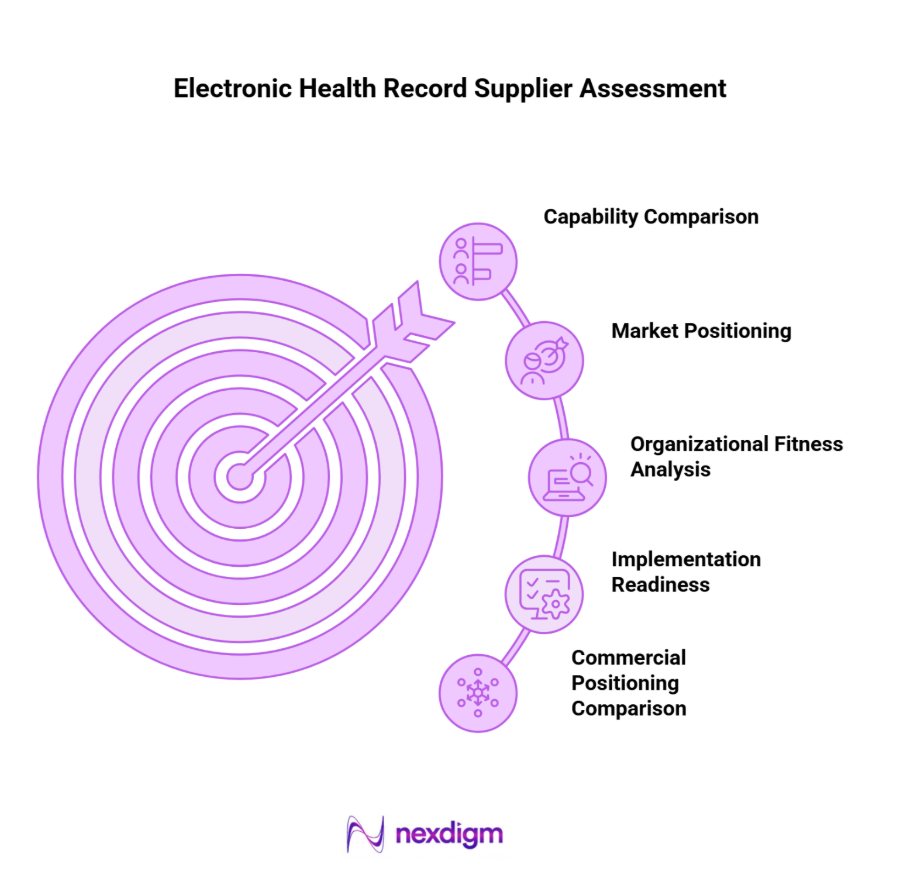
- Capability Comparison: Benchmark vendors across clinical functionality, interoperability, usability, analytics, and administrative capabilities to identify meaningful differences in platform performance.
- Market Positioning: Examine vendor scale, healthcare footprint, implementation experience, technology direction, and areas of specialization to understand competitive standing.
- Organizational Fit: Assess how each vendor’s strengths align with the organization’s care model, technology environment, operational priorities, and future requirements.
- Implementation Readiness: Evaluate deployment resources, migration capabilities, customization requirements, training, support infrastructure, and implementation experience across comparable healthcare environments.
- Commercial Positioning: Compare licensing structures, implementation costs, support models, contract flexibility, and lifecycle economics to understand the broader value proposition.
This approach makes electronic health record supplier landscape analysis more actionable, helping organizations understand where vendors outperform alternatives and which differences are strategically meaningful for their EHR decisions.
What Makes Nexdigm’s EHR Assessment Approach Different
Nexdigm’s approach goes beyond ranking EHR vendors on standalone capabilities. It connects market intelligence, technology assessment, healthcare context, and procurement considerations to create a more decision-oriented view of:
- Market-to-Technology View: Connect vendor market position with clinical functionality, interoperability, implementation capabilities, and technology direction to understand the reasons behind competitive differences.
- Decision-Oriented Analysis: Translate vendor strengths and gaps into practical implications for shortlisting, negotiations, implementation planning, and long-term technology strategy.
- Cross-Functional Areas: Consider clinical, operational, technology, and commercial factors together, recognizing that EHR decisions affect multiple stakeholders across the healthcare organization.
With this approach, Nexdigm makes the electronic health record supplier landscape more than a vendor directory; it becomes a structured decision tool for evaluating competitive positioning, organizational fit, and procurement priorities.
Nexdigm’s Case
Nexdigm supported a healthcare organization in benchmarking 28 EHR vendors across clinical functionality, interoperability, implementation readiness, and commercial positioning. The assessment identified 27% with stronger clinical capabilities, 21% with broader interoperability, and 15% with greater implementation readiness, helping the organization refine its shortlist and focus detailed evaluation on the most relevant vendors.
To take the next step, simply visit our Request a Consultation page and share your requirements with us.
Harsh Mittal
+91-8422857704