

Non-bank platforms like vertical SaaS, marketplaces, and gig-work apps already hold what legacy banks spend billions to acquire: direct, daily customer attention. Integrating financial products into these existing workflows bypasses traditional acquisition costs entirely.
The prize is substantial.
Embedded transactions in non-bank US platforms are forecast to top $7 trillion, driving a global market projected to hit $454 billion by 2031.
Monetization hinges on transaction velocity, workflow stickiness, proprietary customer data, and natural product relevance. Platforms that treat financial tools as logical workflow extensions will capture meaningful margins; those that treat them as bolt-on add-ons will see weak adoption.
The Platform Already Has the Customer
Embedded finance changes how financial products reach users. Instead of asking customers to leave a software platform and interact with a separate bank or fintech, payments, lending, insurance, or financial accounts can be incorporated into the workflow they already use.
Each vertical software owns distinct data: restaurant tools track order volumes, field-service apps manage job invoicing, marketplaces monitor buyer-seller trades, and payroll systems trace recurring employee wages.
That context creates opportunities to offer financial services at the point where a customer is already making a relevant financial decision.
Transaction Density Creates the Opening
Not every digital platform has the same embedded-finance potential.
The strongest candidates tend to have frequent financial interactions and a direct connection to the underlying commercial activity.
Toast, the restaurant technology company processed $195.1 billion in gross payment volume across 164,000 live locations, while financial technology solutions generated approximately 82% of its FY2025 total revenue.
A platform with recurring transaction data can potentially build adjacent services around the same relationship, including working capital, payouts, payroll, or other financial products.
This makes transaction density a useful indicator of opportunity. A platform used once every few months has fewer natural moments to introduce financial services than one embedded in a business’s daily operations.
Some Business Models Have More to Monetize
The opportunity varies considerably by platform type.
- Vertical SaaS platforms can connect payments and financing directly to industry workflows. Healthcare, hospitality, retail, and field services are particularly relevant because financial activity is closely tied to operational transactions.
- B2B platforms can potentially support invoice financing, supplier payments, equipment finance, or other services linked to commercial transactions.
- Marketplaces can embed payouts, working capital, insurance, or payment products for sellers and service providers.
- Workforce platforms can connect payroll infrastructure with services such as earned-wage access, savings, or employee financial products.
A financial service that feels disconnected from the core workflow is harder to adopt and more difficult to differentiate.
Financial Products Must Fit the Workflow
Embedded finance works best when the financial product appears at the moment it becomes useful.
Different users need capital at different points in their routine: contractors want immediate invoice factoring, sellers need instant payouts, retailers require integrated POS reconciliation, and employers’ benefit from credit tied directly to payroll runs.
This creates several potential monetization routes:
- Payments and merchant acceptance
- Business lending and working capital
- Seller or contractor payouts
- Insurance
- Banking and account services
- Payroll-linked financial products
- Invoice and trade financing
A large user base alone does not guarantee revenue.
Commercial success requires an active incentive for customers to move their core financial activity into the software.
Infrastructure and Regulation Set the Boundaries
Embedded finance brings obligations standard software models never face: KYC verification, AML monitoring, fund safeguarding, ledger reconciliation, and strict regulatory compliance.
The 2024 collapse of middleware provider Synapse made the stakes obvious.
Over $265 million in customer deposits froze alongside a $95 million ledger shortfall, exposing the severe operational risks of weak oversight and broken reconciliations.
Partner selection is therefore a fundamental risk decision, not just a technical integration. The primary challenge is not finding popular financial features, but ensuring partner banks and BaaS layers can reliably run compliant operations at scale.
Nexdigm’s Embedded Finance Opportunity Map
An Embedded finance market opportunity study should determine whether a platform has the commercial characteristics required to monetize financial services. Nexdigm can assess the opportunity across five areas:
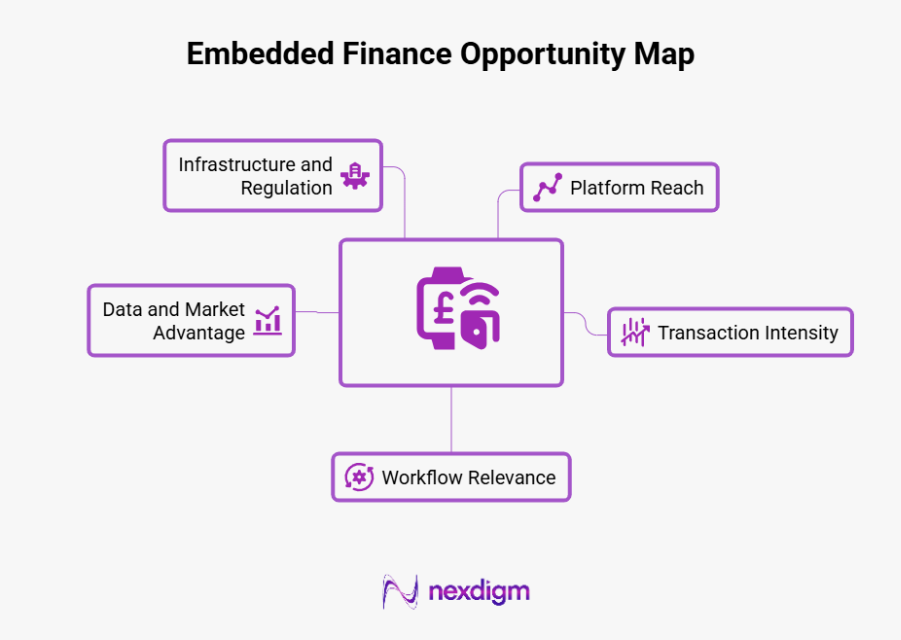
- Platform reach: Evaluate customer base, retention, industry concentration, and geographic presence.
- Transaction intensity: Assess the frequency and value of payments, invoices, sales, payroll, or other financial interactions.
- Workflow relevance: Identify financial needs that naturally arise within the platform’s existing customer journey.
- Data and market advantage: Determine whether the platform has useful operational information that can improve product targeting, underwriting, or customer engagement.
- Infrastructure and regulation: Assess banking partners, licensing requirements, compliance responsibilities, and operational readiness.
This helps distinguish platforms where embedded finance can become a meaningful revenue stream from those where the investment would be difficult to justify.
How Nexdigm Identifies Platforms Ready for Financial-Service Expansion
A vertical software provider with more than $250 million in annual payment volume evaluated whether to expand beyond software into embedded payments and financial products. Nexdigm assessed transaction activity, customer adoption potential, regulatory infrastructure, and product fit to identify the financial services with the strongest expansion potential.
Embedded finance is ultimately a distribution opportunity. The platforms best positioned to capture it already possess customer trust, frequent financial interactions, and a clear connection between their core workflow and the financial product being offered.
To take the next step, simply visit our Request a Consultation page and share your requirements with us.
Harsh Mittal
+91-8422857704
[email protected]