

Embedded systems markets are expanding across automotive, industrial, and consumer applications as connected devices, automation, smart electronics, and real-time control technologies become more widely adopted. These systems support critical functions in vehicles, factory equipment, medical devices, appliances, wearables, and IoT-enabled products.
As demand grows, businesses entering this space need a structured market entry strategy to assess customer needs, technology requirements, regulatory standards, supply chain readiness, and regional growth potential. A focused Embedded systems market entry strategy helps companies position their solutions effectively, manage operational risks, and capture opportunities across fast-evolving hardware and software-driven markets.
Market data shows steady expansion, the global embedded systems market was valued at approximately USD 112.3 billion in 2024 and is projected to reach around USD 169.1 billion by 2030, growing at nearly 7.1% CAGR. Another estimate places the 2025 market near USD 117.05 billion, with growth supported by automotive electronics, industrial automation, IoT devices, and consumer smart products. These trends strengthen the need for a focused Embedded systems market entry strategy.
Strengthening Market Entry Strategy for Embedded Systems Growth Opportunities
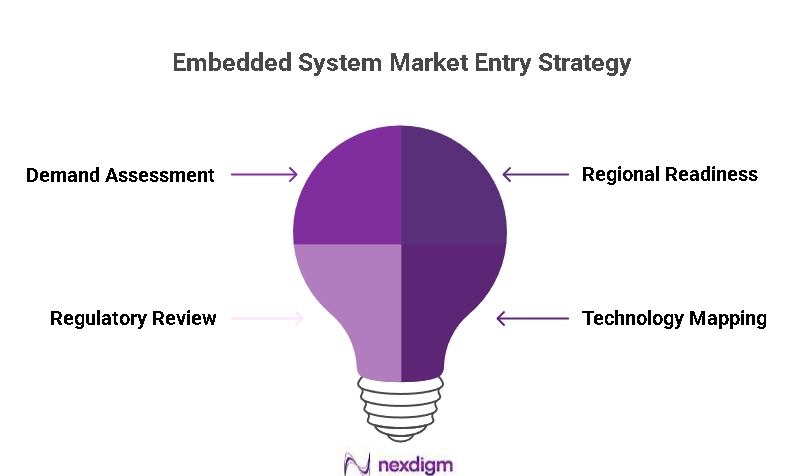
Strengthening market entry strategy for embedded systems growth opportunities helps businesses assess demand, regulations, technology requirements, supply chain readiness, partnerships, and regional adoption across automotive, industrial, and consumer applications:
-
Demand Assessment Across Applications
Evaluate embedded systems demand across automotive, industrial, healthcare, consumer electronics, and IoT applications to identify priority growth opportunities.
-
Regional Market Readiness
Assess infrastructure, technology adoption, customer maturity, policy support, and ecosystem strength before entering new embedded systems markets.
-
Regulatory and Certification Review
Review safety standards, product certifications, data rules, import requirements, and sector-specific compliance obligations before market entry.
-
Technology Requirement Mapping
Analyze processor needs, connectivity standards, software compatibility, security features, and real-time performance requirements for target applications.
Nexdigm’s Tax and Structuring Advisory for Embedded Systems Businesses
Nexdigm’s Tax and Structuring Advisory for Embedded Systems Businesses helps companies evaluate suitable legal, tax, and operating structures for market entry. Nexdigm supports compliance planning, cross-border considerations, incentive assessment, and risk review, enabling embedded systems businesses to enter new markets efficiently while aligning with long-term growth objectives.
Nexdigm’s Operational Readiness Support for Embedded Systems Companies
Nexdigm’s Operational Readiness Support for Embedded Systems Companies helps businesses plan workforce needs, vendor coordination, compliance processes, reporting workflows, implementation timelines, and scalable operations for market entry.
-
Workforce Planning Support
Nexdigm helps assess staffing requirements, skill availability, hiring priorities, and workforce planning needs for embedded systems market entry.
-
Vendor and Partner Coordination
Nexdigm supports vendor identification, partner evaluation, service coordination, and operating model alignment for embedded systems business setup.
-
Compliance Process Setup
Nexdigm helps establish compliance workflows, documentation processes, reporting systems, and regulatory tracking for smooth embedded systems operations.
-
Implementation Timeline Planning
Nexdigm assists in defining setup milestones, approval timelines, resource allocation, and execution steps for structured market entry.
Nexdigm’s case:
Nexdigm helped an embedded systems developer plan market entry across automotive and industrial applications, where demand for connected control solutions was expected to grow by over 7% annually. The company assess operational readiness, workforce needs, vendor coordination, compliance workflows, and implementation timelines. With Nexdigm’s support, the company reduced setup planning time by 25% and identified four priority operational workstreams.
To take the next step, simply visit our Request a Consultation page and share your requirements with us.
Harsh Mittal
+91-8422857704