

Global sourcing is moving toward a more distributed model as businesses seek alternatives to concentrated supply markets. QIMA’s 2026 Global Sourcing Survey found that 43% of supply chains changed sourcing locations in 2025, while only 18% reported full end-to-end supplier visibility. The survey also found that new US sourcing activity flowed mainly toward Vietnam, India, Bangladesh, and Mexico.
Meanwhile, QIMA’s latest 2026 data shows that North American sourcing from China rebounded to 40% of inspection and audit volumes in September, while nearshoring and reshoring remained limited at 6% in North America and 12% in the EU. These shifts make emerging supplier markets research increasingly important for identifying where new production capabilities, competitive costs, and alternative supply ecosystems are developing.
The New Geography of Global Sourcing
Emerging supplier markets are not defined by low costs alone. Their attractiveness increasingly depends on manufacturing capability, infrastructure, skilled labor, trade connectivity, supplier depth, regulatory conditions, and proximity to demand. Southeast Asia continues to strengthen its position, while markets across South Asia, Mexico, and the Mediterranean are attracting attention as companies diversify their sourcing footprints. QIMA reported that Southeast Asian sourcing activity increased 24% year-on-year in 2025, led by Vietnam and Thailand.
Indicators That Reveal an Emerging Supplier Hub
Identifying a promising sourcing market requires looking for signals that indicate whether supplier growth can become commercially sustainable.
- Capacity and Investment Signals: Track factory expansion, foreign investment, production growth, infrastructure development, and supplier formation to identify markets building meaningful industrial capacity.
- Cost and Market Signals: Compare labor, materials, energy, logistics, tariffs, trade access, and supplier competition to determine whether a market offers sustainable cost advantages.
Together, these signals provide a stronger basis for distinguishing temporary sourcing shifts from emerging supplier markets with longer-term potential.
Nexdigm’s Expert-led View on Emerging Supplier Markets
Nexdigm helps businesses look beyond established sourcing locations to understand where the next viable supplier ecosystems may be developing. Through market intelligence, supplier research, trade analysis, cost assessment, and industry expertise, Nexdigm evaluates emerging markets from both commercial and operational perspectives.
The focus is not simply on identifying countries with lower production costs. It is on understanding whether a market has the supplier depth, capabilities, infrastructure, economics, and scalability required to support a sustainable sourcing strategy.
How Nexdigm Identifies Emerging Hubs and Supplier Markets
Nexdigm’s emerging supplier markets research can combine multiple market signals to build a forward-looking view of sourcing opportunities. These signals are:
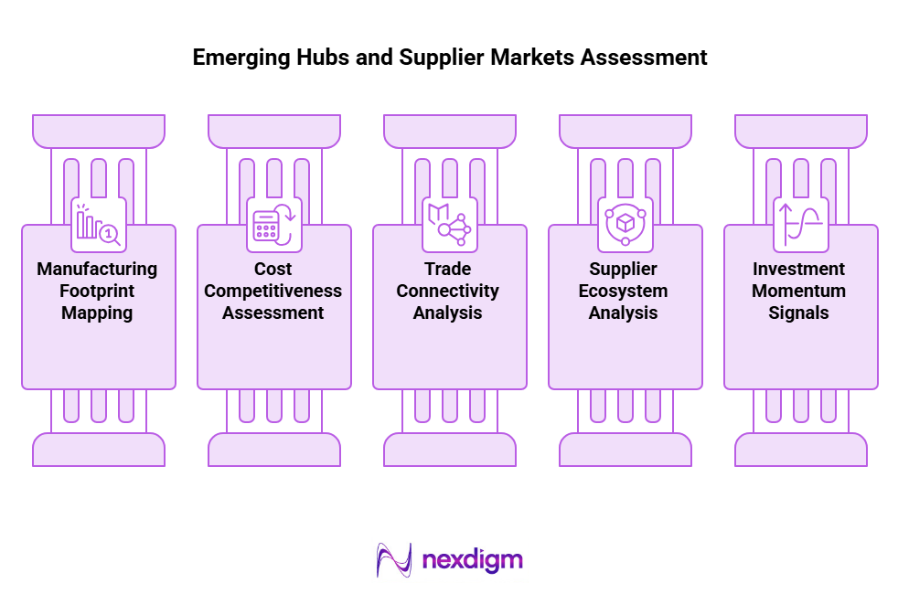
- Manufacturing Footprint: Nexdigm maps existing suppliers, production clusters, manufacturing capabilities, new facilities, and capacity additions to understand where industrial ecosystems are developing.
- Cost Competitiveness: Labor costs are assessed alongside energy, raw materials, logistics, duties, taxes, and other location-specific factors to determine the total sourcing economics.
- Trade Connectivity: Trade flows, export growth, port infrastructure, tariff conditions, trade agreements, and access to major demand markets are considered when assessing a location’s sourcing potential.
- Supplier Ecosystem: A country may offer low production costs but limited supplier depth. Nexdigm therefore examines the availability of component suppliers, specialized manufacturers, service providers, and supporting industries.
- Investment Momentum: Foreign direct investment, announced capacity additions, industrial parks, and expansion activity can provide signals of whether a market is developing into a stronger manufacturing base.
Assessing these signals helps businesses identify whether an emerging market can complement or replace existing sourcing locations.
Why Businesses Partner With Nexdigm for Conducting Supplier Market Research
Experts at Nexdigm combine market research, supplier intelligence, trade analysis, cost assessment, and sector expertise to help businesses evaluate emerging sourcing locations in context.
This enables procurement and strategy teams to distinguish between markets that are simply gaining attention and those that demonstrate the capacity, competitiveness, supplier depth, and strategic relevance required for sustainable sourcing.
Nexdigm’s Identification Approach Creating New Sourcing Opportunities
Nexdigm’s identification approach helps businesses move from broad market signals to specific sourcing opportunities by:
- Identifying Emerging Supply Pools: Mapping new manufacturers, production clusters, and supplier ecosystems that could expand sourcing options beyond established markets.
- Assessing Commercial Potential: Comparing cost structures, pricing conditions, logistics, trade factors, and supplier competition to identify markets offering sustainable sourcing advantages.
- Evaluating Operational Readiness: Examining production capacity, technical capabilities, quality standards, infrastructure, and scalability to determine whether emerging suppliers can meet requirements.
- Prioritizing Sourcing Opportunities: Ranking markets and supplier clusters according to commercial attractiveness, strategic relevance, diversification value, and alignment with specific sourcing objectives.
This approach helps businesses convert emerging-market signals into a focused pipeline of credible sourcing opportunities.
Nexdigm’s Case
Nexdigm assessed 9 emerging sourcing markets across 22+ commercial and operational indicators, identifying markets with stronger supplier-development potential and 6 priority supplier clusters for further qualification. The assessment highlighted a 14% potential cost advantage across selected categories, helping the client expand its sourcing pipeline and reduce geographic concentration.
To take the next step, simply visit our Request a Consultation page and share your requirements with us.
Harsh Mittal
+91-8422857704