

Food and beverage procurement involves a connected set of decisions: identifying suppliers, verifying capabilities, comparing commercial terms, assessing risk, and monitoring spend after contracts are awarded. When these activities are managed separately, businesses may have extensive vendor lists but limited visibility into which suppliers offer the strongest overall value.
End-to-end procurement intelligence links market research with purchasing data so that sourcing decisions reflect external market conditions as well as internal demand and performance.
Build a Clear Supplier Landscape
The first stage is to map the supply base by category, product specification, geography, supplier type, and available capacity. Food manufacturers, ingredient processors, distributors, packaging suppliers, and logistics providers should not be evaluated using identical criteria.
India’s food processing sector recorded a gross value added of ₹2.24 lakh crore in 2023-24, according to government estimates published by the Ministry of Food Processing Industries. This expanding production base creates a broad supplier landscape, but supplier selection still requires product-level assessment of capacity, quality, commercial fit, and market access.
Connect Market Intelligence to Spend
External market information can explain changes in input prices, supplier availability, trade flows, and sourcing alternatives. Internal purchasing records reveal whether those changes are reflected in actual invoices, contract renewals, freight charges, or order volumes.
For end-to-end procurement research intelligence in F&B, the two perspectives should be connected. A rise in an agricultural commodity index may signal cost pressure, but it does not automatically justify an equivalent increase in a finished ingredient’s price. Processing, packaging, inventory, logistics, and contract timing also affect the final cost.
Evaluate Suppliers Beyond Price
A comprehensive supplier assessment should combine commercial terms with delivery performance, product quality, capacity, compliance, and continuity risk. This helps distinguish suppliers that are inexpensive on paper from those that offer reliable supply at a competitive total cost.
Spend analysis should also reveal concentration. Several vendors may depend on the same upstream producer, geographic region, or transport route. Mapping these connections can identify vulnerabilities that a conventional supplier-by-supplier review would miss.
F&B Procurement Intelligence Framework
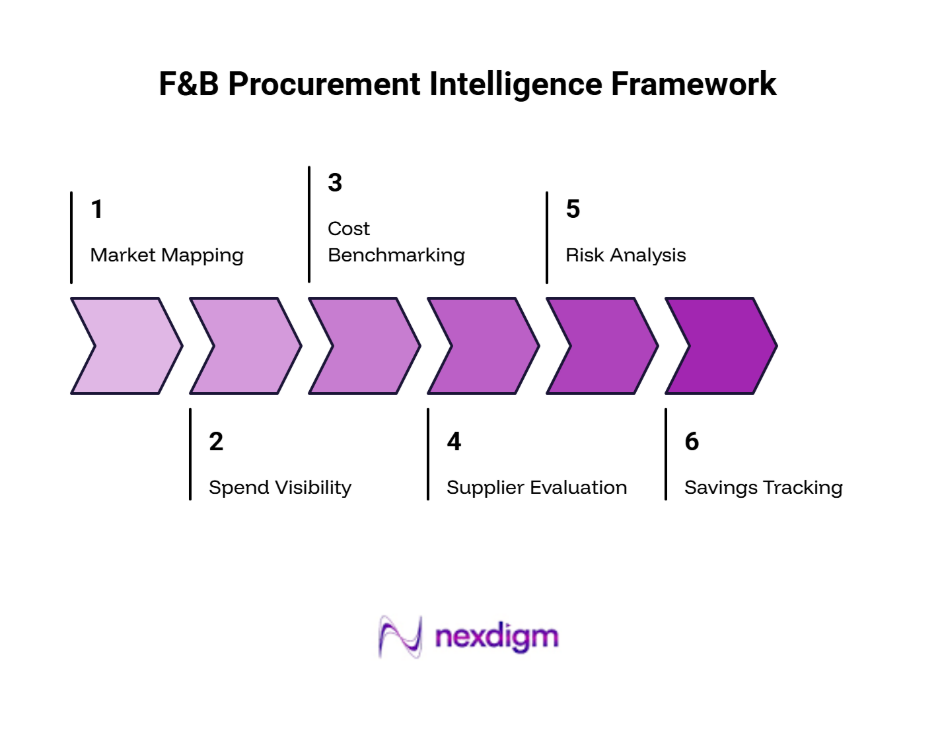
- Market Mapping: Identify suppliers, production regions, product capabilities, alternative sources, and market structures for each priority category.
- Spend Visibility: Consolidate purchase orders, invoices, contracts, freight charges, rebates, and supplier records to establish a consistent view of expenditure.
- Cost Benchmarking: Compare equivalent products and services against supplier quotations, contractual terms, and relevant official market indicators to explain price differences.
- Supplier Evaluation: Assess quality, capacity, delivery performance, compliance, service coverage, and commercial terms using category-specific evaluation criteria.
- Risk Analysis: Map single-source dependencies shared upstream suppliers, geographic exposure, lead times, and the availability of qualified alternatives.
- Savings Tracking: Prioritise negotiation, consolidation, specification changes, and alternative sourcing opportunities, then measure results against a baseline adjusted for volume and product mix.
Turn Intelligence Into Procurement Action
Procurement intelligence should produce clear decisions: which suppliers to qualify, where to negotiate, which categories need alternative sources, and where spending should be monitored more closely. Results should be reviewed regularly because input prices, supplier capacity, product demand, and regulatory requirements change over time.
Nexdigm’s Case Study
A food manufacturer with ₹42 crore in annual external procurement spend consolidated supplier, invoice, and contract data across six categories. The assessment identified inconsistent pricing and concentrated sourcing in three critical inputs. A prioritised sourcing plan targeted a 4% reduction in addressable spend while qualifying alternatives for high-risk categories.
To take the next step, simply visit our Request a Consultation page and share your requirements with us.
Harsh Mittal
+91-8422857704