

Endpoint security is becoming increasingly important as organizations manage distributed workforces, cloud workloads, connected devices, and increasingly sophisticated attacks. The traditional antivirus model is giving way to EDR, XDR, behavioral detection, device control, automated response, and integrated endpoint protection.
Recent threat data highlights the urgency. Verizon’s 2026 Data Breach Investigations Report found that 31% of breaches began with vulnerability exploitation, making it the leading initial-access vector for the first time in the report’s 19-year history. Only 26% of critical vulnerabilities were fully remediated in 2025, while the median resolution time increased to 43 days.
For cybersecurity vendors, endpoint-security providers, CISOs, MSSPs, investors, technology companies, and system integrators, these developments raise important commercial questions related to where the endpoint-security demand growing and which organizations are adopting EDR and XDR.
For this, an Endpoint security demand analysis helps them evaluate the adoption across EDR, XDR, endpoint protection platforms, device control, behavioral detection, automated response, managed endpoint security, and emerging AI-security requirements to identify attractive endpoint-security opportunities.
Endpoint Security Is Becoming a Core Cybersecurity Priority
As organizations expand digital operations across employees, devices, applications, and cloud environments, endpoints have become one of the most critical components of the security landscape.
Increasing attack sophistication, distributed work models, and growing device connectivity are driving demand for solutions that provide greater visibility, faster threat detection, and improved response capabilities across endpoint ecosystems.
The expanding endpoint attack surface is accelerating demand for advanced security capabilities, creating growth opportunities across detection, response, device management, and endpoint protection technologies.
How Nexdigm Helps Identify Endpoint Security Demand
The endpoint security market is evolving rapidly as organizations move beyond traditional antivirus solutions toward advanced capabilities such as EDR, XDR, behavioral analytics, automated response, and AI-enabled threat detection.
In this dynamic environment, understanding where adoption is accelerating, Nexdigm helps businesses, investors, cybersecurity vendors, and technology providers evaluate demand trends, technology adoption patterns, customer requirements, and competitive dynamics.
This enables organizations to identify high-potential market segments, assess commercial opportunities, and align growth strategies with the evolving endpoint security landscape.
Why Understanding Endpoint Security Demand Matters
As organizations strengthen endpoint security strategies, understanding where demand is accelerating is critical for growth and investment decisions. Adoption patterns across EDR, XDR, behavioral analytics, device control, and automated response technologies can provide valuable insight into evolving enterprise security requirements, budget priorities, and market opportunities.
Creating Competitive Advantage with Nexdigm
In a rapidly evolving endpoint security market, competitive advantage depends on understanding where customer demand, technology adoption, and security investments are headed.
Nexdigm helps organizations identify emerging opportunities, anticipate market shifts, and align product, investment, and growth strategies with its framework analysis model. This enables businesses to strengthen market positioning, focus resources on high-potential opportunities, and build sustainable competitive differentiation.
Nexdigm’s Endpoint Security Demand Analysis Framework
As endpoint security adoption accelerates, organizations need a structured approach to evaluate demand patterns, technology preferences, and commercial opportunities. Through its endpoint security demand analysis, Nexdigm assesses key market drivers to help organizations through:
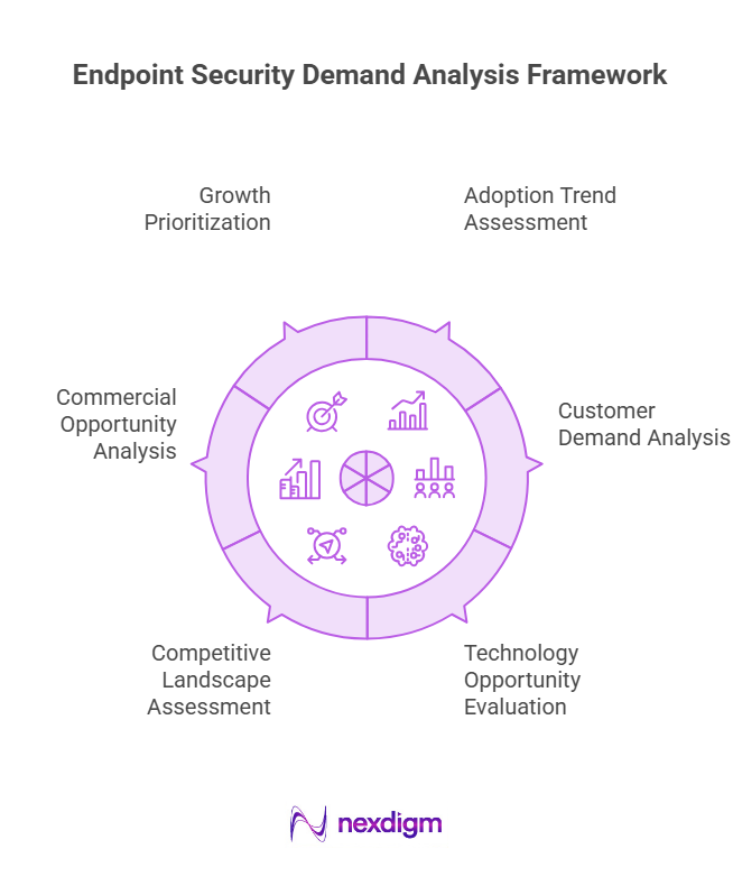
- Adoption Trend Assessment: Evaluating enterprise adoption across EDR, XDR, endpoint protection platforms, device control, behavioral analytics, and automated response capabilities.
- Customer Demand Analysis: Assessing security priorities, purchasing behavior, technology requirements, and investment drivers across industries and enterprise segments.
- Technology Opportunity Evaluation: Analyzing demand for advanced endpoint-security capabilities, including AI-driven threat detection, threat intelligence, and integrated security platforms.
- Competitive Landscape Assessment: Reviewing vendor positioning, market maturity, competitive intensity, and differentiation opportunities across endpoint-security categories.
- Commercial Opportunity Analysis: Evaluating market growth, customer spending patterns, and emerging demand areas to identify attractive commercial opportunities.
- Growth Prioritization: Identifying technologies, customer segments, and markets with the strongest potential for sustainable growth and expansion.
By combining insights from the framework analysis, Nexdigm helps organizations identify attractive endpoint-security opportunities and align growth strategies with evolving enterprise security requirements.
Benefits of Nexdigm’s Endpoint Security Demand Analysis Framework
Nexdigm’s framework helps organizations move beyond understanding adoption trends to identifying actionable growth, investment, and market opportunities across the endpoint security ecosystem by providing the following benefits of:
- Identifying High-Growth Security Segments: Identify and understand endpoint-security categories where enterprise demand, technology adoption, and spending are accelerating, enabling better opportunity prioritization.
- Improving Investment Decisions: Evaluate market attractiveness, adoption maturity, and commercial potential to support capital allocation and strategic investment planning.
- Strengthened Competitive Positioning: Understand customer requirements, vendor activity, and market dynamics to identify differentiation opportunities and competitive advantages.
- Optimized Product Strategy: Align product development and solution portfolios with evolving enterprise demand for EDR, XDR, device control, and threat response capabilities.
This framework helps organizations prioritize opportunities, strengthen decision-making, and create long-term business value in the evolving endpoint-security market.
Nexdigm’s Case
A cybersecurity client engaged Nexdigm to assess EDR, XDR, device control, and threat-response opportunities. The assessment identified five priority segments and nine high-potential opportunities, contributing to a 16% increase in projected market opportunity and enabling focused product development, customer targeting, investment allocation, and expansion planning.
To take the next step, simply visit our Request a Consultation page and share your requirements with us.
Harsh Mittal
+91-8422857704