

Reducing factory energy consumption is becoming a strategic priority as manufacturers seek to control operating costs while expanding production. The opportunity is significant: the IEA estimates that industrial energy efficiency improvements could reduce global industrial energy demand by around 15% by 2030 under an accelerated transition pathway.
Meanwhile, global investment in clean energy technologies reached approximately $2.2 trillion in 2025, nearly twice investment in fossil-fuel supply. These trends are encouraging manufacturers to explore technologies that improve efficiency without compromising throughput.
High-efficiency motors, variable-speed drives, industrial heat pumps, advanced process controls, energy-management systems, waste-heat recovery, electrification, and smart automation can help reduce energy intensity while supporting capacity growth. The challenge is identifying which technologies offer the strongest combination of energy savings, production performance, investment economics, and scalability for each manufacturing environment.
Technology Is Enabling Smarter Energy Efficiency in Manufacturing
Manufacturers are increasingly adopting technologies that improve energy performance without restricting production growth. Solutions such as advanced automation, process controls, industrial electrification, digital monitoring, and energy-management systems help optimize resource consumption while maintaining productivity and operational reliability. As energy costs and sustainability expectations rise, technology-driven efficiency is becoming an important source of manufacturing competitiveness.
Balancing Energy Savings with Operational Performance
The success of energy-efficiency initiatives depends not only on reducing consumption but also on preserving production performance. Factors such as implementation cost, payback period, scalability, process compatibility, and operational impact influence technology selection. A structured evaluation helps manufacturers identify solutions that deliver measurable energy savings while supporting capacity utilization, productivity improvements, and future growth objectives.
Nexdigm’s Industry-Led Expertise in Energy Efficiency Technologies
With manufacturers increasingly balancing cost efficiency, sustainability targets, and production growth, technology selection has become a critical strategic decision. Nexdigm helps businesses evaluate energy-efficiency technologies through an Energy efficient manufacturing technology market study, to gain practical understanding of manufacturing operations, energy economics, and industrial performance requirements. This enables organizations to identify solutions that improve energy performance, support operational reliability, and create long-term business value.
Key Evaluation Areas in Nexdigm’s Energy Efficiency Technology Assessment
Nexdigm’s strategic assessment helps manufacturers evaluate energy-efficiency opportunities by focusing on the following key areas:
- Energy Consumption Hotspots: Identify processes, equipment, and operations that contribute most significantly to overall energy usage and efficiency improvement potential.
- Technology-Process Alignment: Assess the suitability of different energy-efficiency technologies based on production requirements, operating conditions, and facility-specific needs.
- Operational Performance Impact: Evaluate how technology adoption may influence throughput, product quality, reliability, maintenance requirements, and overall manufacturing efficiency.
- Investment and Return Potential: Analyze implementation costs, expected savings, payback periods, and long-term financial benefits associated with technology deployment.
- Scalability and Future Readiness: Examine the ability of technologies to support future production growth, sustainability objectives, and evolving operational requirements.
This assessment helps manufacturers develop a clear roadmap for energy-efficiency improvements while balancing operational performance, investment priorities, and long-term growth objectives.
Nexdigm’s Energy Efficiency Technology Assessment Framework
As manufacturers seek to reduce energy consumption while maintaining operational performance, selecting the right technology requires a structured evaluation of technical, operational, and financial considerations. Nexdigm’s Energy efficiency technology assessment framework helps businesses identify solutions through a structured process:
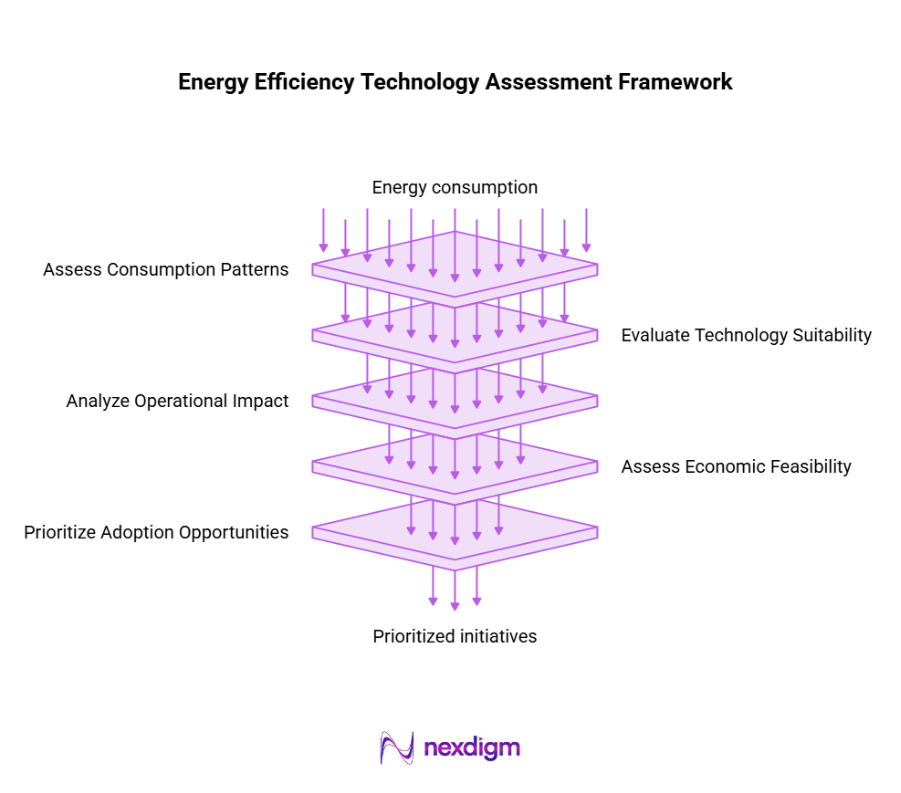
- Assess Energy Consumption Patterns: Analyze energy usage across manufacturing processes, equipment, and utility systems to identify areas with significant efficiency improvement potential and cost reduction opportunities.
- Evaluate Technology Suitability: Assess technologies such as high-efficiency motors, variable-speed drives, industrial heat pumps, automation systems, and waste-heat recovery based on operational requirements.
- Analyze Operational and Production Impact: Evaluate how technology implementation may affect productivity, process efficiency, equipment performance, reliability, and overall manufacturing output across operations.
- Assess Investment and Economic Feasibility: Examine capital requirements, implementation costs, expected savings, payback periods, and long-term financial benefits to support investment decision-making.
- Prioritize Technology Adoption Opportunities: Identify and rank energy-efficiency initiatives based on energy-saving potential, operational benefits, scalability, implementation feasibility, and strategic business objectives.
Through this structured framework, Nexdigm helps manufacturers identify energy-efficiency technologies that reduce operating costs, improve sustainability performance, and support long-term production growth.
Nexdigm’s Technology Assessment Framework Delivering Sustainable Value
Energy-efficiency initiatives can create benefits that extend beyond immediate cost savings. When aligned with operational and strategic objectives, the right technologies can help manufacturers with:
- Lower Operating Costs: Reduced energy consumption and improved resource utilization to enhance overall manufacturing cost competitiveness.
- Improved Operational Efficiency: Support towards more reliable production processes, higher equipment performance, and better utilization of manufacturing assets.
- Enhanced Sustainability Performance: Contribute to emissions reduction, energy management objectives, and broader environmental commitments.
- Greater Scalability: Enabled manufacturing operations to support future capacity growth without proportionate increases in energy consumption.
By connecting energy efficiency with broader business objectives, manufacturers can create lasting value that supports both operational excellence and long-term competitiveness.
Nexdigm’s Case
Nexdigm supported an industrial manufacturer evaluating technologies to reduce factory energy intensity without affecting production targets. The assessment screened 20+ efficiency technologies, analyzed operational factors, and identified 7 priority interventions, helping reduce the technology shortlist by 40% and focus investment on scalable solutions.
To take the next step, simply visit our Request a Consultation page and share your requirements with us.
Harsh Mittal
+91-8422857704