

Engineering outsourcing is changing as products become more software-enabled, regulated and technically complex.
Companies may outsource a complete engineering function, a specialised capability such as testing, or individual stages of product development. The commercial opportunity therefore depends less on the overall engineering-services market and more on identifying which capabilities clients are unwilling or unable to maintain internally.
That distinction is becoming increasingly important as engineering workloads expand across automotive, aerospace, healthcare, industrial technology and other sectors.
The Outsourcing Market Is Moving Toward Specialisation
The global engineering services outsourcing market is estimated at $4.1 billion in 2026 and is projected to reach $15.2 billion by 2033, representing a 20.4% CAGR. Asia Pacific accounted for 40.5% of revenue in 2025.
But the headline market hides significant variation by service.
Grand View Research identifies testing as the largest service segment, while designing is projected to record one of the faster growth rates through 2033.
This creates several distinct outsourcing opportunities.
Where External Capability Enters the Product Lifecycle
- Design and development
Outsourcing can provide additional engineering bandwidth, specialised design expertise or access to capabilities that are difficult to recruit internally. - Prototyping and validation
As products become more complex, external engineering teams can support simulation, prototyping, verification and testing before commercialisation. - Testing and compliance
Testing becomes increasingly important where products face stringent safety, quality and regulatory requirements. - Systems integration
Companies may require external expertise to connect mechanical, electrical, software and digital systems into functioning products.
The demand signal is strongest where internal engineering teams face a capability, capacity or speed constraint.
Why Companies Outsource
Cost remains relevant, but it is rarely the entire decision.
The more useful way to examine engineering outsourcing is through four client pressures:
- Capacity pressure
Internal teams cannot absorb the volume of projects or development cycles. - Capability pressure
The required expertise is specialised or difficult to build internally. - Speed pressure
Companies need to shorten product-development or testing timelines. - Complexity pressure
Products increasingly combine multiple engineering disciplines, software and advanced technologies.
The outsourcing provider that addresses these pressures can compete on value rather than labour cost alone.
Geography Is Part of the Buying Decision
Location influences the outsourcing proposition through talent availability, cost, time-zone overlap, engineering maturity and proximity to end markets.
India’s engineering services outsourcing market is projected to reach $1.32 billion by 2033, with a 21.4% CAGR from 2026 to 2033.
This growth reflects a broader shift toward distributed engineering models, but geographic opportunity still needs to be assessed by capability rather than labour availability alone.
A market with abundant engineers may not be attractive for every service line. The relevant question is whether the workforce has the specific technical depth required by the target industries.
The Capability Gap Is the Real Opportunity
A useful engineering-services assessment should identify where client requirements exceed internal capabilities.
For example, an automotive company may retain core product architecture internally while outsourcing testing and validation. A medical-device company may outsource specialised regulatory testing. An industrial manufacturer may require external support for digital twins, simulation or automation engineering.
These are different markets even though all fall under engineering services.
Nexdigm’s Engineering Capability Demand Matrix
Nexdigm can support engineering services demand assessment research through service-line sizing, customer segmentation, capability mapping, competitor benchmarking and geographic opportunity assessment.
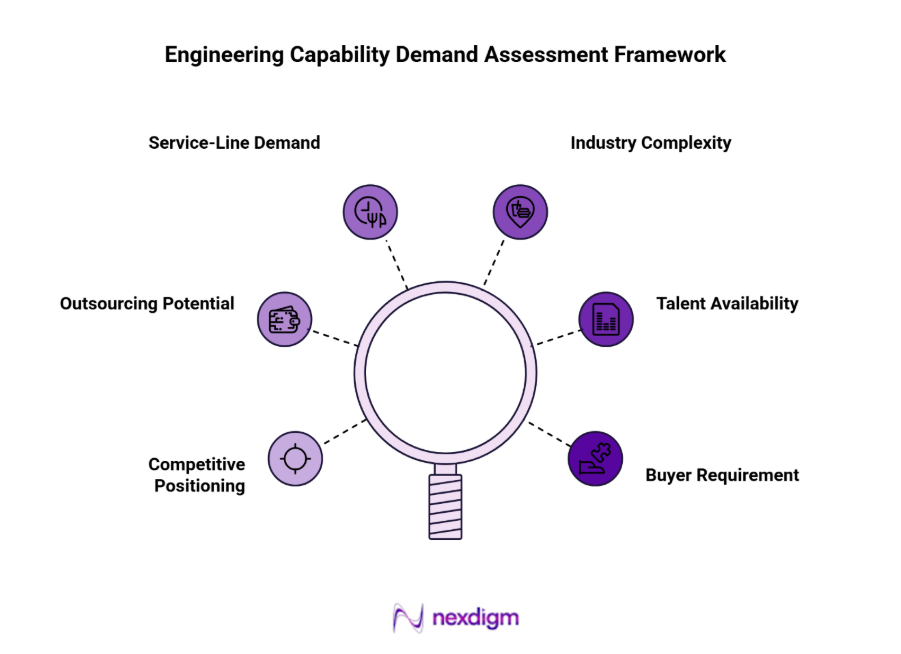
- Service-Line Demand: Measure demand across design, prototyping, testing, integration, simulation and other engineering capabilities.
- Industry Complexity: Identify sectors where product complexity and regulatory requirements increase outsourcing needs.
- Buyer Requirement: Determine whether clients are seeking cost reduction, capacity, specialist expertise or faster development.
- Talent Availability: Assess technical talent pools, experience levels, labour costs and capability depth by geography.
- Competitive Positioning: Benchmark providers by service breadth, domain expertise, delivery model, pricing and customer base.
- Outsourcing Potential: Estimate the addressable work that can realistically move from internal teams to external providers.
This creates a clearer view of where engineering outsourcing demand is expanding and why.
Nexdigm Case Study: Identifying High-Potential Engineering Services
Nexdigm supported an engineering services provider evaluating expansion opportunities across design, testing and product development. The assessment examined a $4.1 billion 2026 outsourcing market, 40.5% Asia Pacific revenue share and service-line demand to identify capability gaps and prioritize target markets.
The analysis helped the client align its service portfolio with higher-demand engineering capabilities and focus expansion efforts on markets with stronger outsourcing potential.
To take the next step, simply visit our Request a Consultation page and share your requirements with us.
Harsh Mittal
+91-8422857704