

Engineering services demand is expanding as manufacturers face a difficult combination: products are becoming more complex while development cycles are becoming shorter.
Vehicles increasingly combine mechanical systems, electronics, embedded software, connectivity, and advanced safety features. Industrial equipment is incorporating sensors, automation, and digital controls. Semiconductor and electronics companies are dealing with increasingly specialised design and testing requirements. Healthcare and aerospace products face additional validation and regulatory requirements.
The result is a broader market for external engineering capabilities.
The more useful question for engineering companies is where that demand is actually forming.
Product Complexity Is Expanding the Engineering Workload
Product development increasingly involves several engineering disciplines simultaneously.
A manufacturer developing an electric vehicle component may require mechanical design, electronics engineering, embedded software, simulation, testing, cybersecurity, and regulatory validation. The same convergence is appearing in industrial machinery, consumer electronics, medical devices, and aerospace systems.
This increases the value of specialist engineering partners because maintaining every capability internally can be expensive, particularly when demand fluctuates between projects.
Recent product-engineering research points to growing demand for design, development, testing, modernization, embedded systems integration, and lifecycle management as companies move toward software-defined and connected products.
For service providers, this creates opportunities beyond traditional design outsourcing.
Testing Is Becoming a Larger Commercial Requirement
Testing sits at the intersection of product complexity and regulatory pressure.
As products incorporate more electronics and software, manufacturers need additional validation across performance, reliability, safety, cybersecurity, interoperability, and environmental conditions.
A 2026 market assessment estimates testing will account for 37.5% of engineering-services outsourcing revenue, reflecting demand for specialist facilities and expertise that companies may not need continuously enough to maintain internally.
This is particularly relevant in automotive, aerospace, medical devices, semiconductors, and industrial equipment.
Testing also creates recurring opportunities. Design projects may end after development, but certification, validation, maintenance engineering, and product upgrades can generate longer-term service relationships.
Automation Is Creating a Different Engineering Demand Pool
Automation changes the engineering requirement from designing individual products to designing production systems.
Manufacturers adopting robotics, machine vision, automated inspection, digital controls, and connected equipment require engineering capabilities spanning mechanical integration, controls, software, simulation, commissioning, and maintenance.
The demand is also moving into industries that historically used less automation. The International Federation of Robotics reported 38,000 industrial robot installations in the US in 2025, an 11% increase year-on-year. Food-industry installations rose 30%, while automotive installations reached 13,500 units.
Engineering providers that can connect equipment design with automation and factory integration can therefore address a broader portion of the capital-investment cycle.
Geographic Demand Is Also Changing
Asia Pacific accounted for 40.5% of engineering-services outsourcing revenue in 2025
The region benefits from large manufacturing ecosystems and expanding technology production. India is particularly relevant as companies expand semiconductor, electronics, automotive, industrial, and digital engineering capabilities.
At the same time, engineering demand is not simply moving toward lower-cost delivery centres. Customers increasingly require proximity to product teams, domain expertise, regulatory knowledge, and integration capabilities.
That creates a tiered market. Basic drafting and documentation can remain highly cost-sensitive, while systems engineering, validation, simulation, and specialised product development can command higher value.
The Opportunity Is Moving Toward Higher-Value Engineering
Engineering companies need to distinguish between services that are easily commoditized and capabilities that become embedded in a customer’s product-development process.
Design documentation may face significant pricing pressure. Specialist testing, digital twins, embedded systems, simulation, regulatory validation, and complex system integration can create stronger differentiation.
The underlying market therefore needs to be segmented by both service and customer problem.
A company considering expansion should ask whether demand is coming from new-product development, factory modernization, regulatory compliance, cost reduction, product localization, or technology migration.
That distinction forms the basis of meaningful engineering services market assessment consulting.
Nexdigm’s Engineering Services Demand Assessment Framework
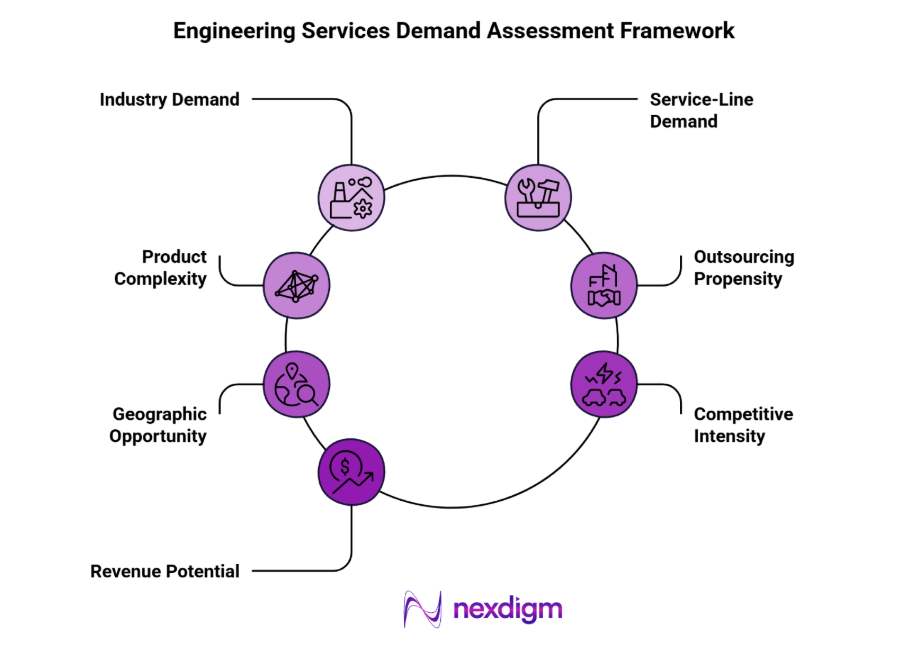
- Industry Demand
Map engineering requirements across automotive, aerospace, electronics, semiconductors, industrial equipment, healthcare, and other target industries. - Service-Line Demand
Assess demand across design, prototyping, simulation, testing, automation, product engineering, systems integration, and lifecycle support. - Product Complexity
Identify industries where increasing electronics, software, connectivity, automation, or regulatory requirements are expanding engineering workloads. - Outsourcing Propensity
Measure which engineering activities companies are increasingly externalizing and the factors driving third-party adoption. - Geographic Opportunity
Compare engineering demand, manufacturing concentration, technical talent, cost structures, and customer proximity across target markets. - Competitive Intensity
Map engineering firms, specialist providers, captive centres, pricing structures, technical differentiation, and customer concentration. - Revenue and Expansion Potential
Assess project size, recurring service opportunities, cross-selling potential, utilization, pricing, and the ability to scale delivery.
Case Study: Engineering Services Market Assessment Consulting
Engineering services outsourcing is estimated at $4.1 billion in 2026, with Asia Pacific accounting for 40.5% of 2025 revenue and testing representing an estimated 37.5% of 2026 demand. Mapping service-line growth against industry complexity can identify higher-value engineering opportunities.
Nexdigm can support engineering services market assessment through demand mapping, service-line segmentation, competitive benchmarking, customer analysis, and geographic opportunity assessment.
To take the next step, simply visit our Request a Consultation page and share your requirements with us.
Harsh Mittal
+91-8422857704