

Enterprise automation has moved beyond the deployment of individual robotic process automation tools. Organisations increasingly want platforms that connect workflows, applications, data and AI-enabled capabilities across business functions. Finance teams may automate invoice processing, customer service departments may streamline case handling, and operations teams may coordinate approvals across multiple systems. These requirements create a broader procurement challenge: identifying a platform that can support automation at enterprise scale without introducing fragmented technology or unnecessary complexity.
The Shift from Task Automation to Connected Operations
Traditional RPA solutions were primarily designed to automate repetitive, rule-based tasks. They remain useful for activities such as transferring information between applications, extracting structured data and processing standard transactions. However, enterprise requirements have expanded.
Modern automation environments may combine workflow orchestration, document processing, application integration, process mining, low-code development and AI-based decision support. Some platforms also provide capabilities for managing AI agents and coordinating human intervention when automated decisions require review.
This expansion makes platform boundaries less clear. A provider may offer strong RPA functionality but depend on third-party products for advanced workflow management or integration. Another may provide a broader automation suite while offering less flexibility for specialised processes.
Procurement teams need to distinguish between native capabilities, partner integrations and features that require additional licences.
Comparing the Core Platform Capabilities
Robotic process automation
RPA remains relevant where processes involve repetitive, predictable interactions with existing applications. Vendors should be evaluated on bot development, execution reliability, exception handling, unattended automation and monitoring.
The assessment should also consider how bots respond to application interface changes. Automations that depend heavily on screen-based interactions can become difficult to maintain when underlying software changes. API-based connections may provide greater stability where they are available.
Workflow orchestration
Workflow capabilities determine how activities move between systems, employees and automated processes. Relevant features include approval routing, business rules, case management, process visibility and escalation mechanisms.
For organisations managing complex operations, workflow flexibility can be more important than the number of bots a platform supports. A solution should allow processes to be redesigned without requiring extensive redevelopment each time business rules change.
AI and intelligent automation
AI can extend automation into activities involving unstructured documents, language processing, classification and recommendations. However, procurement teams should examine accuracy, explainability, human review and governance requirements.
An AI feature demonstrated in a controlled environment may perform differently when exposed to inconsistent documents, incomplete records or changing business conditions. Supplier evaluation should therefore include realistic use cases and testing against representative data.
Integration and interoperability
Automation platforms must connect with enterprise applications, databases, cloud services and legacy systems. Organisations should assess API support, connectors, integration development tools, identity management and compatibility with existing architecture.
A platform with a large connector catalogue may still require substantial custom development for critical systems. The relevant question is whether it can support the organisation’s actual application environment with manageable maintenance requirements.
Governance and scalability
Enterprise deployment introduces questions about access control, audit trails, bot credentials, environment management, version control and monitoring. Suppliers should demonstrate how administrators can govern automation across business units without allowing uncontrolled development.
Scalability also involves licensing, infrastructure requirements, execution capacity and support availability. Organisations should understand whether costs increase with users, bots, transactions, environments or consumption.
Measuring Commercial Value Beyond Automation Volume
The number of automated tasks is not a sufficient measure of business value. A platform may automate thousands of low-impact activities while leaving expensive process bottlenecks untouched.
Procurement teams should examine the operational outcomes associated with proposed use cases. These may include reduced processing time, fewer manual errors, improved compliance, lower exception rates and better visibility across business functions.
A useful business case considers the full cost of deployment, including platform licences, implementation services, integration work, training, maintenance and internal governance. It should also account for the cost of redesigning processes before automation. Automating an inefficient process without addressing its underlying problems can simply make inefficiency faster.
Vendor demonstrations should be based on selected business scenarios. Suppliers can be asked to demonstrate how a process moves from initiation to completion, how exceptions are handled and how administrators investigate failures. This produces more useful evidence than comparing feature lists in isolation.
Managing Automation Supplier Risk
A growing automation footprint can create dependency on a single platform, particularly when business-critical workflows become difficult to migrate. Organisations should review data portability, export capabilities, integration standards and contractual exit provisions.
Security assessment is equally important. Automation platforms may hold credentials, access sensitive records and execute transactions across multiple applications. Procurement teams should evaluate privileged access management, encryption, auditability, vulnerability management and the supplier’s approach to software updates.
How Nexdigm Supports Automation Platform Research
Nexdigm provides market research, vendor intelligence and supplier benchmarking to support enterprise technology procurement. Its analysis can help organisations compare automation providers, understand platform positioning, evaluate commercial structures and identify capability gaps across RPA, workflow, AI and integration requirements.
Enterprise automation platform supplier benchmarking enables organisations to compare providers across automation capabilities, integration options, governance, scalability and commercial models. The objective is to understand which platforms can support the organisation’s operating model, rather than select a supplier based on the number of features demonstrated during a product presentation.
Enterprise Automation Platform Supplier Benchmarking Framework
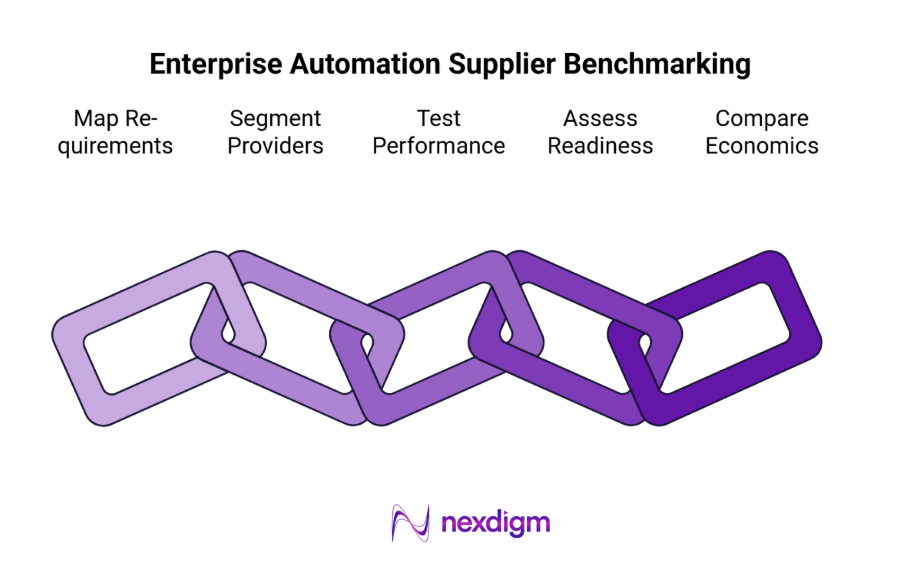
- Map automation requirements: Identify processes, transaction volumes, application dependencies and business outcomes.
- Segment platform providers: Classify suppliers by RPA, workflow, intelligent automation, integration and enterprise orchestration capabilities.
- Test functional performance: Evaluate automation reliability, exception handling, AI accuracy and process visibility.
- Assess enterprise readiness: Review security, governance, scalability, interoperability and support capabilities.
- Compare lifecycle economics: Analyse licences, implementation costs, maintenance, training and potential platform dependency.
Nexdigm’s Case Study: Benchmarking Enterprise Automation Platforms
Nexdigm assessed 11 automation suppliers across five capability categories, evaluated 24 enterprise use cases and compared implementation and licensing models. The research identified three platforms suitable for the client’s priority workflows and integration requirements.
To take the next step, simply visit our Request a Consultation page and share your requirements with us.
Harsh Mittal
+91-8422857704