

Selecting a cloud platform is a strategic procurement decision with consequences that extend well beyond the initial contract. The platform influences application performance, data management, cybersecurity, infrastructure expenditure and the organisation’s ability to respond to changing business requirements.
Yet enterprise cloud sourcing often begins with an incomplete comparison. Providers may be evaluated on headline compute prices, storage rates or service catalogues without considering the full cost of running workloads. Security and compliance requirements may also be reviewed separately from commercial negotiations, creating gaps between technical approval and procurement decisions.
A structured enterprise cloud platform procurement research exercise brings these considerations together. It helps technology and procurement teams assess the market, compare provider capabilities and identify platforms that meet enterprise requirements at a sustainable cost.
Start With Workload Requirements, Not Vendor Shortlists
Before approaching suppliers, enterprises should establish what they need the cloud platform to support.
A workload assessment should consider application criticality, computing intensity, data sensitivity, performance requirements, integration dependencies and expected demand patterns.
For example, an analytics workload may require scalable computing and high-throughput storage, while a customer-facing application may place greater emphasis on latency, availability and regional deployment.
A useful classification separates workloads into four groups. Business-critical applications require particular attention to availability, recovery, support and security. Data and analytics workloads depend on processing capacity, storage and data movement. Development and testing environments often prioritise flexibility, automation and consumption-based pricing. Regulated or sensitive workloads require stronger governance, access controls and data residency arrangements.
This segmentation gives procurement teams a clearer basis for comparing providers and prevents technical requirements from being reduced to a generic checklist.
Performance: Can the Platform Support Business Demand?
Cloud performance depends on the interaction between compute, storage, networking and application architecture.
Providers should be compared according to processing capacity, memory options, storage performance, network latency, regional availability and scalability. Service-level agreements should be examined to understand what availability commitments actually cover and what exclusions apply.
Enterprises should also consider how workloads behave during demand spikes. A platform may offer substantial theoretical scalability, but provisioning limits, service quotas or regional capacity constraints can affect practical performance.
Where workloads are business-critical, proof-of-concept testing can help validate vendor claims.
Procurement teams should define representative workloads and compare results using consistent conditions rather than relying exclusively on supplier demonstrations.
Security and Compliance Must Be Part of the Commercial Decision
Cloud security is a shared responsibility between the provider and the customer. The division of responsibilities depends on the service model, infrastructure configuration and controls retained by the enterprise.
Supplier assessments should examine identity and access management, encryption, key management, network security, logging, threat detection and incident response.
- Data residency and regulatory requirements also influence provider selection. Organisations operating across jurisdictions may need to understand where data is stored, how it is processed and which legal or contractual obligations apply.
- Security due diligence should address relevant certifications and independent assurance reports, access controls and privileged account management, encryption at rest and in transit, vulnerability management and security incident notification, backup and disaster recovery, and data ownership, portability and deletion provisions.
The commercial agreement should clearly establish responsibilities, audit rights, notification timelines and remedies for service or security failures.
Understanding the Full Cost of Cloud Procurement
Cloud pricing can be difficult to compare because providers structure charges differently. Compute may be billed by instance type and duration, storage by capacity and performance tier, and networking by data transfer or connectivity usage.
The overall cost can also include managed database and application services, software licensing and operating system charges, premium technical support, data egress and inter-region transfers, backup and monitoring services, security tools, migration, integration and ongoing administration.
Enterprises should build cost scenarios using representative workloads. At minimum, they should compare expected usage, peak demand and lower-utilisation conditions.
Contract terms deserve equal attention. Committed-use discounts may reduce unit costs but create exposure if consumption falls below agreed levels. Procurement teams should examine price protection, renewal conditions, escalation clauses, minimum commitments and exit assistance.
Building a Sourcing Strategy That Can Adapt
Cloud requirements change as applications evolve, data volumes increase and new technologies enter the enterprise environment. A sourcing decision should therefore account for future flexibility.
This does not mean every application needs to be portable across providers. Instead, organisations should identify where portability is commercially or operationally important and where specialised services offer sufficient value to justify dependency.
Supplier selection should also reflect internal capability. A technically advanced platform may not be the best choice if the organisation lacks the skills to manage it effectively.
The final evaluation should combine performance, security, commercial competitiveness, integration requirements and operational readiness. This gives decision-makers a clear view of the trade-offs behind each shortlisted provider.
Enterprise Cloud Platform Procurement Framework
A procurement programme can follow six stages, each producing a specific decision output:
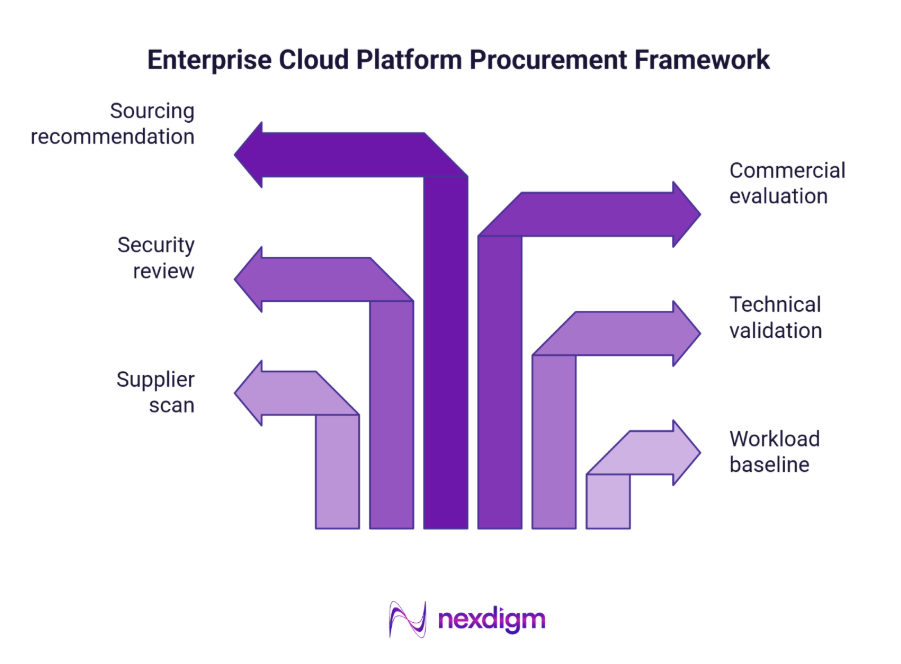
- Workload baseline: Document applications, usage patterns, performance thresholds, data sensitivity and business criticality.
- Market and supplier scan: Identify providers with relevant infrastructure, platform services, regional coverage and enterprise support.
- Technical validation: Compare performance, scalability, integration, availability and workload compatibility through consistent evaluation criteria.
- Security and compliance review: Validate controls, certifications, data residency, shared responsibilities and contractual safeguards.
- Commercial evaluation: Model consumption, licensing, support, data transfer, commitments, migration and exit costs.
- Sourcing recommendation: Rank providers against weighted enterprise requirements, document trade-offs and establish negotiation priorities.
Nexdigm can support enterprises through cloud market intelligence, supplier benchmarking, commercial analysis and technology procurement research. These services help organisations understand provider capabilities, compare pricing models and develop evidence-based sourcing strategies that align technical requirements with business and financial objectives.
Nexdigm’s Case Study: Evaluating Enterprise Cloud Sourcing Options
Nexdigm assessed 11 cloud platforms across 4 enterprise workload groups, comparing performance, security, compliance and commercial models. The research identified an 18% variation in comparable service costs, shortlisted 4 providers and established 9 sourcing criteria for enterprise evaluation.
To take the next step, simply visit our Request a Consultation page and share your requirements with us.
Harsh Mittal
+91-8422857704