

Collaboration software has become part of the infrastructure through which organisations communicate, coordinate projects, share documents and manage everyday work. Messaging applications, video conferencing platforms, shared workspaces and document collaboration tools are now used across departments, locations and external business relationships.
However, selecting these platforms is not simply a matter of choosing the most familiar interface. Organisations need to consider user adoption, information governance, integration, security, administrative control and the cost of maintaining multiple subscriptions. A platform that works well for a small team may not provide the controls required by a large enterprise operating across several countries.
A structured enterprise collaboration software vendor analysis helps buyers compare suppliers according to the way employees work and the level of control the organisation needs.
Collaboration Tools Are Becoming Core Enterprise Applications
The adoption of cloud-based office and communication tools illustrates how central digital collaboration has become to business operations. Eurostat reported that 52.7% of EU enterprises used paid cloud computing services in 2025. Among enterprises purchasing cloud services, 71.7% used cloud-based office software.
This broad adoption creates a competitive market covering team messaging, video meetings, document sharing, project management, digital workspaces and integrated productivity suites.
For procurement teams, the challenge is often not a lack of available tools. It is managing overlapping applications that perform similar functions across different departments. A business may have one platform for meetings, another for messaging, a separate document-sharing service and several project management subscriptions. Without a coordinated assessment, the organisation may pay for duplicated functionality while employees continue switching between applications.
What Should Buyers Expect From a Collaboration Platform?
The first consideration is user experience. Employees need to communicate, share information and coordinate work without navigating unnecessarily complicated interfaces. Buyers should assess search functionality, notification controls, accessibility, mobile usability, document co-editing and the ease of joining meetings or creating shared workspaces.
The second consideration is governance. Collaboration platforms can contain sensitive business information, customer records, internal discussions and confidential documents. Procurement teams should examine identity management, role-based permissions, guest access, retention policies, audit logs, data residency and administrative controls.
Integration is equally important. A collaboration platform should work with existing email, calendar, document management, identity, CRM and project management systems. Poor integration can create fragmented information and force employees to duplicate tasks across applications.
Finally, enterprises should evaluate scalability. A platform must support additional users, business units, external partners and geographical locations without making administration or licensing disproportionately difficult.
Security and Information Governance Cannot Be an Afterthought
Collaboration software introduces information-sharing risks that may not be obvious during a product demonstration.
External guests may receive access to shared files, employees may create workspaces without central oversight, and confidential information may remain available long after a project has ended. These issues make governance capabilities central to vendor selection.
Procurement and IT teams should examine:
- Single sign-on and multi-factor authentication.
- Granular access permissions and external sharing controls.
- Data encryption, retention and deletion policies.
- Audit trails and administrative reporting.
- Compliance certifications and data location arrangements.
- Integration with enterprise security and identity systems.
The assessment should also establish how the provider handles security incidents, service interruptions and changes to its product or data policies.
The Commercial Challenge: Overlapping Subscriptions
Collaboration software is frequently purchased by individual departments, which can make total expenditure difficult to track. Different teams may subscribe to separate tools for meetings, messaging, file sharing and task management, even when existing platforms offer similar capabilities.
A spend review should identify active users, unused licences, overlapping features and additional charges for storage, administration or advanced security.
Commercial comparisons should examine per-user pricing, subscription tiers, minimum commitments, annual renewals, guest access charges and enterprise-wide licensing arrangements. Businesses should also consider the cost of migrating documents, conversations and workflows if they change providers.
The lowest subscription price is not necessarily the most economical option. A platform with stronger integration may reduce administrative work and eliminate the need for additional applications.
Selecting Software Around the Way Teams Actually Work
A collaboration platform should be tested against real operating scenarios rather than evaluated through a generic feature checklist.
For example, procurement teams may need to share contracts and maintain approval records. Project teams may require shared workspaces, task tracking and document version control. Customer-facing teams may need secure communication with external stakeholders.
These use cases should be translated into practical evaluation exercises. Users can test how easily they create a workspace, find a previous discussion, share a document, manage permissions and coordinate a meeting.
This approach reveals usability and governance gaps that may not be visible in vendor presentations.
Nexdigm’s Enterprise Collaboration Software Vendor Assessment Framework
A supplier comparison should connect employee experience with the organisation’s technology and governance requirements:
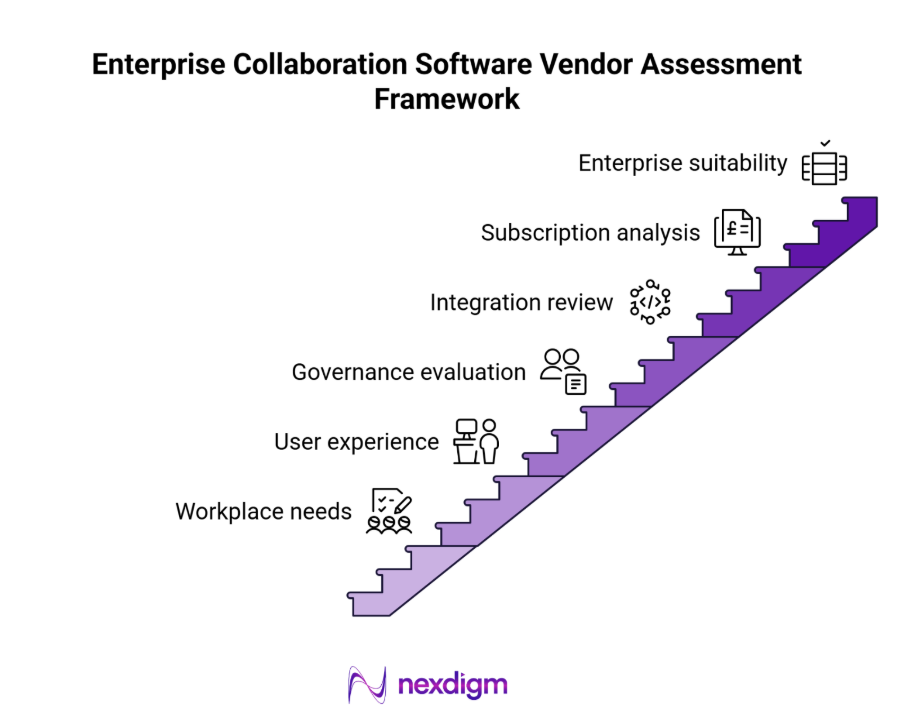
- Workplace needs assessment: Identify communication patterns, team structures, external collaboration needs and existing applications.
- User experience testing: Compare navigation, search, accessibility, document collaboration and mobile functionality.
- Governance evaluation: Examine permissions, retention, auditability, external sharing and administrative controls.
- Integration review: Test compatibility with identity, email, calendars, productivity tools and business applications.
- Subscription analysis: Compare licensing tiers, active-user costs, overlapping applications, renewals and migration expenditure.
- Enterprise suitability: Assess scalability, security, support and the platform’s ability to meet organisation-wide requirements.
Nexdigm can support organisations through collaboration software market research, supplier intelligence, platform benchmarking and commercial analysis. This helps enterprise buyers assess competing solutions, identify duplicated spending and evaluate providers against workplace requirements.
Nexdigm’s Case Study: Evaluating Enterprise Collaboration Platforms
Nexdigm compared 12 collaboration software providers across 5 capability areas, assessing user experience, governance, integration, scalability and pricing. The study identified 4 overlapping software categories, highlighted a 16% variation in comparable subscription costs and shortlisted 4 suppliers.
To take the next step, simply visit our Request a Consultation page and share your requirements with us.
Harsh Mittal
+91-8422857704