

Enterprise laptop procurement is becoming more complex as organizations balance workforce mobility, computing performance, device security, and budget constraints. According to Omdia, worldwide notebook shipments declined 20.6% year on year in Q3 2026, reaching 46.4 million units. Another research also reported that DRAM costs increased fivefold year on year in Q2 2026, contributing to higher PC prices and reduced shipment volumes.
These developments are influencing product availability, purchasing costs, and vendor strategies. Enterprises therefore need to look beyond device specifications when selecting suppliers. Through enterprise laptop supplier research, organizations can assess vendor portfolios, product differentiation, market presence, support capabilities, and commercial models to identify suppliers suited to their workforce and procurement requirements.
How Enterprise Laptop Requirements Differ Across Workforces
Laptop requirements vary across employee roles, operating environments, and business functions. Mobile teams may prioritize portability and battery life, while technical users require higher processing capacity and memory. Organizations must also consider device security, compatibility with enterprise applications, and centralized fleet management. Understanding these differences helps establish suitable device categories and procurement priorities.
Considerations That Shape Enterprise Laptop Procurement
Before evaluating vendors, organizations should establish the requirements that influence device selection:
- Workload and Performance Requirements: Assess processor capabilities, memory, storage, graphics, and application compatibility to support different employee roles and computing workloads.
- Device Reliability and Security: Examine build quality, durability, hardware security, endpoint protection compatibility, and device management capabilities to support dependable operations.
- Commercial and Lifecycle Requirements: Consider acquisition costs, warranty coverage, maintenance, upgrade options, and replacement cycles to understand long-term procurement implications.
These considerations provide a foundation for evaluating suppliers against workforce needs and enterprise deployment priorities.
Nexdigm’s Industry-Led Expertise in Enterprise Laptop Procurement
Nexdigm’s experts bring industry-led research expertise to enterprise laptop procurement, helping organizations understand supplier capabilities and evolving market dynamics. Our approach combines industry knowledge, competitive intelligence, and structured vendor assessment to evaluate product portfolios, performance standards, reliability, and commercial positioning. These insights help enterprises make informed sourcing decisions aligned with workforce needs and technology priorities.
How Nexdigm’s Experts Assess Enterprise Laptop Procurement Considerations
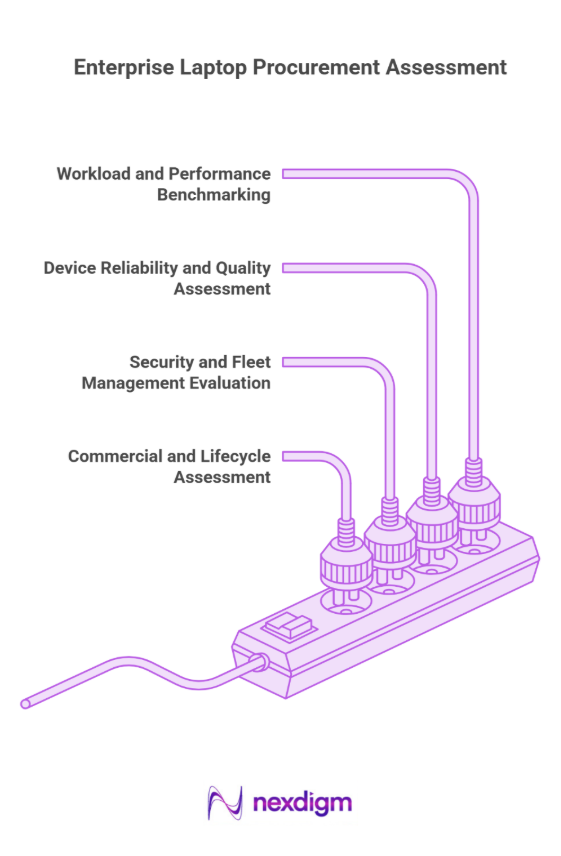
Our experts evaluate enterprise laptop procurement requirements through a structured, research-led approach, examining key considerations that influence supplier suitability and purchasing decisions:
- Workload and Performance Benchmarking: Assess processor capabilities, memory, storage, graphics, and application compatibility to identify laptops suited to different workforce requirements.
- Device Reliability and Quality Assessment: Examine build quality, durability, battery performance, component standards, and product testing to understand device dependability.
- Security and Fleet Management Evaluation: Review hardware security features, endpoint management compatibility, firmware controls, and centralized device administration capabilities.
- Commercial and Lifecycle Assessment: Compare acquisition costs, warranty coverage, maintenance expenses, upgrade options, and replacement cycles to evaluate long-term procurement value.
This enterprise laptop supplier research assessment helps enterprises establish clear evaluation criteria, compare supplier capabilities, and identify laptop solutions aligned with their operational and technology priorities.
Nexdigm’s Assessment Offering Long-Term Sourcing Advantages
Nexdigm’s assessment helps enterprises look beyond immediate laptop procurement requirements and identify suppliers capable of supporting future business needs. Our experts examine three areas to provide a forward-looking view of the supplier landscape:
- Tracking Supplier Innovation and Technology Roadmaps: Evaluate vendor investments in AI-enabled laptops, processor advancements, device capabilities, and product development to identify suppliers with future-ready portfolios.
- Monitoring Supplier Competitiveness and Market Positioning: Track vendor market presence, product launches, portfolio expansion, strategic partnerships, and competitive developments to identify emerging sourcing alternatives.
- Assessing Long-Term Supplier and Commercial Viability: Examine supplier stability, product availability, pricing strategies, lifecycle support, and upgrade options to understand their ability to meet evolving enterprise requirements.
These insights help organizations anticipate supplier developments, identify potential sourcing opportunities, and build enterprise laptop procurement strategies that remain relevant as technology and market conditions change.
Nexdigm’s Case
A global organization planning a large-scale laptop refresh wanted to identify suppliers capable of meeting its performance, service, and regional deployment requirements. Through enterprise laptop supplier research, Nexdigm assessed 16 vendors across product availability and commercial flexibility. The study found that 37% had inconsistent regional service coverage, while 31% offered limited customization options. Based on the assessment, suppliers were shortlisted for further consideration.
To take the next step, simply visit our Request a Consultation page and share your requirements with us.
Harsh Mittal
+91-8422857704